

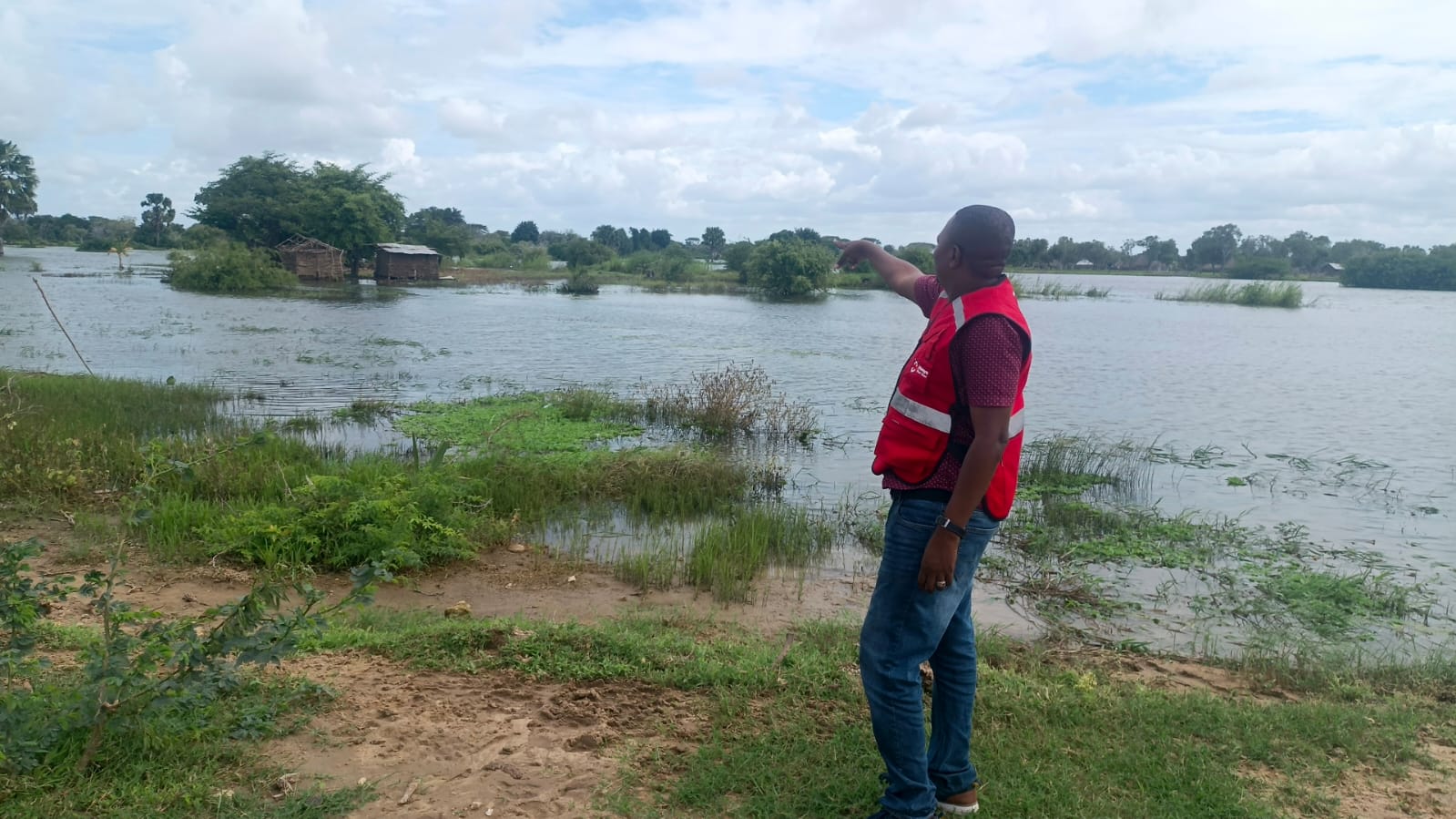
 A Kenya Red Cross official looking at some of the marooned houses in Tana River.
A major humanitarian crisis is unfolding in Tana River county after devastating floods swept through Tarasaa and Tana Delta subcounties.
The month-long flooding has left schools, villages and health facilities submerged, disrupting livelihoods and essential services across the county.
More than 3,127 families have been left homeless, without food, and with limited access to healthcare services.
Tarasaa subcounty has borne the brunt of the disaster, with villages including Samicha, Odhole, Mwanja, and Handaraku completely marooned by floodwaters.
Economic activities in the affected areas have ground to a halt as residents struggle to cope with the disaster.
It is the same situation in Tana Delta subcounty, where families have been displaced from their homes after floodwaters swept through residential areas and farmlands, destroying crops and livelihoods.
Learning and healthcare services have been severely disrupted, with many schools and health facilities rendered inaccessible.
Thousands of residents have sought refuge in internally displaced persons (IDP) camps established on safer ground.
During a monitoring and evaluation exercise conducted by the Kenya Red Cross Society, journalists witnessed firsthand the extent of the destruction caused by the floods.
Many of the affected villages can only be reached by boat, forcing humanitarian workers to rely on water transport to access stranded communities.
Samicha village, which borders Odhole, remains completely inaccessible.
Residents have relocated to the Marafa IDP Camp, while the local Early Childhood Development Centre (ECDC) has been shut.
In Odhole, nearly half of the residents have moved to IDP camps, affecting more than 85 per cent of school-going children who accompanied their families to safer areas.
Kenya Red Cross officials said they have distributed non-food relief items to affected families but warned that food shortages and limited access to healthcare remain critical challenges.
Speaking during the assessment tour, Kenya Red Cross Society's manager for emergency preparedness and response, Anthony Muchiri, said they had recorded 3,127 displaced families currently living in IDP camps across the affected areas.
"We have witnessed widespread destruction caused by the floods. Seventeen health facilities have been marooned and are currently non-operational, while several schools remain inaccessible, preventing children from attending classes," Muchiri said.
Kenya Red Cross, working alongside the county government and other humanitarian partners, had provided emergency shelter materials to 2,700 families and distributed water, sanitation and hygiene (WASH) supplies to the households.
"As part of our response efforts, we have also established a number of IDP camps and constructed 71 latrines in collaboration with the county water department. We continue to monitor the situation and support affected communities," Muchiri added.
The floods first hit the region on April 17 and have continued to wreak havoc across many parts of the county.
Konemasa location chief Issa Komora said the scale of displacement in Tarasaa was overwhelming.
"Samicha village alone has 103 households, while Odhole has about 300 households. The entire Samicha village is marooned. Fortunately, residents had been sensitised early and moved to Marafa IDP Camp, which is currently hosting more than 500 households," he said.
Komora appealed to both the national government and humanitarian agencies to provide urgent food assistance to the affected families, many of whom lost everything in the floods.
At Kijo Farm IDP Camp in Tana Delta, camp leader Omar Maro Diwayu said 113 displaced households had received non-food assistance from the Kenya Red Cross but were still facing severe shortages.
"The floods destroyed all our crops just when they were about to mature. We have nothing left for survival," he said.
"The problem is that you can sleep in a shelter and feel safe, but if you have nothing to eat, you cannot sleep peacefully. We lost everything because of the floods."
Flood victim Idi Jarso Wario from Handaraku said residents were struggling because roads and access routes remained submerged.
"We cannot reach our homes or grazing fields because everything is flooded," he said.
Another victim, Madina Abdalla, said the floods had left families without food, shelter, and clean water.
"We have no food. We are hungry. There is nothing at all. We are appealing to the government to help us," she said.
At Kijo Farm IDP Camp, Sultan Hero from Bula Rahma said although humanitarian agencies had provided some support, the need for food assistance remained urgent.
"We appreciate the support from the Kenya Red Cross, but we still do not have enough food. Many families are struggling to survive," he said.
INSTANT ANALYSIS
The latest floods in Tana River County highlight the region's recurring vulnerability to climate-related disasters and inadequate flood mitigation infrastructure. With over 3,100 families displaced, schools closed, health facilities rendered inaccessible, and farmlands destroyed, the crisis extends beyond an emergency response issue to a development challenge.