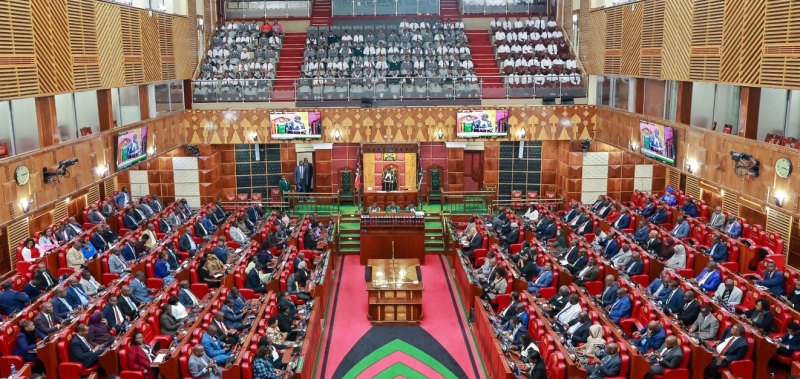


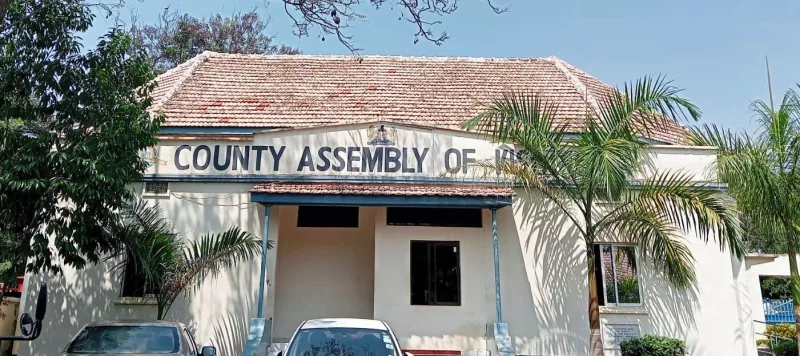
 Kisumu County Assembly Building./KNA
The Kisumu County Assembly has approved the county budget estimates for the Financial Year (FY) 2026/27, amounting to Sh14,460,638,805.
The approval now sets the stage for the implementation of programmes and projects that have been earmarked to accelerate socio-economic development within Kisumu County for the financial year that has just started.
The approved budget comprises a total share of National Revenue amounting to Sh11,942,344,932 and Own Source Revenue amounting to Sh2,334,293,893.
This approval effectively marks the formal transition from the budget formulation stage to the implementation phase, where the County Executive is now expected to operationalise the approved plans and ensure delivery of essential public services across all sectors of the county.
The budget represents an increase of Sh4,860,638,809 compared to the FY 2025/2026 allocation, a development that reflects a notable upward adjustment in the county’s financial capacity for the current financial year.
This increase is widely viewed as a step towards strengthening service delivery mechanisms, accelerating development across key sectors, and enhancing efficiency in the utilisation of public resources.
It further signals increased confidence in the county’s development priorities and presents an opportunity to deepen economic growth, expand employment opportunities, and improve overall public service delivery.
Following the approval of the budget by the County Assembly, the focus now shifts firmly from budget-making to implementation, as the entire County Executive assumes responsibility for translating the approved financial plans into tangible development projects and improved public services for residents.
The approved budget is now awaiting assent by Governor Anyang’ Nyong’o before it is formally gazetted.
The budget places strong emphasis on the completion of ongoing projects rather than the introduction of new ones, reflecting a strategic shift towards consolidating existing investments and ensuring that stalled or incomplete projects are brought to completion before Nyong’o`s term comes to an end in August next year.
Governor Nyong’o has urged Members of the County Assembly to direct resources towards high-impact development interventions, with particular focus on critical sectors such as health and infrastructure.
This approach contrasts with the previous financial year, 2025/2026, which saw a comparatively greater allocation of resources towards the initiation and funding of new development projects that are currently at various stages of implementation.
The current budget also reinforces the County Assembly’s commitment to strengthened oversight, prudent management of public resources, transparency, accountability, and the broader goal of achieving sustainable development for the people of Kisumu County.
The recurrent expenditure is set at Sh8,544,312,367, which includes allocations for both personal emoluments and operations and maintenance. Specifically, personal emoluments account for Sh5,548,779,614, while operations and equipment maintenance are allocated Sh2,995,532,753.
This recurrent allocation is intended to support staff remuneration, ensure continuity of government operations, and facilitate the smooth running of day-to-day public service delivery across all departments.
In addition, development expenditure has been allocated Sh5,916,326,438, which is directed towards infrastructure development and the continuation of long-term projects aimed at improving service delivery across the county.
A further Sh587,358,284 has been set aside for the payment of pending bills, reflecting deliberate efforts to clear outstanding financial obligations and stabilise payments to suppliers and contractors engaged by the county government.
The allocation towards development expenditure highlights continued investment in infrastructure and long-term projects designed to enhance service delivery outcomes for residents. Similarly, the provision for pending bills underscores efforts to restore financial stability, improve government credibility, and ensure timely settlement of obligations owed to service providers.
Overall, the budget reflects a carefully balanced approach that seeks to maintain ongoing operations, support staff-related costs, and steadily advance development priorities across the county.
The Speaker of the Assembly, Elisha Jack Oraro, expressed appreciation to the Members of the County Assembly for their detailed deliberations and for ultimately approving the budget estimates alongside the Kisumu County Appropriations Bill, 2026.
He also commended members of the public for their active participation in the budget-making process, particularly through the submission of feedback and memoranda on the proposed estimates, which contributed to shaping the final approved budget framework.
Since the inception of devolution in 2013, Kenya's 47 counties have cumulatively received over Sh3.7 trillion in equitable revenue shares, grants, and development partner loans. Over Sh. 2.4 trillion of this amount was disbursed solely as unconditional equitable revenue in the first eight years.
County allocations are reviewed annually through the Division of Revenue Act (DORA) and County Allocation of Revenue Act (CARA). For instance, counties were allocated a total equitable share of Sh85.4 billion in the 2023/2024 financial year, which grew to Sh415 billion and subsequently reached Sh428 billion for the recent allocations.
Since the onset of devolution in 2013, Kisumu County has received more than Sh120 billion in cumulative allocations from the national government. This total encompasses both the unconditional equitable share and conditional grants disbursed across successive financial years.
Devolution was meant to bring development closer to the people and it has brought about positive changes in many of the counties.