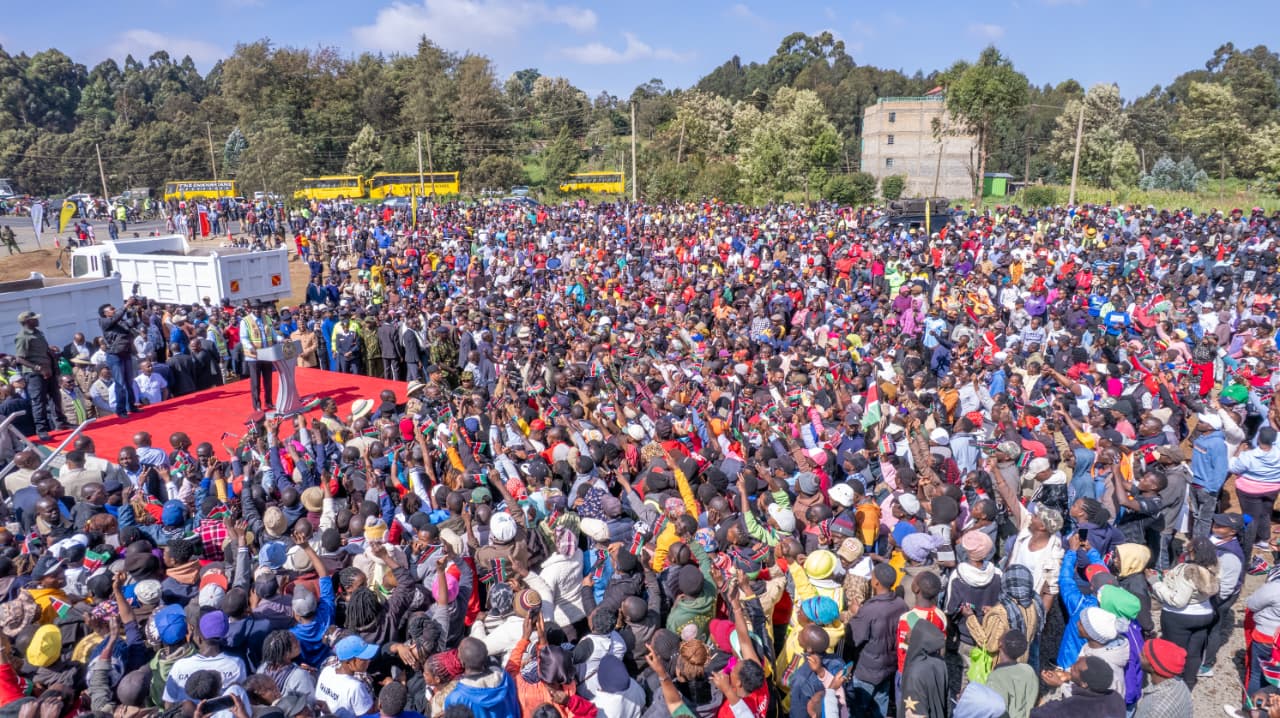
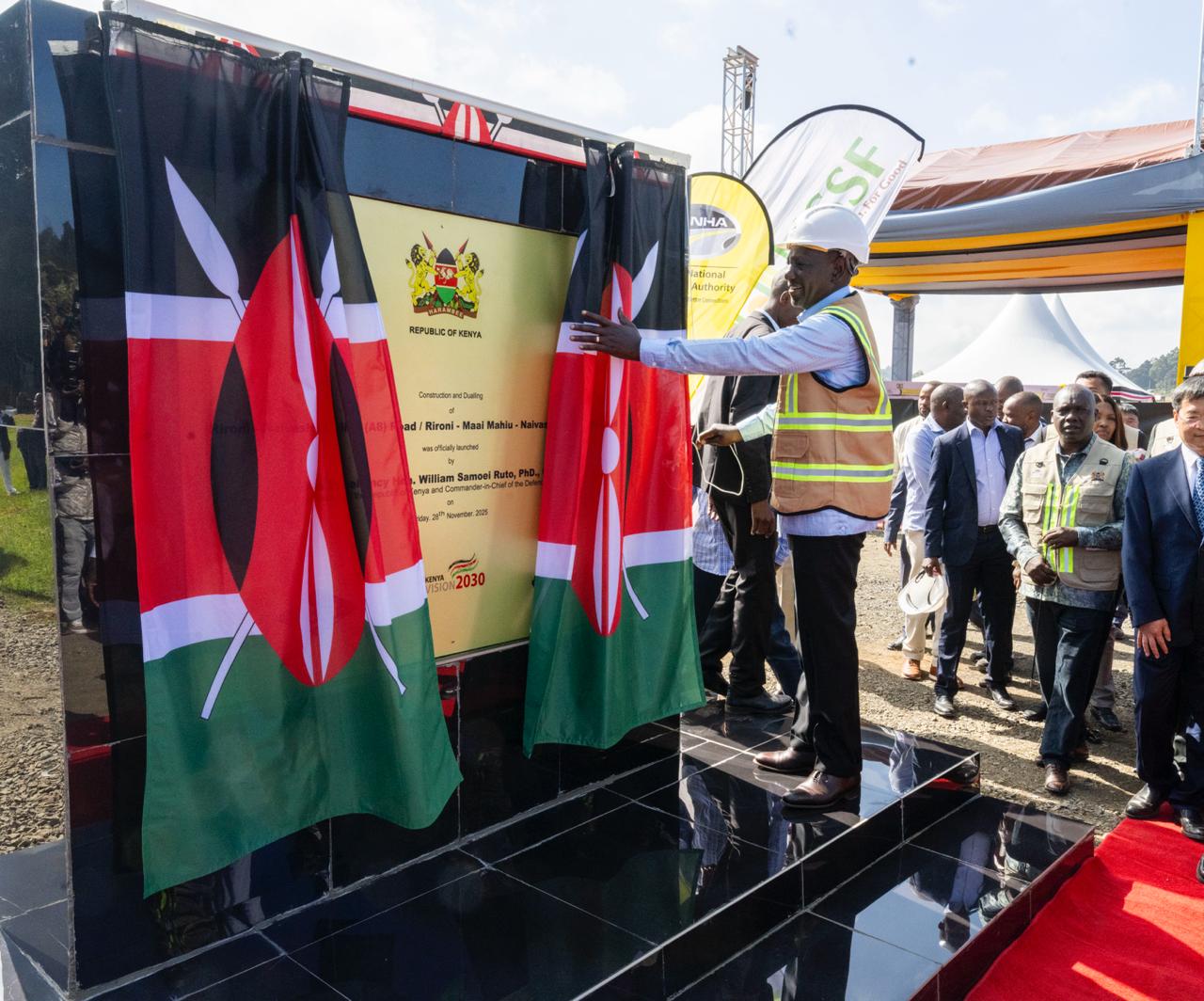
President William Ruto on Friday made history
by breaking ground for the monumental Rironi-Mau Summit dual carriageway,
declaring it the definitive end to the era of infrastructure stagnation and a
bold step toward first-world status.
In a ceremony charged with political undertones, the President
framed the project as a decisive break from a past of inadequate budgets,
unsustainable debt, or outright development paralysis.
"For decades, stagnation became a quiet paralysis that
crept into our systems, our confidence and our national spirit.”
“It convinced us that mediocrity was normal, that average was
acceptable," President Ruto told the gathering. "Today, we break
those chains."
The Sh170 billion Nairobi-Nakuru-Mau Summit (A8) and
Nairobi-Maai Mahiu-Naivasha has been hailed as revolutionary, being the first
major project under the Public-Private Partnership (PPP) arrangement.
The Nairobi Expressway was the first, but was not to the scale
of the road which is envisioned to unlock the traffic gridlock that has left
Kenyans and goods heading to western stranded for days.
"This is not merely about laying down a new corridor. It is
about laying the foundation for a Kenya reborn," he said.
In a swipe at the United Opposition, the President said his
administration was fully committed to delivering on its promises.
He asked Kenyans to shun the opposition led by Rigathi Gachagua
and Wiper’s Kalonzo Musyoka, saying they have no agenda other than ‘one term,
Kasongo and Must Go’.
“We must do away with backward politics of tribalism, average
thinking,” the President said while rallying Kenyans to back his desire for a
first-world Kenya.
“It is a historic moment. I said we will move Kenya from a
third-world country to a first-world country, we will beat poverty, give our
young people jobs,” President Ruto said.
“Today, this road we are building here from Kamandura to Gilgil
will be completed in six months. We have another contractor starting the work
from Gilgil.”
The ambitious project, which the President announced will be
officially opened on June 1, 2027, is part of a broader vision to overhaul the
country’s transport network and stimulate regional trade.
In his remarks, President Ruto said his administration opted for
PPP to navigate the critical impasse that has historically stalled major
infrastructure projects in Kenya.
He said over-reliance on the constrained national budget,
unsustainable borrowing or outright stagnation was no way out.
"It positions Kenya as a leader in innovative financing and
in the audacity to think big when the world expects us to think small."
The President said his team had departed from the past
administrations, saying the country cannot continue operating like in the past,
where an era of “quiet paralysis” accepted mediocrity as normal.
"For too long, this corridor carried more than it could
bear. Traffic consumed our time, accidents stole our loved ones and delays cost
our economy billions. Today we say: no more," Ruto said.
He projected that the road would slash travel times, reduce
accidents, save lives and also create a seamless logistics chain linked to the
Naivasha ICD.
The PPP model, he emphasised, allows the government to leverage
private sector efficiency and capital without exacerbating the national debt.
“This is a living demonstration of what happens when government
stops trying to do everything alone and starts doing things smarter and in
partnership with the private sector,” he said.
The President framed the project as far more than just tarmac.
He described it as a “gateway to prosperity, unity and transformation” that
will modernise a vital economic artery.
The upgraded corridors will feature multi-lane dual
carriageways, new interchanges, truck laybys, pedestrian bridges, advanced
lighting, barriers, drainage systems and intelligent transport technology.
The enhancements are designed to drastically cut travel times,
reduce accidents and handle heavy commercial traffic, thereby boosting regional
trade.
“This route is a vital artery linking Nairobi to Uganda, South
Sudan, Rwanda, Burundi, and the Democratic Republic of Congo, sustaining our
economy and powering regional trade and opportunity,” Ruto said.
Beyond the immediate project, the President said he was keen on
implementing his aggressive nationwide infrastructure plan.
He confirmed that the roads listed in his recent State of the
Nation Address would commence construction next year.
“I intend to launch this road officially on June 1, 2027, after
its completion. It is possible. It will not end at Mau Summit,” he said.
He said funding from the Asian Investment Bank has been secured
for a feasibility study to link Mau Summit to Malaba.
“We will also build the one from Mau Summit through Kericho to
Kisumu. Kenya will change. We are late with development.”
He announced he had instructed the Ministry of Roads to work on
an additional 28,000kms of roads across the country.
This includes major dual-carriageway corridors such as Muthaiga
to Kiambu, Machakos Junction to Mariakani, and key links in Western Kenya and
the Coastal region.
To correct what he termed a “historic shortfall,” the President contrasted
Kenya’s 22,000km of tarmacked roads since independence with Japan’s over one
million kilometres.
He said the nation’s infrastructure gap has to be sealed for the
country to make a difference.
President Ruto connected the road projects to his
administration’s Bottom-Up Economic Transformation Agenda.
To finance the ‘Singapore’ dream, the government is establishing
a National Infrastructure Fund and a Sovereign Wealth Fund.
The funds would draw from budgetary allocations, privatisation
proceeds, natural resource royalties and private capital.
Ruto issued a rallying cry against mediocrity, urging that
leaders employ a national shift towards excellence.
“We no longer want mediocrity, average, normal and the similar
in our equation. We must go for excellence,” he said.
Ruto also emphasised that nation-building is a collective
endeavour, calling on contractors, local businesses and communities to uphold
quality and transparency.
“Together, we must ensure this project becomes a beacon of
pride, a testament to our resilience,” the President said.
The Mau Summit highway project is expected to create 15,000 jobs
for young Kenyans, providing them with valuable skills while building the
highway.
The President also acknowledged the expertise of Chinese
partners, whose technology and experience are bolstering the project while
building local capacity.
Concluding his address, Ruto painted a picture of a confident,
connected and prosperous Kenya.
“This is our moment to rise from the ordinary… to leave mediocrity
behind and to walk confidently and decisively into excellence,” he said.
“The work we begin today will echo far beyond our borders,
reshaping trade, expanding prosperity, and elevating lives across our region.”
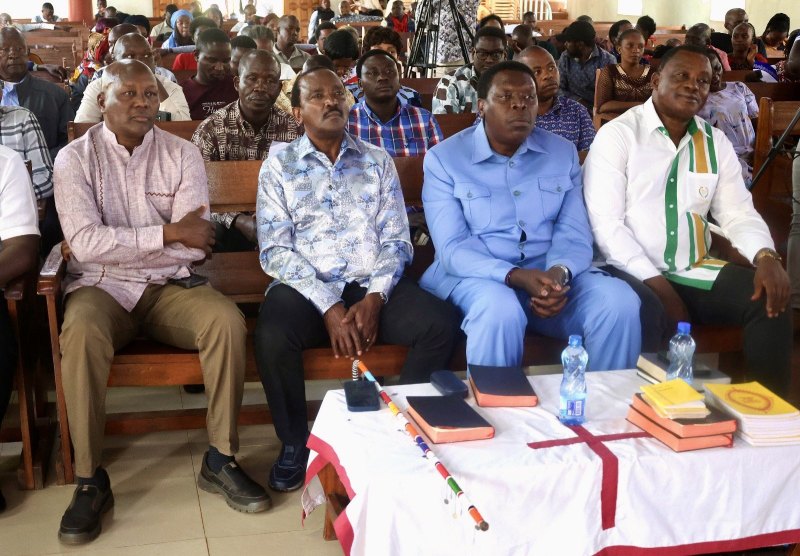
The President was accompanied by governors Kimani Wamatangi
(Kiambu), Susan Kihika (Nakuru), several Cabinet Secretaries and MPs.