

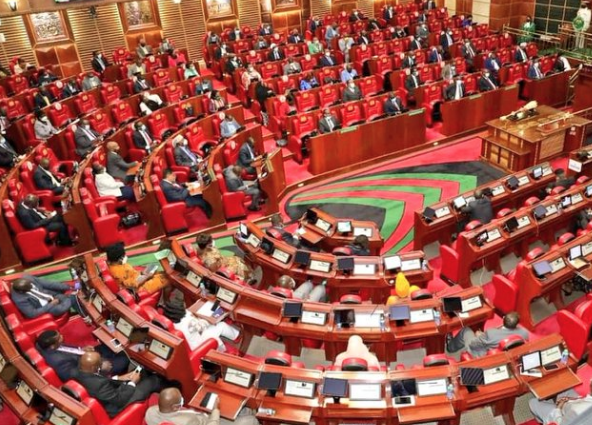
A parliamentary committee has
approved a bill seeking to decriminalise suicide, setting the path for the
removal of the colonial-era law from the statutes.
The Justice and Legal Affairs Committee has agreed to the
proposed deletion of Section 226 of the Penal Code, which provides for the
offence of attempted suicide.
Section 226 as read with Section 36 of the Penal Code provides
that any person who attempts to kill himself or herself is guilty of a
misdemeanour.
It sets punishments to include imprisonment for up to six years
or a fine or both a fine and jail terms, a situation Mathare MP Antony Oluoch
seeks to change.
The bill by Oluoch has been before the Justice committee,
chaired by Tharaka MP Gitonga Murugara, which has approved that it be passed.
“Upon reviewing the bill and the submissions received, the
committee observed that the bill is a progressive, humane and constitutionally
aligned reform,” the committee said.
MPs want the national government, in collaboration with the
county governments, to develop the necessary physical and technological
infrastructure to tackle mental illnesses.
“The law obligates the government to provide the facilities for
care, rehabilitation, and provision of health services to persons with mental
illnesses, which include persons with suicidal ideation or behaviour,” the
report before the plenary reads in part.
The committee received submissions from the Law Society of
Kenya, National Gender and Equality Commission, Outreach for Action Kenya and
Anjarwalla and Khanna law firm.
They supported the bill with LSK and ALN saying the High Court
had declared the section targeted in the amendment as unconstitutional.
They argued that the Mental Health Act already defines a person
with mental illness to include a person with suicidal behaviour.
ALN said that the existing law stigmatises and disgraces victims
of suicide ideation in the eyes of the community for actions beyond their
control.
“Additionally, the section exposes survivors of suicide and
persons with suicidal tendencies to criminal sanction instead of healthcare,
thereby eroding the right to have the highest attainable standard of health as
provided in the constitution,” the report reads.
LSK and Outreach for Action Kenya said in passing the bill,
Kenya would align itself with countries that have taken steps to reduce the
global suicide rate.
They hold that it would also promote a mental health-based
approach because individuals who attempt suicide are often in serious
psychological distress.
“Criminal sanctions penalise suffering rather than address the
root causes,” the LSK and OAK said in their submissions, adding that Kenya
would promote compassion and reduce stigma around suicide.
NGEC, for its part, made calls for the decriminalisation of
substance abuse and use, and instead facilitated care for addicts.
MPs, however, said the proposal touching on drugs and substance
abuse needed a substantive bill, separate from the instant bill.
Jlac has considered and approved the bill hot on the heels of
another House committee recommending the deletion of the suicide law.
The Petitions Committee in October recommended that the law be
expunged from the statutes following a petition by Dr Lukoye Atwoli.
Atwoli presented a powerful case before the committee, arguing
that the law was a harmful measure.
"Kenya remains one of the few countries that still has
legislation criminalising suicide attempts, a leftover from colonial
times," he told MPs.
He framed suicide attempts squarely as a health issue, stating,
"Suicide attempts are classified in the psychiatric literature as a
medical emergency requiring immediate intervention to prevent serious injury or
death."
He argued that the current law actively prevents people from
getting help, as it "directs them into the criminal justice system instead
of a health facility.”
Furthermore, Dr Atwoli contended that the law violates multiple
articles of the constitution.
He said criminalising a symptom of mental illness constitutes
discrimination based on health status, contrary to Article 27, and violates
human dignity, protected under Article 28.
"Categorising a person’s psychological distress and signs
of mental illness as a criminal offence amounts to denying their inherent
dignity, and punishing them for their symptoms is the exact opposite of
protecting their dignity," he said.
His arguments were supported by data, citing a study in Nandi
County that found "1 in 6 people in the community had made a suicide
attempt in their lifetime."
INSTANT ANALYSIS
World Bank reports a 6.1 per 100,000 suicide rate in the
country, with the health ministry saying the rate stands at 11, with men
accounting for the highest. Section 226 of the Penal Code has been deemed a
"relic of colonial legislation" that "promotes stigma and
barriers to mental health care."