Governors maintain that the continued centralisation of these roles has undermined service delivery, resource utilisation, and the spirit of devolution.
IGRTC has previously identified several pieces of legislation requiring amendment to fully anchor the devolved system.
Audio By Vocalize
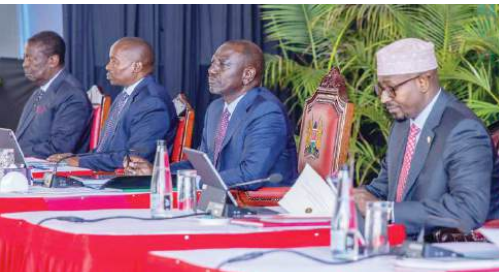
Prime CS Mudalia Mudavadi, DP Kithure Kindiki, President William Ruto and Council of Governors chairperson Ahmed Abdullahi during the National and County Governments Coordinating Summit at State House, Nairobi /PCS
President William Ruto has moved to resolve the long-running
impasse between the national and county governments over the control and
transfer of multi-billion shilling devolved functions.
During the 12th ordinary session of the National and County
Governments Coordinating Summit held on Wednesday and chaired by the President,
leaders directed that the dispute be fast-tracked to ensure clarity on roles
and funding.
In its communiqué, the summit tasked the Intergovernmental
Relations Technical Committee (IGRTC) with hastening the unbundling and
delineation of all contested functions earmarked for transfer to counties.
It further directed the Commission on Revenue Allocation and
the National Treasury to verify the financial resources tied to these functions
and use the findings to guide allocations through the Division of Revenue Act
for the 2026-27 financial year.
The standoff has persisted for years, with county governments
accusing the national government of holding onto functions that were
constitutionally devolved.
An initial valuation conducted by IGRTC indicated that
functions still being performed by national entities—despite falling under
county jurisdiction—were worth Sh272.2 billion.
Governors maintain the continued centralisation of these
roles has undermined service delivery, resource utilisation and the spirit of
devolution.
IGRTC has previously identified several pieces of
legislation requiring amendment to fully anchor the devolved system.
In November 2023, the committee gazetted elements of 65
functions for transfer following extensive stakeholder engagement.
These included forestry, mining, cinemas, video shows and
hiring, betting and gambling oversight, water and sanitation services, street
lighting, county abattoirs and fisheries extension services.
Additional functions lined up for transfer include plant
disease control, animal husbandry, solid-waste management, veterinary services
(excluding professional regulation) and ambulance services.
Governors have also pressed for the devolution of roads
functions managed by the Kenya Rural Roads Authority (KeRRA) and the Kenya
Urban Roads Authority (KURA), arguing that counties oversee most roads and require
corresponding resources for rehabilitation and expansion.
They have similarly sought to take up energy-related roles
currently handled by the Rural Electrification and Renewable Energy
Corporation, despite the legal and technical complexities involved.
However, the notice was immediately recalled amid protest
reports from the ministries, department and agencies that were set to surrender
the functions.
The summit further resolved that counties will work jointly
with relevant state agencies, including IGRTC, to secure legal ownership of all
transferred fixed and movable assets.
It also directed Prime Cabinet Secretary Musalia Mudavadi to
work with the Speakers of the National Assembly and the Senate to ensure the
stalled Intergovernmental Relations (Amendment) Bill, 2024, is concluded.
The State Department for Devolution, the Council of Governors,
IGRTC and the Office of the Attorney General were mandated to develop
regulations required to guide the preparation and submission of the summit
report to Parliament and county assemblies as required under the
Intergovernmental Relations Act.
The meeting also sought to resolve the dispute surrounding
county bursaries.
Counties have recently clashed with the Controller of Budget
after being blocked from issuing bursaries on grounds that
education—particularly primary, secondary, and tertiary—is not a devolved
function.
The summit directed IGRTC to finalise all pending
intergovernmental participatory agreements on bursary administration within 14
days to provide a clear framework.
Addressing the persistent cash-flow crisis in counties, the
summit ordered the National Treasury to release funds promptly each month.
It directed that all personnel emolument costs be disbursed
to County Revenue Fund accounts by the third day of every month.
The Controller of Budget was also instructed to expedite
approvals, while counties must ensure all statutory deductions are settled by
the ninth day of the month.
The resolutions mark a significant step toward unlocking long-standing
intergovernmental disputes and strengthening devolution more than a decade
after its introduction.