

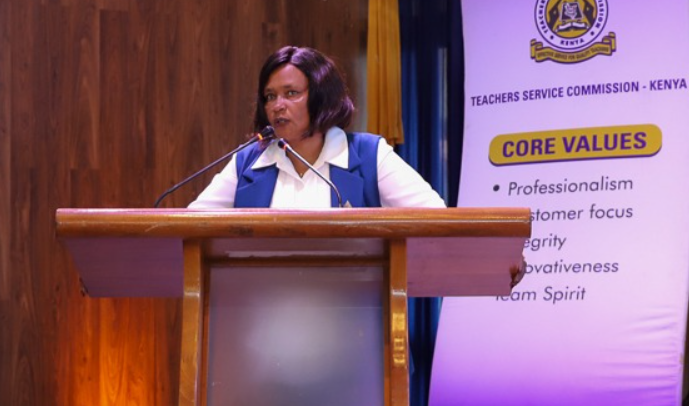
 Acting TSC CEO Evaleen Mitei speaking during stakeholders’ engagement forum on proposed amendment to Regulation 20 of the Code of Regulations for Teachers at the Kenya Institute of Special Education (KISE), May 14, 2026. /TSC
The Teachers Service Commission (TSC) is reviewing entry standards and academic qualifications for teacher registration in a move that could allow more primary school teachers to qualify for deployment to junior schools.
Proposed changes to Regulation 20 of the Teachers Service Commission Code of Regulations for Teachers would enable primary school teachers with a Diploma in Education, a KCSE mean grade of C (plain) and a C+ in at least one teaching subject to qualify for registration and deployment to junior school.
Currently, a KCSE mean grade of C+ and at least a C+ in two teaching subjects is the minimum requirement for registration as a secondary school teacher qualified to teach in junior school.
The existing threshold has for years denied many P1 teachers an opportunity to teach in secondary schools, even after advancing their studies to diploma level or obtaining a bachelor's degree in secondary education, because they attained an overall KCSE mean grade of C (plain).
The review of the minimum grades and certification requirements is intended to standardise teacher training and align subject combinations with the needs of the Competency-Based Education (CBE) curriculum.
Although domiciled within primary schools, junior schools (Grades 7, 8 and 9) have a separate cadre of teachers who must be registered by the Teachers Service Commission and hold valid qualifications in secondary education.
To be legally qualified to teach in junior school, an individual must hold a KCSE certificate with a minimum mean grade of C+, attain at least a C+ in each of the two teaching subjects they intend to teach, and possess at least a Diploma in Education (Secondary option), a Bachelor of Education degree, or a Postgraduate Diploma in Education (PGDE).
Primary school teachers holding P1 certificates and degrees with a primary education option are generally not eligible to teach at the junior school level unless they undertake additional diploma training to qualify for transfer.
If adopted, the proposed changes could help the commission bridge the huge teacher deficit in junior schools.
Despite the government's recruitment of more than 100,000 teachers over the last three years to support the rollout of CBE, Kenya continues to face a shortage of approximately 70,000 teachers in junior schools alone.
A move by the TSC to bridge this gap by hiring 44,000 graduate teachers as interns backfired after the Court of Appeal ruled that teacher internship recruitment was unconstitutional because it discriminated against qualified teachers.
The court said that employing qualified, registered teachers on inferior terms while others received permanent contracts amounted to unfair labour practices
As part of efforts to formalise the proposed teacher qualification and registration criteria, the TSC has begun stakeholder consultations on amendments to Regulation 20 of the Code of Regulations for Teachers.
On May 14, the commission held a stakeholders' engagement forum on the proposed amendments at the Kenya Institute of Special Education (KISE).
Acting TSC chief executive officer Evaleen Mitei said the teacher registration framework must remain responsive and robust to keep pace with the evolving education requirements of the CBE and emerging technological advancements.
She added that the views of all stakeholders are critical in shaping the teaching service, hence the need for public participation.
As the proposed amendments await parliamentary approval, TSC said eligible teachers will be invited to apply through its online portal once the legal framework is in place.
Subcounty directors of education, through whom the applications will be processed, have been instructed to balance subject combinations and ensure gender representation in postings.