

Kenya and Rwanda have signed three landmark agreements that will allow Rwanda to import bulk refined petroleum products through Kenya under a Government-to-Government (G2G) arrangement, marking a major step in strengthening regional trade and energy security.
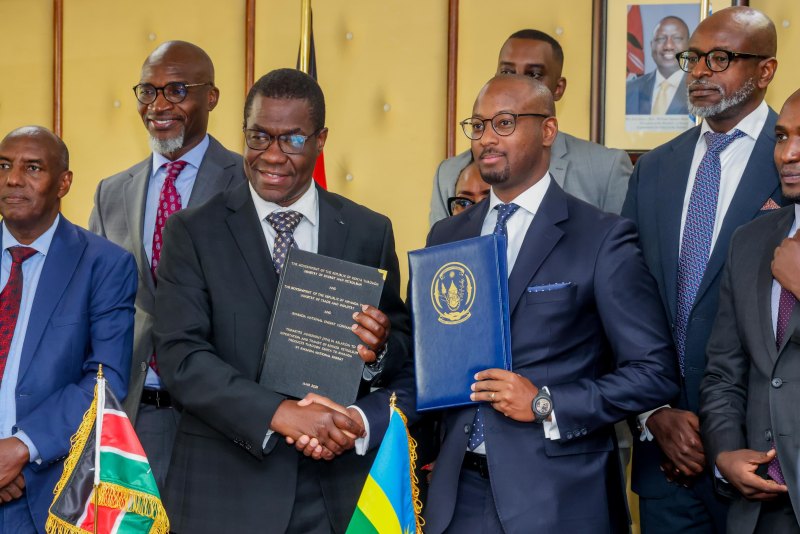
The agreements, signed on Monday at KASNEB Tower in Nairobi, comprise a Memorandum of Understanding (MoU), a Tripartite Agreement (TPA) and a Transport and Storage Agreement (TSA). The signing is expected to open the Northern Corridor for Rwanda's petroleum imports fully.
The event was witnessed by Energy and Petroleum Cabinet Secretary Opiyo Wandayi, Rwanda's Minister of Trade and Industry Antoine-Marie Kajangwe, Kenya Pipeline Company (KPC) Acting Managing Director Pius Mwendwa, Rwanda National Energy Company (RNEC) Director Chris Twagirimana, alongside senior government officials and representatives from the energy sector.
The agreements conclude negotiations that began with bilateral talks in Kigali in November 2024 and were approved by Kenya's Cabinet on June 16, 2026.
Under the new framework, Rwanda's petroleum imports through the Northern Corridor are projected to increase more than tenfold, from approximately 42,000 cubic metres handled in 2025 to over 500,000 cubic metres annually.
The first shipment under the arrangement, designated RNEC 001/2026, is expected to arrive at the Port of Mombasa between September 4 and 6, 2026.
Speaking during the signing ceremony, Wandayi said the agreements represented more than a legal framework, describing them as a long-term commitment by Kenya to guarantee Rwanda a secure and reliable supply of refined petroleum products.
"The volumes are set to grow more than tenfold. But the numbers are not the endgame; what this represents for our two great nations is deeper economic integration that will serve the East African Community and the Great Lakes Region for several decades to come," he said.
Rwanda's Trade and Industry Minister Kajangwe described the agreements as a turning point for the country's energy sector, saying they would provide reliable, affordable and secure access to petroleum products while strengthening cooperation between the two countries.
"These agreements are the product of trust between our two governments, our institutions and our people. We look forward to welcoming the first cargo in September as the beginning of a long and prosperous journey together," he said.
KPC Acting Managing Director Pius Mwendwa said the deal marked the culmination of more than a decade of efforts to regain Rwanda's fuel market, noting that Kenya had previously supplied less than 10 per cent of the country's petroleum demand.
He said KPC had invested heavily in infrastructure to support the expanded trade, including 1.13 billion litres of petroleum storage capacity, a 1,342-kilometre pipeline network across Kenya and the Kisumu Oil Jetty on Lake Victoria. He added that the Eldoret–Kampala pipeline corridor could eventually be extended to Kigali as regional integration advances.
To enhance the competitiveness of the new arrangement, Mwendwa announced that KPC's Board had approved extending the storage period for Rwanda-bound petrol and diesel cargoes from 35 days to 90 days for an initial two-year period.
He also noted that Rwanda is a shareholder in KPC, having invested in the company's Initial Public Offering, saying the partnership would generate commercial benefits for both countries.
The agreements were developed by a Joint Technical Committee comprising officials from Kenya's State Department for Petroleum, KPC, the Energy and Petroleum Regulatory Authority (EPRA), Rwanda's Ministry of Trade and Industry and the Rwanda National Energy Company.
RNEC has since been registered in Kenya and licensed by EPRA to import, export and wholesale petroleum products, completing the legal and regulatory framework required for the new trade arrangement.
Both governments expressed confidence that the partnership would strengthen regional trade by enabling Rwanda to expand fuel supplies to neighbouring towns and other landlocked markets, increasing business opportunities and commercial returns across the region.