


Nairobi rain has a very specific talent for destroying confidence. You leave the house feeling composed and emotionally organised, then 15 minutes later, you are squinting through a fogged windshield, praying your tiny car does not become a submarine near South B.
The thing about Nairobi rain is that it does not just fall. It reveals.It exposes that this entire city is being held together by vibes, the collective prayer life of wananchi and the shared imagination of our ongoing dream of becoming “Singapool”.
At first, there is order. People are still trying. Indicators still mean something. Space still exists. But slowly, the rain starts rewriting everyone’s patience. The fuel gauge begins to act emotionally. A matatu behind you is hooting like you invited the clouds yourself. Another one is already on the pavement, splashing water on pedestrians and still finding time to insult the entire system. You enter a pothole and briefly meet your ancestors. Traffic lights stop functioning out of fear. Matatus develop fresh demonic energy as every road becomes a live-action obstacle course. Then comes the traffic … for three hours. It feels like collapse.
But that is not the full story. Because even in that same chaos, something else keeps happening.
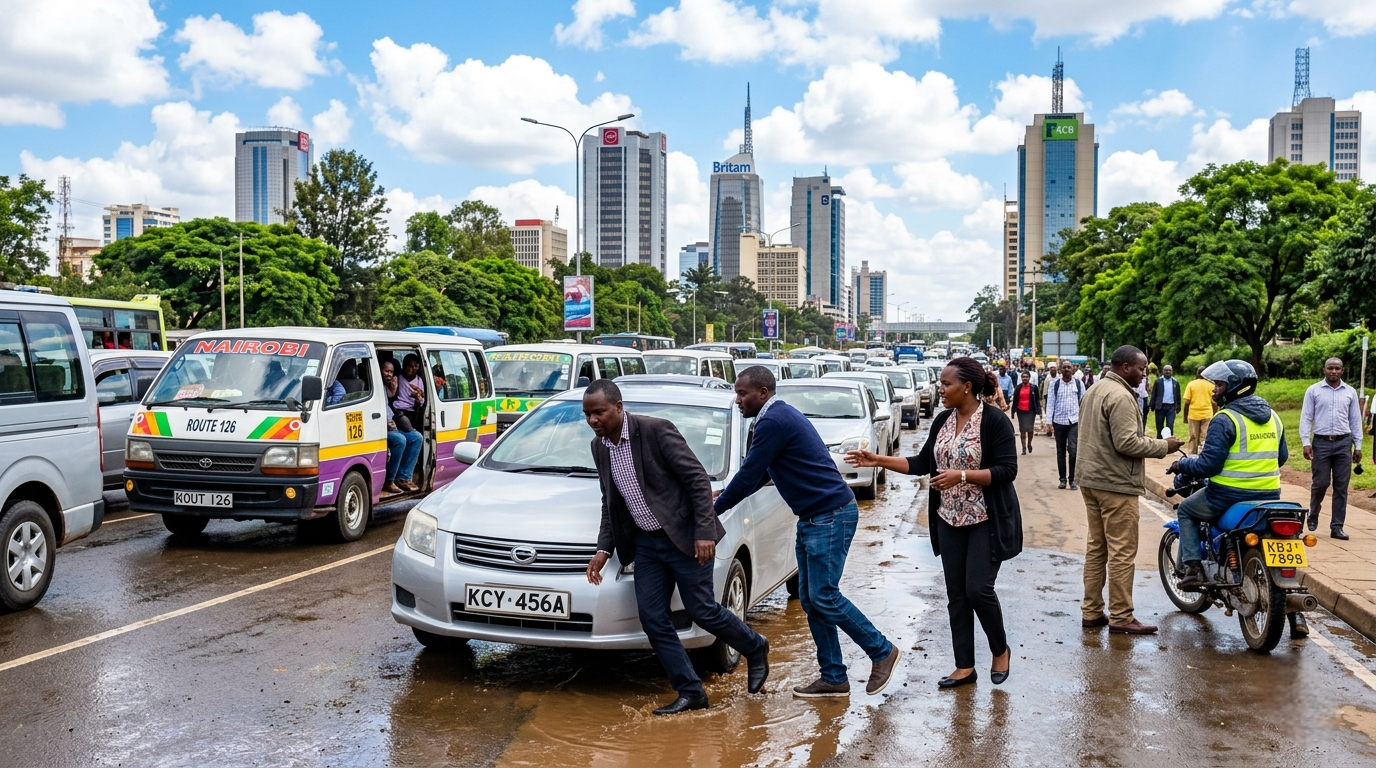
People show up. A stranger will step out and push a stalled car without asking for anything. Someone will stand in the rain, directing traffic like it is their personal responsibility. A boda rider will stop just to check if you are okay. Someone will warn you, “Usipite hii side,” like your survival matters to them. No transaction. No gain. Just instinct and kindness.
Should you get stuck, out of nowhere, men in shorts and slippers step into water like they already understand it. They assess, they guide, they push cars, they direct traffic, then they move on. Not as heroes. Just as people reacting to what is in front of them. And women, men, everyone really… They are all just trying to get through the same moment without breaking.
And that is the part that often gets missed when we talk about systems failing. Yes, the systems are weak. Yes, the planning is inconsistent. Yes, the roads expose how much is missing. But Nairobi is not only defined by what collapses. It is also defined by what remains human inside the collapse.
Because beneath the frustration, there is still something intact. Ubuntu. “I am because we are.”
You see it in the smallest things. In warnings shared between strangers. In help offered without expectation. In patience that appears briefly, unexpectedly, in the middle of traffic. In people choosing not to make someone else’s bad moment worse.
So the rains do expose Nairobi. They expose the weak infrastructure. The drainage that never quite works. The traffic systems that buckle too easily. The planning that never fully caught up.
But they also expose something else. That even when the city is struggling to function, the people in it are still functioning towards each other. Not perfectly. Not always. But enough to matter.
And maybe that is the real truth of Nairobi rain. Not just that everything breaks. But that even in the breaking, people still choose each other in small, ordinary, almost harmless ways.
Still, it should not have to be this way. People do not deserve to leave their houses neatly dressed and return covered in mud and dirty water. Children deserve to see rain as a blessing, not an inconvenience. Businesses deserve to know that when it rains, their stock is safe and their day is not automatically compromised.
The government should take the people it is meant to serve seriously. Kenyans deserve better than improvising survival every time the sky opens. Kenyans deserve respect.