In Kenya, the Swahili word for
demonstrations or collective protest, maandamano, has transcended its political
usage into a vibrant civic dissent, democratic negotiation and historical
memory.
Gradually, Kenyan streets have become public spaces for citizens to
challenge exclusion, to reveal state paradoxes and to continually reimagine
justice, freedom and belonging in the postcolonial nation state.
Such interpretations are often
read as a sign of instability or democracy's fragility in Africa; but they
camouflage some of the Afrocentric and historical roots of the culture of
protest in Africa.
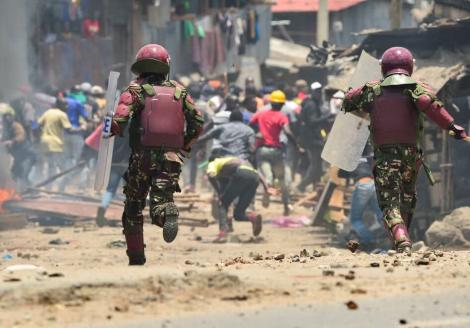
The public disorder that is maandamano is more than just an
occurrence in Kenya; it is a longstanding political tool that that the citizens
use to challenge domination, inequality, and the constant silencing of marginalised
voices.
Democracy in Kenya, has been
redefined beyond its theoretical depicted as living archive for a common dreams
of justice and citizenship that is continually constructed.
The colonial violence and the historical foundations of protest
Colonialism's violent
architecture in Kenya is embedded in its protest culture, which manifests in
racial separation, land dispossession, forced labour, taxation and systematic
exclusion from political power.
In the
early 1900s, labour organisations, women's organisations, nationalists,
churches, and peasant groups joined together to organize strikes, boycotts, to
speak out orally, to sing songs of defiance, to organise secret groups, and to
reject colonial authority through symbolic means.
A major theme in this history is
the Mau Mau uprising of the 1950s. It is frequently referred to as a mere
insurgency, but it was actually a fight for land, sovereignty and African
self-determination.
Resistance persisted in kinship networks, through oral
memory, ritual solidarity and communal mobilisation networks despite the
violent repression.
In this genealogy of
anti-colonialism, maandamano is a language of protest and a voice reclaiming
from the historically voiceless.
Afro-centric and indigenous political thoughts and the making of democracy
This Afrocentric perspective on
protest culture in Kenya critiques Eurocentric views that democracy came to
Kenya only as a result of colonial modernity. African societies had long been
in place with their own complex systems of governance that were based on consultation,
collective responsibility, reciprocity, and restorative justice, well before
colonialism.
In many communities across Kenya there was a form of decision
making structures through councils of elders, communal assemblies, age grade
systems and public forums of leadership which had legitimacy because of the
principles of social accountability and public debate.
One such interpretation of
maandamano in the contemporary period is continuity rather than a breakage with
the politics of Africa. Protest takes the form of a new expression of older
communal practices which are employed to address injustice and to negotiate
social order.
From anti-colonial resistance to digital activism
The very dawn of independence in
1963 was envisioned as marking the point of an era of democratic inclusion,
economic justice, and African self-determination in Kenya.
However, the
post-colonial state established numerous centralised colonial institutions, in
an atmosphere of censorship, detention, intimidation and restrictions on
freedom of expression.
The universities were the arena for ideological
conflicts, and journalists and opposition figures were subjected to
surveillance and repression. Here maandamano did not just become a form of
protest, but a continuing language of democracy's resistance and a symbol of
the voice of freedom itself.
The continuation of protest in
Kenya indicates that the country still has many unresolved issues of national
significance that have been looming in the post-colonial state since Kenya's independence:
What is the value of freedom to? Whose voice is heard in a democracy? Who is
left out of economic and political citizenship?
The unplatonised nature of
postcolonial democracy in Africa is evident in these unresolved tensions.
Africa should define adapt democracy that fits in the context and culture and
history of the people to satisfy the needs of the people.
In the contemporary period, digital
technology has led to organisation of a more structured sophisticated
Maandamano. Social media is now a new decentralised political space where
satire, civic education, political critique, and mobilisation can rapidly flow.
Hashtags facilitate collective action and viral imagery reveals the violence of
the state and failures of institutions. But there is a historical continuity
beneath these technological changes, as many citizens are still feeling
alienated from the claims of independence and democratic inclusion.
The series of protests in Kenya
are thus less about economic discontent and more about existential crises.
They
represent a fight for dignity, recognition and for citizenship. A nation of
maandamano is not just a nation of perpetual protest, but also a society in
perpetual negotiation with unfinished freedom, justice and democratic belonging
in postcolonial Africa.
Kenya's streets have become sites of dissent more than
ever. They are democratic archives of life in which history can be heard,
memory is defiant and Africa's democratic fantasy can be extended.
The writer is a Kenyan historian, lecturer at Kibabii University and postdoctoral fellow at the University of Lagos under the ARUA–Mastercard Foundation programme.