


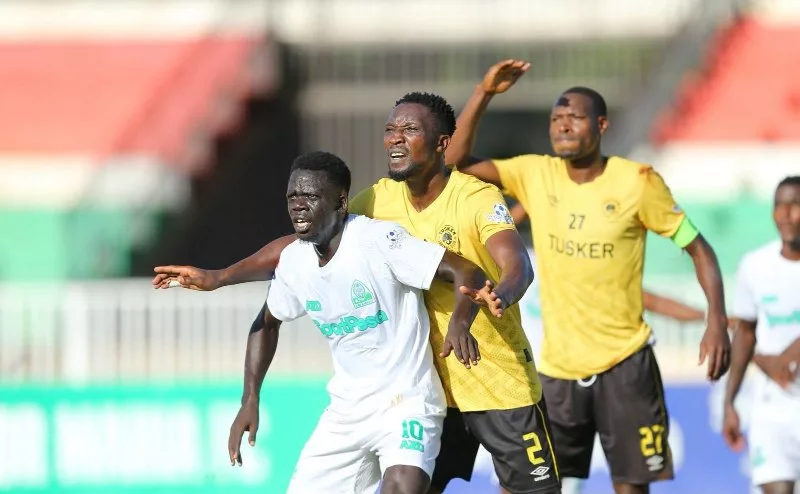
 Gor Mahia's Jackson Dwang and Tusker's Ibrahim Joshua during their SportPesa League match/HANDOUT
The Football Kenya Federation (FKF) has unveiled a seven-member committee to spearhead the transition of the SportPesa Premier League into a semi-autonomous affair, easing tensions that had threatened to derail the start of the 2026/27 season.
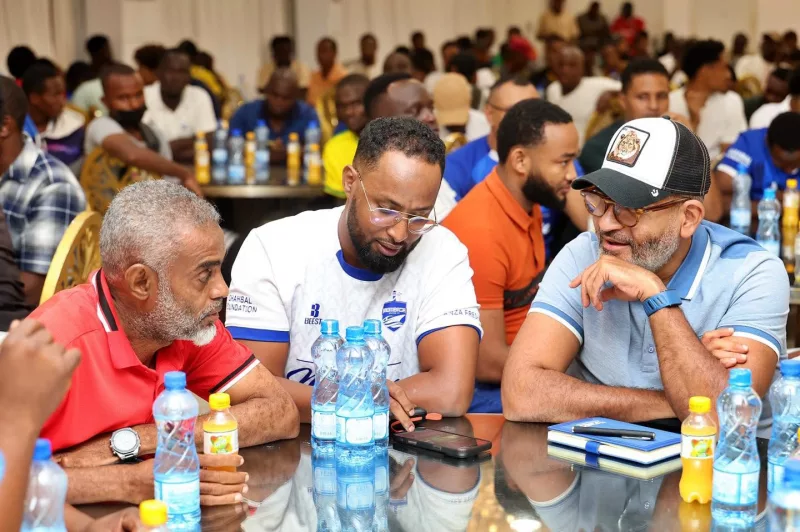
The committee was agreed upon during a high-level meeting on Thursday between FKF President Hussein Mohamed, Chief Executive Officer Dennis Gicheru, and chairmen of top-flight clubs following weeks of disagreement over the future league's governance.
The breakthrough comes after club chairmen warned they would boycott the new season, scheduled to kick off on August 22, unless the federation honoured an earlier agreement to establish a more independent management structure for the country's top-tier competition.
Gor Mahia chairman Ambrose Rachier described the meeting as productive, saying it had laid the foundation for a structured transition.
"We met to review the resolutions of the previous meeting; it was a very useful engagement," Rachier said.
"The important thing is that we have a committee in place to oversee the transition of the SportPesa Premier League into a semi-autonomous competition."
"We will be looking at means of getting there through collaboration with key stakeholders including the league sponsors," he added.
The seven-member committee will comprise two representatives from FKF, two from Premier League clubs, two from the corporate sector and one representative from the National Super League.
The committee has been mandated to formulate a commercial strategy capable of attracting new investment while safeguarding existing sponsorship and broadcast agreements. Rachier said the committee would focus on creating a sustainable governance model rather than rushing into structural changes.
"This is not about confrontation but about ensuring the league develops on a firm foundation that benefits every stakeholder," Rachier said.
He noted that both clubs and the federation recognised the importance of maintaining stability ahead of the new campaign while implementing reforms in a phased manner.
"The discussions showed there is goodwill on all sides. We want a league that is professionally managed, commercially attractive and accountable," Rachier said.
The governance dispute dates back to a meeting held on May 26 at the Serena Hotel, where FKF and club chairmen agreed on a roadmap to hand over greater operational control of the league to a semi-autonomous structure beginning with the 2026/27 season.
However, frustration grew after clubs accused the federation of failing to establish the promised Transition League Management Committee, leaving uncertainty over how the new governance framework would be implemented.
Mathare United chief executive officer Jecktone Obure said the meeting also addressed logistical challenges that clubs are likely to face next season because several major stadiums will be unavailable during the 2026 African Nations Championship (CHAN).
"We discussed infrastructure because some clubs, especially those based in Nairobi, will not have access to the main stadiums that will be in use during the tournament," Obure said.
"FKF asked us to recommend some venues and facilities, such as Afraha Stadium in Nakuru, Dandora and Kericho Green Stadium, which were proposed."
Obure welcomed the agreement on league reforms but said the transition would have to be implemented carefully to avoid legal complications. "I think the introduction of a semi-autonomous league will be a wonderful idea, but it will take off gradually because we are keen to avoid running into legal hurdles," he said.
"FKF President Hussein Mohamed reiterated his desire to have the best league in Africa but also stressed the need to do everything within the confines of the law," he added.
Thursday's meeting revisited the May resolutions and resulted in a compromise that places the newly formed committee at the centre of the transition process. Rachier expressed confidence that the latest agreement would help restore trust between FKF and the clubs.
"The most important thing is that we now have a structured process. We all want the same outcome, which is a stronger and more competitive league," Rachier said. He also stressed the need to strengthen the league's commercial value by working closely with sponsors and broadcasters.
"We must continue engaging our commercial partners because they are central to the growth and sustainability of the competition," Rachier said.
FKF reiterated its commitment to protecting existing agreements with title sponsors SportPesa and broadcast partners Azam Media while pursuing additional investment opportunities through the committee. The federation also maintained that the current prize structure, which awards Sh15 million to the league champions, Sh3 million to the runners-up and Sh2 million to the third-placed team, remains part of its strategy to enhance the competition's commercial appeal.
With the governance deadlock eased, attention now shifts to the committee as it begins work on delivering the long-awaited transition before the new Premier League season kicks off on August 22.