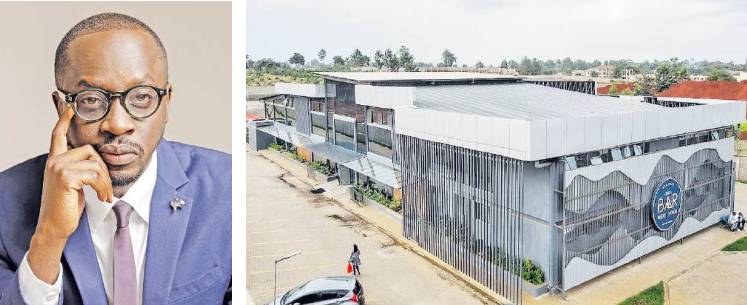
Growing up was a roller coaster
for Antony Owich as he describes
it. From living in Nairobi West to
schooling in Cario to coming back
and attending government schools
and moving to Eastlands and having
to “fit in”.
A lot of these experiences
have been critical to shaping the man
he is today, he says, as he forges a path
in high end entertainment and delivery business in a challenging Kenyan
business environment.
The Star spoke to the city entrepreneur whose first actual business was
selling chewing gums and pin pops
in high school and now runs two top
city entertainment outlets (The Bar
Next Door or BND) and a beverage
delivery company.
Who is Antony Owich and how old is
he?
I am a son, brother, uncle and friend.
I also happen to be a serial entrepreneur and I am 33.
Do you have a nickname? If yes, how
did it come up?
Yes. Back in the day when D’banj
was popular, someone called me
Koko Master and it stuck but now
it’s just Koko.
Tell us about your early life, were you
born in the city? Where did you go to
school Kenya or abroad?
My early life was quite interesting
with a mix of life in Kenya and life
in Cairo Egypt.
I was born in Nairobi
Kenya and went to school here up until 1998 where we relocated to Cairo
as part of foreign service duty my late
father was called for.
Cairo which is
predominatly a muslim country and
going to a muslim school I got to be
in touch with different religions and
culture which was eye opening.
What time do you wake up?
At about 4am to 4:30am.
What is the first thing you do when
you wake up?
Pray, check on my dog and head to
the gym.
How was it growing up?
Growing up was a roller coaster if I
could say so but one that I look back
and enjoy and I’m grateful for. From
living in Nairobi west to schooling in
cario to coming back and attending
government schools and moving to
eastlands and having to “fit in”.
A lot
of these experiences have been critical
to shaping the man I am today and
the ability to show up in difference
situations life throws your way.
What is that one thing you did as a kid
that got you into so much trouble?
Lol! Coming back to Nairobi from
Cairo where we were allowed to talk
back to teachers, that was something.
I think that’s the most beating I received from teachers and after that I
had to understand how things work
here.
Tell us about your education, career
and experience?
I’ll start from high school, I went
to Aquinas High School and after
that was accepted at the University
of Nairobi where I did my Bachelor
of Economics and Statistics degree
while undertaking my certification
in investments and securities analysis course.
Post university, I worked
for Trueblaq, Chase Bank(now SBM
bank) in their customer service and
later treasury department.
I was later appointed as Jameson brand ambassador for East Africa which was
and still is a very sought after job.
Carlsberg poached me to build on
their sales and marketing team for
Kenya to grow their Carlsberg and
Tuborg brands here.
My last job was with DIAGEO(EABL) as a reserve
account manager in charge of managing significant trade partners for
EABL.
As I was transitioning from
employment to entrepreneurship I
had some time to undertake a masters degree (MBA) at United Stated
International University.
The education and work experience overtime
equipped me with knowledge to set
up the Bar Next Door businesses
and now Front Door, an ecommerce
B2C (Business-to-consumer) and B2B
(business-to-business) distribution
business.
What was the first business you ever
did?
First actual business was when I
was in high school and I would sell
chewing gums and pin pops from my
desk to other students. Buy them in
wholesale and sell them for a profit.
Do you now consider yourself an entrepreneur or a C-suit executive?
I see myself as a hybrid—an entrepreneurial C-suite executive. I bring
the visionary mindset and agility of
an entrepreneur, always seeking innovation and growth opportunities,
while also embracing the strategic
leadership and operational excellence
required at the executive level.
This
unique blend allows me to drive bold
ideas forward while ensuring they
align with the organisation’s longterm goals and deliver measurable
impact.
You are behind one of the top clubs
in Kenya tell us about it, why the line
of business?
Having been in the industry for so
long, I believed it was important to
create a brand based on quality, community and proximity and so BND
(The Bar Next Door ) was born.
We
started during Covid when everyone
was cautious about the restaurants business with some having to shut
down over the strict operating rules
at the time.
We believed in ourselves
and The Bar Next Door has now
claimed its spot on the global arena. This is by 50Best-the World’s 50
Best Restaurants list produced by UK
media company William Reed, which
recognised us as among the top outlets in the globe.
We were also named
the best night club in Kenya at this
year’s Kenya Tourism Board awards.
What does it take to be the best?
It takes a lot of work and consistency
and understanding your line of business. It has taken a lot of work and
focus from all of us at BND and so
I am proud of the recognition that
our work and brand have received.
Apart from BND, any other business
you are in?
I also own FrontDoor. A beverage
delivery company rooted in consumer-friendly pricing, eco friendly solutions and the use of AI to create a
friendly, efficient and personalised
customer experience.
Check us out
on Instagram and website www.
frontdoorke.com
Are you dating, married, kids?
I am single and enjoying it.
What do you do on your free time?
I enjoy travelling, eating good food
and exploring experiences both locally and around the world.
As a bar owner, do you drink yourself?
Yes. I enjoy Glenlivet and occasional
tequila. I drink responsibly.
What is your ideal weekend?
My weekends are slow, filled with
books, relaxing and time with friends
and family.
What country gave you the most
memorable moments and why?
I’d say Egypt, the cultural and religion differences were an eye opener
and also lead to an appreciation of
different people and cultures which
lead me to be more open minded.
How has it been starting and running
a business in Kenya?
It has been a great learning experience. There’s some things that you
can only see and learn once you are
in the process. It has given me a deep
appreciation for my community and
for an efficient team, once you find it.
What are some of the challenges you
have faced?
As an entrepreneur in Nairobi’s hospitality industry, I have faced several
challenges while growing my business.
One of the biggest hurdles is
the high cost of operations, including
rent, utilities and labour, which eats
into profit margins.
Additionally,
inconsistent power and water supply often disrupt operations, forcing
me to rely on expensive alternatives
like generators.
Access to affordable
financing has also been a struggle, as
high-interest rates and strict collateral
requirements make it difficult to expand or upgrade facilities.
Competition is fierce and standing out requires
constant innovation and marketing,
which can be costly.
Lastly, navigating regulatory requirements and licensing processes is time-consuming
and often frustrating.
Despite these
challenges, Nairobi’s growing middle class and tourism potential keep
me motivated to push forward and
find creative solutions to grow my
business.
What advise would you give someone
who wants to invest in the same line
of business?
Take the time to build and invest in
relationships with partners and customers. This line of business is an
ecosystem of people both vertically
and lateral.
What is the dumbest thing you ever
did in your life?
This happened quite recently actually…lol! On one of my travels last
year, I convinced myself to take a nap
at 1am and I had a flight to catch at
6am.
The nap turned out being more
than that and I woke up to the airline
app with the flight being almost half
way to the destination.
How do you perceive the Kenyan business environment and maybe what
needs to change or improve to support
entrepreneurs?
The Kenyan business environment
is full of potential, especially in the
hospitality and beverage industry, but
it needs improvements to better support young entrepreneurs.
Access to
affordable financing remains a major
hurdle, with high-interest rates and
stringent collateral requirements stifling startups.
Additionally, bureaucratic red tape
and complex regulations make it
difficult to start and run businesses
smoothly.
To foster growth, there should be
more focus on simplifying regulatory
processes, providing mentorship and
training programmes and improving
infrastructure, especially in rural areas.
A stable policy environment and
support for innovation and technology adoption would also go a long
way in helping young entrepreneurs
thrive.