I
can say without fear of contradiction that no name has been used and abused
like that of the ODM party leader Raila Odinga. Whether as a hate figure
manufactured by his opponents or as a subject of adulation by the millions of
his supporters, the name of the former Prime Minister has for decades been used
to build and destroy political careers in equal measure.
The trouble with this
is that this has led to a political-industrial complex of pettiness and foolishness.
Take for instance, the latest rumours around the ODM chief’s health.
Let
us be clear that at 80, going 81, with nine years of his life spent in harsh
conditions in detention, an unmatched political itinerary spanning thousands upon
thousands of miles in the last three decades and a travel schedule that would
have taken a toll on people half his age, there is really nothing wrong with
the former premier being under the weather once in a while. But sections of his
party, and the political class, act with plain animalistic instincts, whenever
this happens.
Incidentally,
Raila himself has been a proponent of openness and free communication regarding
his health. As PM in 2010, and following a punishing campaign for a new
constitution, he checked himself into hospital with what was initially reported
as exhaustion but turned out to be a head injury. He dispatched his surgeon Dr
Oluoch Olunya to update the country, an act that made the phrase ‘subdural
hematoma’ quite famous in these shores.
Much
later, at the height of the Covid pandemic, once again, the ODM boss was in his
element, being quite open about his infection and recovery, providing regular
updates to an anxious nation. You would imagine that with this background the
people and structures around Raila have mastered their leader’s communication
model on delicate issues, but no, the fumbling around the matter portrays both
a shocking lack of preparedness for such delicate communication, as well as a
glaring absence of protocol over what to do in such eventualities.
To
begin with, Raila’s team does not really need to churn out letters and social
media posts in an attempt to prove he is okay. That is just callous and
reckless. And in Kenya’s excitable political circles, this only leads to more
queries and intrusions. Which leads me to my earlier submission; there is
really no compelling reason to prove to anyone that an 81-year-old man is in
perfect health. There obviously is the option of letting the rumours swirl
around until the ODM leader is sighted again. After all, he doesn’t hold any
public office that requires the level of intrusion we have seen recently.
Having
said that, there is a certain level at which I have to blame mainstream media.
Given how Raila has been open and approachable in the past, the media owes him
the dignity to avoid being the fuel used to perpetuate vicious misinformation
regarding his health. Understandably, Raila’s name sells papers, but restraint
sometimes denotes class. The desire to be the first out with adverse news is
now, admittedly, a Kenyan thing, but the weight of responsibility still weighs
heavily on mainstream media.
Be
that as it may, my assessment of the recent events around the ODM boss and his
party indicates that part of the confusion possibly emanates from competing
interests in his formation. Last week, on a TV show, while commenting on the
20-year milestone achieved by the party, Suba South MP Caroli Omondi bemoaned
the emergence of “mercantilism within ODM”, a far cry from the original ideals
of the party. It is difficult not to agree with the legislator, and I suspect
that these “political traders”, in an attempt to control the information flow
around the boss, are responsible for the conflicting updates on the whereabouts
and health of the former PM.
Each
day, listening to and watching Kenyan politics, you are confronted by the
reality that for certain leaders in Raila’s party, there is a hurry to deliver
the bases to President Ruto, everything else be damned. There is so much
enthusiasm in this faction of the party, that it campaigns for the President’s
reelection, more than the latter’s own party, UDA. The net effect is that this
faction’s mentality has gradually moved to the politics of Raila’s transition,
without anyone paying attention to them.
In
my view, the absence of Raila’s ideological peers, such as Governors Anyang’
Nyong’o (Kisumu) and James Orengo (Siaya), from the centre of ODM power
politics, is partly to blame for the gaping gap that has been filled by what
Caroli calls the mercantilist political operators. The disjointed communication
over Raila’s health manifests this absence of expert political hands, with an
understanding of Raila’s journey and life, to help steer the ship in turbulent
times. If anything, one can sense a level of panic over possible scenarios that
lie ahead, in a party which for two decades, hasn’t had to deal with anything
like it.
It
reminds me of the infamous anecdotes we have read, detailing events around
founding President Mzee Jomo Kenyatta in the twilight of his life. With
discussions of the President’s mortality off the table, competing interests
took to trying to outdo each other, pushing and pulling to position themselves in
vantage succession slots if ‘something’ happened to the President. Ultimately,
the scripts were all thrown out of the window when something did happen, but it
doesn’t stop latter day ‘mercantilists’ from trying.
Too
much has been invested in Raila, by too many people, for his affairs to be
managed in such a pedestrian manner in his hour of need. There are millions of
supporters across the country who still desire to reach ‘Canaan’ via his
leadership. There is the broad-based regime, hanging on his support to not only
reach the 2027 electoral cycle in a stable environment, but possibly help it
secure reelection. Then there are the myriad ‘ticket traders’ whose own
political survival hinges on Raila’s name, either for or against, to get
elected in certain parts of the country.
With
this background, my advice to the ODM leadership would be to develop proper
protocols for handling adverse reports around the leader. These protocols have
to align with the former PM’s own openness to issues of personal health, while
maintaining the dignity and honour of his office and his long years of sacrifices
for national good. And since he is heading to 81, there is no harm in these
protocols including a succession process, because to be prepared is to
eliminate the fumbling we have currently witnessed.
While
at it, it is important for Raila handlers to avoid seeing ghosts and enemies in
every shadow. It was quite surreal, to see a statement blaming the joint
opposition, especially impeached former DP Rigathi Gachagua and Wiper leader
Kalonzo Musyoka, for being responsible for the rumours over the ODM chief’s
health. I can’t remember the two, or indeed the opposition, ever discussing
Raila’s health. If anything, most of these rumours have been peddled within ODM
circles. To blame everyone else except party operatives, is to miss the point
by miles. The point being that rumours about the health of senior leaders
didn’t begin today and won’t end today. Neither are they just about Raila. It
is the response that matters, hence the need to have credible systems that
assure the bases and steady the party.

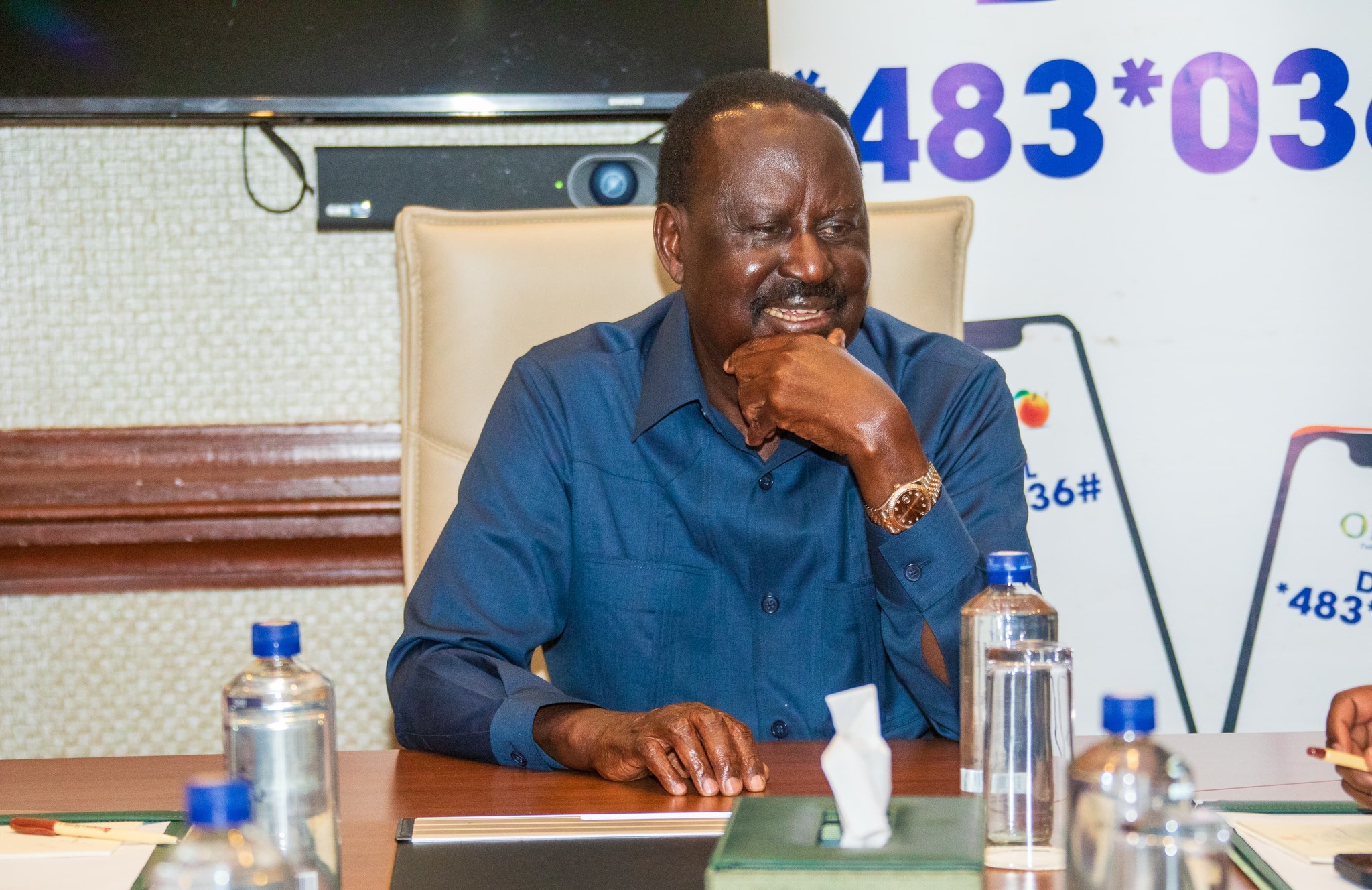 ODM party leader Raila Odinga./FILE