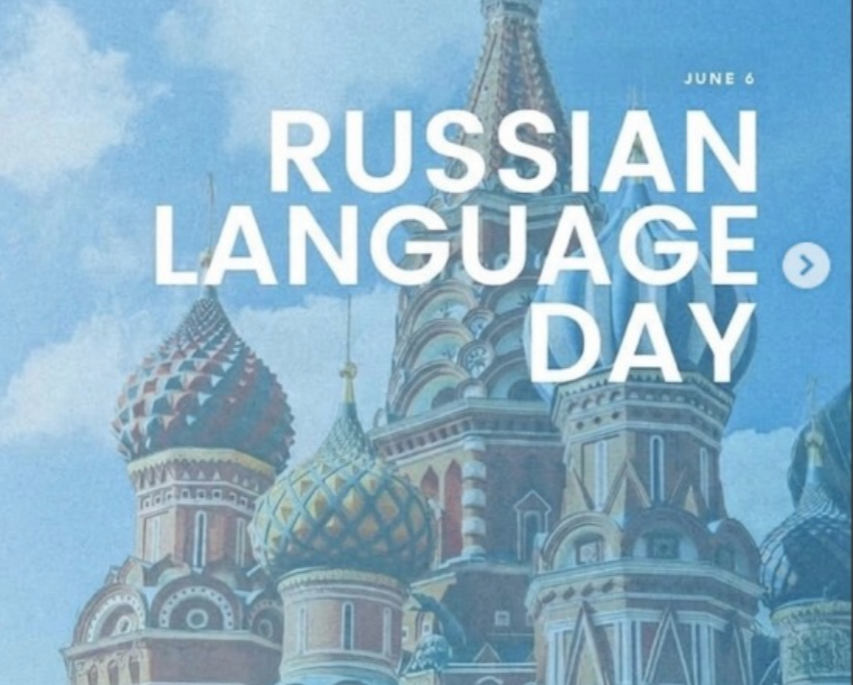


Russian Language Day was marked on June 6 in a message highlighting the global significance of the Russian language and its cultural heritage.
The day was marked with particular attention to the legacy of poet Alexander Pushkin and the language’s continued global reach.
The message was issued by the Directorate team of the World Youth Festival.
“Today is a special day,” the directorate team said, opening the statement with a brief acknowledgment of the occasion before reflecting on the broader importance of Russian in communication, education and creative expression.
“Russian Language Day is traditionally celebrated on June 6. Thanks to the Russian language, more than 250 million people around the world are able to communicate, work and create something new every day,” the statement read in part.
The message emphasised the scale of the language’s reach, describing it as a tool for everyday communication and a medium for professional and artistic creation across different countries and cultures.
It framed Russian as a language that continues to connect speakers beyond national borders.
The date of the observance is closely tied to literary history, coinciding with the birth anniversary of one of Russia’s most influential cultural figures, the poet Alexander Pushkin.
“The date was chosen for a reason. June 6 marks the birthday of the great Russian poet Alexander Pushkin,” the team noted.
Pushkin is widely regarded as a foundational figure in modern Russian literature, credited with shaping the structure and expressive depth of the Russian literary language and helping to define its modern form.
The statement also highlighted aspects of his background, including references to Abram Gannibal, an African-born figure who is believed to be among Pushkin’s ancestors and who served under Emperor Peter the Great.
“One of Pushkin’s ancestors was an African named Abram Gannibal, who came to Russia to serve Emperor Peter the Great,” the message read.
It further noted that Pushkin’s first language was French.
“Even more surprising, the young poet’s first language was French,” the team said.
Despite this, Pushkin went on to play a central role in shaping modern Russian literary expression, contributing to its simplification and evolution by moving it away from rigid and overly formal styles.
“Yet this did not stop Pushkin from shaping the modern Russian literary language, freeing it from excessive formality and bookishness,” the message added.
The message concluded with a broader reflection on language as a space of inclusion and creativity, using Pushkin’s legacy to underline how cultural and linguistic identity can transcend background or origin.
“The poet proved that anyone regardless of their nationality or cultural background can speak, create, and think in Russian,” the directorate team noted.
Through the commemorative message, the Directorate framed Russian Language Day as both a celebration of literary heritage and a recognition of the language’s continued relevance in global cultural exchange today.












![[PHOTOS] Security beefed up ahead of budget reading](https://cdn.radioafrica.digital/image/2026/06/5397619f-b1c7-41d5-a284-6e065c2249df.jpg)