Normalcy has resumed across the country after a day marked by road blockades and running battles, particularly in Nairobi, as families of victims, activists and politicians marked the second anniversary of the deadly 2024 Gen Z protests that left at least 62 people dead and scores injured.
Unlike the widespread unrest witnessed two years ago, Thursday's demonstrations unfolded under one of the heaviest security deployments in recent history, with the government banking on an aggressive containment strategy to prevent a repeat of the chaos.
The most visible measure was the closure of major roads leading into Nairobi's Central Business District (CBD), where police mounted roadblocks that effectively sealed off the city centre.
The restrictions stranded thousands of commuters, forcing many to walk long distances to work while others abandoned their journeys altogether, despite the government's insistence that it would be a normal working day.
Interior Cabinet Secretary Kipchumba Murkomen defended the road closures, saying intelligence reports indicated that goons were being ferried from different parts of the country to infiltrate the demonstrations.
"As a result, relative calm prevailed in the city and its environs," he said, while regretting the inconvenience caused to commuters and other road users.
By the government's own assessment, the strategy achieved its primary objective of preventing widespread disorder.
Murkomen said 355 people were arrested countrywide for alleged vandalism and road obstruction, adding that the heavy police deployment and security screenings kept would-be troublemakers at bay.
The CS also commended demonstrators for remaining largely peaceful.
"This is the political culture we should encourage as a country. That notwithstanding, we look forward to the day when demonstrations will not affect those who have nothing to do with them."
While the roadblocks appeared to limit criminal activity and large-scale confrontations, they also prevented thousands of ordinary Kenyans from reporting to work, undermining the government's pledge that business would continue uninterrupted.
Opposition leaders Kalonzo Musyoka, Eugene Wamalwa, James Orengo and Martha Karua argued that the security operation had, in effect, enforced the stay-at-home call they had issued.
"May I thank the police for making the day so successful. When you barricade the roads, you are enforcing the public holiday, so congratulations to you," Karua said.
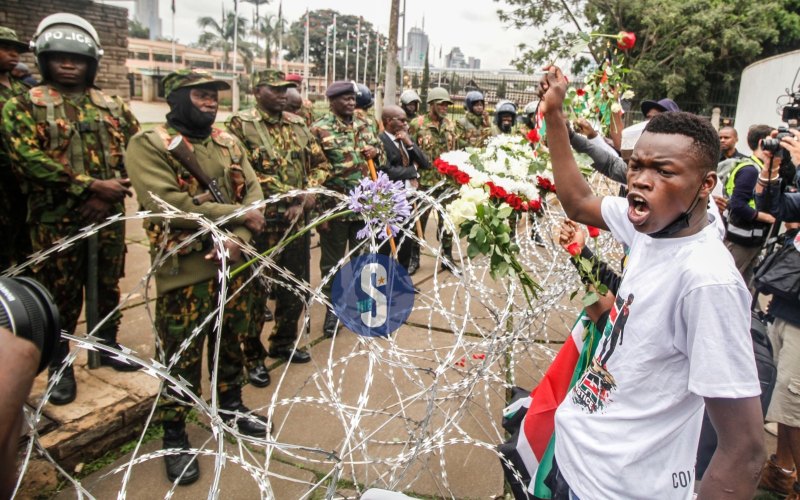
The extensive security operation also frustrated plans by opposition leaders, families of victims and activists to march to Parliament and lay wreaths in memory of those killed during last year's anti-government protests.
Blocked by police from accessing Parliament, they instead placed the wreaths on the razor wire surrounding the precincts.
Even then, Karua praised the scale of the security deployment.
"There's so much police presence, it is inconceivable that there can be any looting or any damage to property or any attack when there's so much police presence," she said.
Beyond the roadblocks, police also introduced a crowd-control tactic never before seen in Kenya.
Although tear gas remained part of the security response, officers relied heavily on Long Range Acoustic Devices (LRADs) mounted on armoured vehicles to disperse crowds while minimising confrontations.
The sound cannons emitted concentrated beams of sound reaching high decibels, allowing police to broadcast commands from a safe distance while physically disorienting protesters.
Whenever the deafening sirens were activated, many demonstrators hurried away while covering their ears with their hands.
The human threshold for pain is about 130 decibels, while LRADs can exceed 160 decibels, causing immediate ear pain.
The intense sound can trigger headaches, nausea and dizziness by disrupting the inner ear, forcing those exposed to move away from the source.
The government's approach nevertheless attracted criticism from civil society groups, which argued that some of the measures violated constitutional protections on the right to peaceful assembly.
Activist Shakira Wafula said the widespread roadblocks ignored existing court orders regulating police conduct during demonstrations.
"The government is setting a bad precedent when it comes to dealing with picketing and demonstrations. Last year, Justice Mugambi gave a conservatory order that the police are not allowed to put up roadblocks or barricades without any due notice, but then we woke up, and there were barricades," she said on Citizen TV.
"Again, the police came out with their faces covered. Again, there's an order from court that police should not have their faces covered when they come out to public. A lot of them were in civilian clothing."
Despite the criticism, the government maintained that its security plan had succeeded.
"Today is proof that when demonstrations are conducted in accordance with the provisions of the constitution, peace and security are guaranteed. We regret the inconvenience occasioned by these measures, but at the same time appreciate their effectiveness in securing the city and other parts of the country," Murkomen said.
Political analyst Mutahi Ngunyi offered a different perspective, arguing that the day's events underscored how difficult it would be to recreate the scale and momentum of the June 2024 protests.
"Today's Maandamano was a total waste of our national imagination. No Oomph! No energy. No people as promised. And no Gen Z. Lesson: you cannot repeat a political trick twice. June 2024 cannot be replayed ever. It was a moment in time. And it was justified. You cannot replay it."
While opinions remained sharply divided, Thursday's events suggested that the state's security strategy largely succeeded in preventing widespread unrest, albeit at the cost of disrupting normal life and reigniting debate over the balance between maintaining public order and protecting constitutional freedoms.

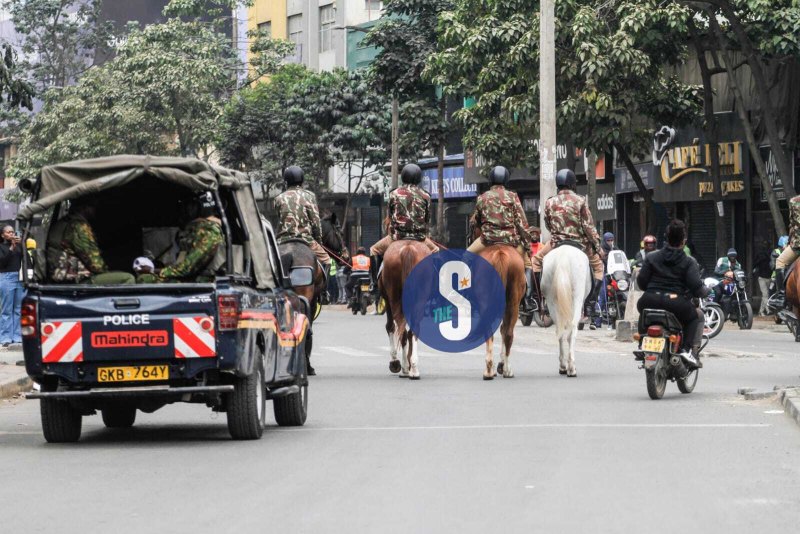 Anti-riot police patrol Moi Avenue in Nairobi during the Gen Z second anniversary commemorative protests, June 25, 2026. /ENOS TECHE