It was a dream come true for Jacinta Leorto. After years of making and selling beads in Wamba, Samburu East, the mother of four
and her colleagues were trained by Ushanga Kenya Initiative, a
government project with partners that supports pastoralist women.
In 2022, the group flew out to Dubai, where they spent two
weeks selling their products.
"That trip opened my eyes. Today, I sell my
products online," Leorto, 54, said.
"Through beadwork, I have been able to educate my
children. The last-born is in college. As a single mother, I meet all our needs
like food and clothing. I pay my SHA premiums and don't worry about
illness."
Leorto is a member of Ngishoni Beadwork Cooperative,
comprising 40 mothers. There are now 190 such groups supported by the
government. Ushanga Initiative has reached more than 200,000 women in 10 counties.
This financial year alone, at least 2,000 have been trained.
"Ushanga does not serve the already privileged. Its
beneficiaries are, by design and by necessity, the women most excluded from
Kenya’s formal economy. The initiative operates exclusively in the 10 counties
that form Kenya’s pastoral belt, communities where women have historically had
little control over productive assets, limited access to formal financial
services and few pathways to independent income," Ushanga Kenya Initiative
national coordinator Dorothy Mashipei said.
Ushanga’s focus
is skills and capacity building, combating middlemen exploitation, improving
market access locally, national and internationally, promoting digital
commerce and supporting intellectual property and brand protection.
“We are creating digital hubs to enable them sell globally.
If there is one thing President William Ruto is passionate about, it is Ushanga
as a tool for the empowerment of pastoralist women," Mashipei said.
The programme is one of the many initiatives by the government that are transforming the lives of women across Kenya.
“The Kenya Kwanza administration is firm on the empowerment
of women as a key driver of inclusive growth, as well articulated in the in
Bottom-up Economic Transformation Agenda (BETA),” Gender PS Anne Wang’ombe said.
This is through addressing persistent structural
inequalities facing women and girls such as poverty, unemployment, property
exclusion, low levels of representation in decision-making, gender-based
violence, FGM and difficulties in access to education.
Wang’ombe said many women have benefited from government
interventions in empowerment and protection.
“Through Access to Government Procurement Opportunities (Agpo),
for example, 30 per cent of government tenders are reserved for women. It is
unfortunate that some women win the tenders but lack the funds to deliver on
them,” the PS said.
To solve this problem, the government is working with banks
to facilitate women’s access to credit.
In agriculture and food security, the government is
supporting women to transition from subsistence production to commercial farming.
“In Kirinyaga county where I was the other day, coffee farmers enjoy better
prices for their crop,” she said.
Wang’ombe said the government has sponsored a Bill in
Parliament to enhance the protection and empowerment of widows, who often
suffer several forms discrimination, including in property rights.
In education, Kenya has achieved gender parity at nearly all
levels.
Although the two-thirds gender rule in elective and
appointive positions has not been achieved, the number of elected women
continues to increase every election, currently at 23 per cent in Parliament.
University of Nairobi sociologist Marygorety Otieno said low
representation of women in elective positions should be addressed through
implementation of the two-thirds gender principle.
“Compare Kenya to the small country of Rwanda, which has the
world’s highest women representation at 64 per cent,” she said.
In the Judiciary, headed by Chief Justice Martha Koome and
deputy CJ Philomena Mwilu, the representation on women is at 44 per cent. And for
the first time, Kenya’s Attorney General is a woman, Dorcas Oduor.
Other women in high positions of power include Controller
of Budget Margaret Nyakang’o and Auditor General Nancy Gathungu. In 2024,
President Ruto appointed Maj Gen Fatuma
Ahmed as the first woman commander of the Kenya Air Force
“In the Executive, this is the administration with the
highest number of women appointed as CSs, PSs, CEOs and chairpersons of
boards,” Wang’ombe said.
Away from high-profile jobs, the government’s economic
empowerment and inclusion programmes are transforming the lives of women and
girls across the country.
But sociologist Otieno said public awareness of funds meant
for women remains low.
“The funds are very important for women’s socioeconomic
empowerment but many women do not know about them. In Nairobi, where people are
better informed, the funds have worked very well,” she said.
“Since the Kenya Kwanza government came to power in 2022,
the National Government Affirmative Action Fund, under the Ministry of
Gender, Culture and Children Services, has supported 866,272 women through
provision of grants for socioeconomic empowerment totalling Sh2.45 billion. Registered
women’s groups are supported with grants for table banking and value addition
initiatives,” NGAAF acting chief executive officer Grace Wasike said.
In the financial year 2022-2023, NGAAF supported 147,088
women in 2,325 registered groups with Sh427 million in grants.
Further, the fund gave 47,158 vulnerable students bursaries
and scholarships for totalling Sh362 million.
In the financial year 2023-2024, the fund supported 196,804
women in 3,117 registered groups to the tune of Sh579 million. A total of
50,342 vulnerable students received bursaries and scholarships worth Sh496
million.
In 2024-2025, NGAAF gave Sh619 million to 221,270 women in
3,483 registered groups. A total of 59,654 vulnerable students received
bursaries and scholarships worth Sh497 million.
NGAAF supported 297,279 women in 5,058 registered groups
with Sh828 million grants in the 2025-2026 financial year.
Further, 61,976 vulnerable students got bursaries and scholarships totalling
Sh681 million.
“Bursaries from the Department of Gender and the county
government have kept my children in school. I used to fear my daughter, Rehema,
would drop out because I was unable to raise fees. Today, she is pursuing her
secondary education uninterrupted,” said Guracha Jebaano, a parent in Tana
River.
“The support towards women and vulnerable students has
gradually been increasing owing to the fact that the fund has over the years
received increased funding from the government. This is one of the Kenya Kwanza
government’s initiatives of ensuring improved livelihoods of the affirmative
action groups,” Wasike said.
NGAAF has also supported the distribution of three million
sanitary pads to vulnerable students at a cost of Sh1.8 billion.
The Women’s Enterprise Fund had as at June disbursed Sh28.79
billion to 2.3 million women in 160,000 groups.
“In line with the President’s vision for women’s economic
empowerment, the Women Enterprise Fund is breaking barriers to financial
inclusion and unlocking opportunities for millions of Kenyan women,” CEO
Rachael Musyoki said.
“Through access to
credit, capacity building, and market linkages, we are transforming women from
participants in the economy into drivers of national prosperity.”
Other state programmes like Nyota fund, Kazi Majuu and affordable
housing are designed to include women at 50 per cent of the available
opportunities.
Celestina Wairimu, from Hindi in Lamu, is a happy beneficiary of government’s social protection initiatives specifically target vulnerable women.
“With financial support from Inua Jamii, I no longer rely on
neighbours for food and medicine. Every two months, I receive the money in my
phone to buy food and medication for high blood pressure,” she said.
The campaign against female genital mutilation spearheaded
by the National Anti-FGM Board remains on course. The success stories include
the decline of the practice from 38 per cent in 1998 to 15 per cent for persons
aged 15 to 45 years by 2022.
The national decline of FGM among the younger generation was
nine by 2022 for ages 15 to 19 years. Samburu, Masaai, Pokot and Sabaot elders have vowed to end
FGM in their communities.
Anti-FGM Board programme officer Nyerere Kutwa said the
launch of county and subcounty anti-FGM steering committees has enhanced coordination
of interventions.
County youth anti-FGM networks have been launched, as well
as national and county survivors’ forums. Anti-FGM content has been included in
the school curriculum up to Grade 3.
“The national budget
is too meagre to cover all the 22 FGM hotspot counties, where the board
implements Anti-FGM interventions. The board has resorted to enhance its
resource mobilisation strategies from partners, which is still inadequate,”
Kutwa said.


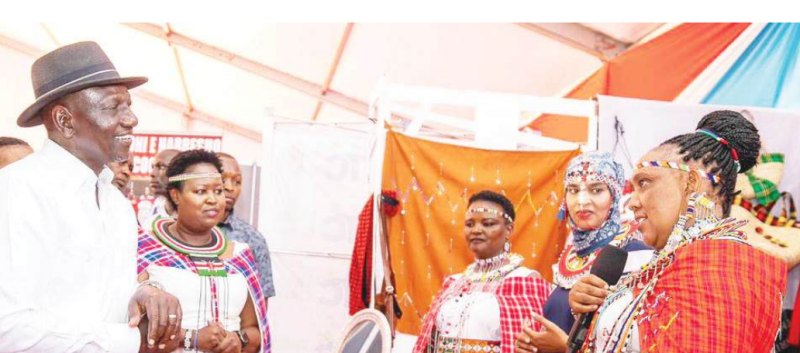
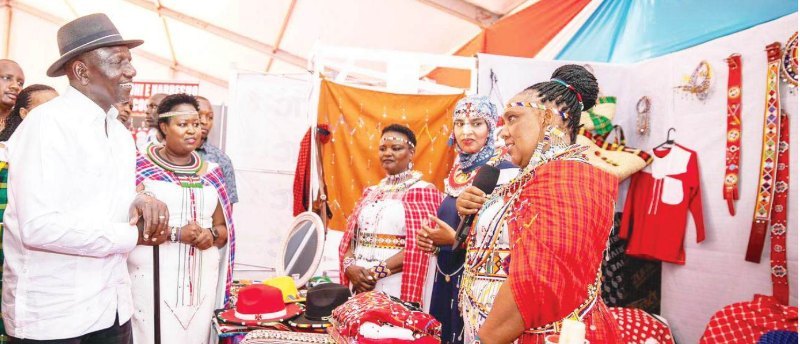 President William Ruto and Ushanga Kenya Initiative national coordinator Dorothy Mashipei interact with women displaying their beadworks during the Maa Cultural Festival in Kajiado /HANDOUT