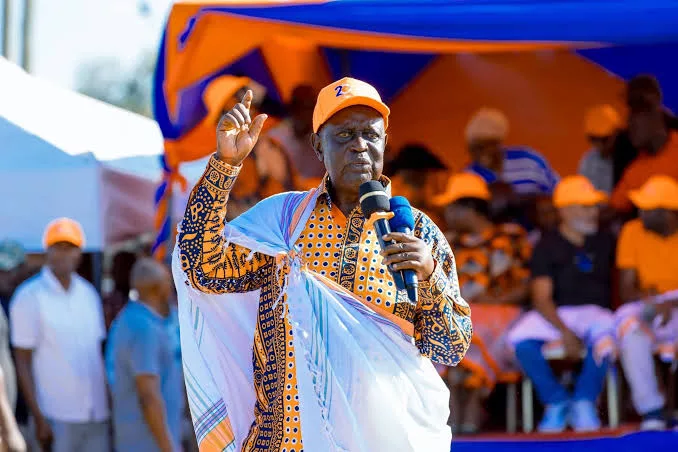


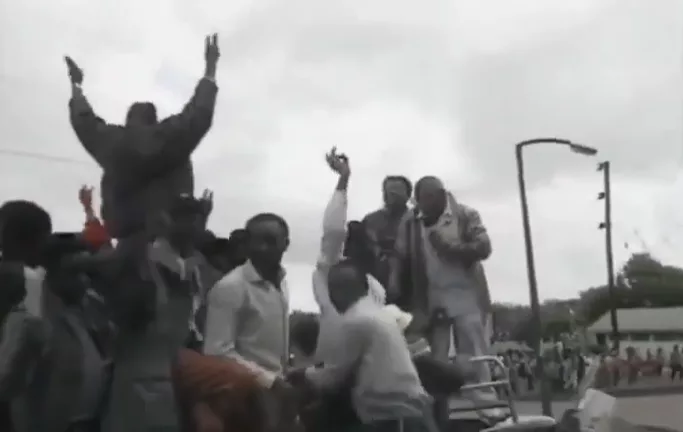
 James Orengo and Martin Shikuku at the forefront of the first Saba Saba protests at the Kamukunji Grounds on July 7, 1990. /SCREENGRAB
July 7 has become one of the most symbolic dates in Kenya's political history, marking a journey that has transformed Saba Saba from a struggle for multi-party democracy into a broader movement championing accountability, economic justice and human rights.
While the first Saba Saba protests in 1990 sought to dismantle one-party rule under President Daniel Moi, this year's demonstrations are being organised by a new generation of activists pursuing a different set of demands in a vastly different political environment.
Although the annual commemoration continues to revolve around citizens' right to protest and demand reforms, the faces leading the movement, the issues driving it, the methods of mobilisation and even the state's response have all evolved over the past 36 years.
The original Saba Saba movement was born on July 7, 1990 after the government banned a planned pro-democracy rally at Nairobi's Kamukunji Grounds and arrested opposition leaders Kenneth Matiba and Charles Rubia.
At the time, Kenya was a one-party state governed by the Kenya African National Union (KANU), with growing public frustration over political repression, corruption, economic hardship and the lack of democratic space.
Despite the arrests and the heavy deployment of security forces, thousands of Kenyans defied the ban and took to the streets demanding free elections and political pluralism.
Police responded with tear gas, batons and live ammunition, leaving several people dead, hundreds injured and more than 1,000 protesters arrested.
Although the demonstrations were violently suppressed, they fundamentally altered Kenya's political trajectory.
Mounting pressure from pro-democracy activists eventually compelled the government to repeal Section 2A of the constitution in 1991, restoring multi-party politics and paving the way for wider constitutional reforms over the following two decades.
Tuesday's Saba Saba protests are no longer centred on securing democratic space, but on what many activists describe as unfinished governance reforms.
Organisers are demanding an end to extrajudicial killings, enforced disappearances and police brutality while also pushing for greater economic justice, responsible public spending, transparency and accountability in government.
Perhaps the most striking difference is the people leading the movement. Whereas the original protests were spearheaded by veteran opposition politicians and pro-democracy figures such as Matiba and Rubia, this year's demonstrations are largely being organised by young Kenyans, many of them associated with the Gen Z movement that emerged during the anti-finance bill protests.
Human rights organisations and grassroots civic movements now play a far more prominent role than traditional political parties.
That shift is also reflected in this year's political landscape. Unlike previous Saba Saba commemorations, when the opposition Orange Democratic Movement (ODM) was often at the forefront of mobilisation, the party's Nairobi leadership has distanced itself from Tuesday's demonstrations.
Instead, the Grassroots Economic Justice Movement (GEJM), also known as Mtetezi, has taken the lead in organising the march.
The movement's national convenor, Francis Awino, led the lobby group in formally notifying the National Police Service of the planned procession, saying between 1,000 and 3,000 participants are expected to march from Jeevanjee Gardens to Parliament Buildings to present petitions calling for an end to extrajudicial killings, enforced disappearances and police brutality.
The decision to notify police underscores another significant shift from the early 1990s.
During the original Saba Saba protests, organisers did not seek police authorisation because the one-party government had outlawed the gathering altogether.
However, Nairobi Regional Police Commander Issa Mohamud has said no one has formally notified the police of any planned protests in the capital on Tuesday, July 7, warning that any gathering held without the required notification will be treated as illegal.
Speaking after a meeting with top police commanders in Nairobi, Mohamud assured residents that security remains under control and urged the public to go about their normal activities.
“Tomorrow is a normal working day, and public transport will not be affected, although there will be screening of vehicles entering the city. Of course, we must conduct screening,” he said.
He added that there was no cause for alarm, saying, “There will be no problem at all. The day will be a normal working day.”
Tuesday's demonstrations, by contrast, are organised within the framework of constitutional rights guaranteeing peaceful assembly, even though disputes often arise over how those rights should be exercised.
The methods of mobilisation have also changed dramatically. In 1990, organisers relied on clandestine meetings, printed leaflets and word-of-mouth communication to evade state surveillance.
This year's mobilisation has largely unfolded online, with activists using social media platforms to coordinate activities, raise funds, share information in real time and amplify their message to both local and international audiences.
The venues associated with Saba Saba have similarly evolved. While the original movement revolved around Kamukunji Grounds, now regarded as a historic symbol of Kenya's struggle for democracy, contemporary commemorations typically begin at Jeevanjee Gardens before protesters march to Parliament to deliver petitions.
The emphasis has shifted from holding political rallies to engaging state institutions through organised demonstrations and formal peaceful demands for policy action.
Even as constitutional protections have expanded since the return of multi-party politics and the promulgation of the 2010 constitution, activists argue that the state's response to protests continues to evolve rather than disappear.
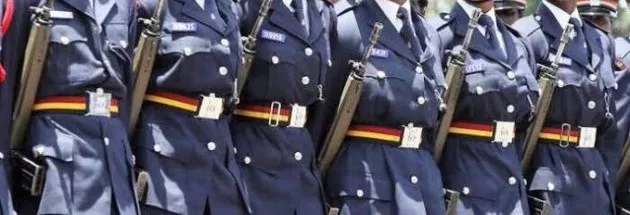
While the KANU era was characterised by outright bans, detention without trial and violent dispersal of demonstrators, recent protests have increasingly featured extensive road closures, heightened digital surveillance, large deployments of anti-riot police and allegations of excessive use of force.
This year's commemorations have also generated debate over public participation. Although the government has not declared July 7 a public holiday, activists have urged Kenyans to treat it as one.
"On Saba Saba, let me take this opportunity to declare that the 7th of July 2026 will be a public holiday. I have said it; we have said it. Kila mtu akae nyumbani na kama unatoka, utoke ukuje kwa street," activist Muteti Mulinge said during a television interview.
"Tuende kupeleka petition ya kusema extrajudicial killings must end and abductions and enforced disappearances must end. We must be clear that the struggle is not over."
At the same time, ODM's Nairobi leadership has maintained that the party will not participate in the demonstrations.
"We have said children should go to school, and there is a leader who has said people should participate in the protests and when the day comes he runs away. We have no problem with Saba Saba activities and we have no issue with those planning the protests. We appeal to the police to provide security," the party said.
Thirty-six years after citizens first took to the streets demanding an end to one-party rule, Saba Saba, Swahili for Seven Seven, remains a barometer of Kenya's democratic journey.
The struggle has shifted from winning political pluralism to demanding accountable governance, economic justice and respect for fundamental rights.
Although the personalities, tactics and priorities have changed, the annual protests continue to reflect a belief shared across generations that sustained public pressure remains one of the country's most powerful drivers of reform.