What the new Central Bank law means for banks, savers and the economy
Ruto assented to the Central Bank (Amendment) Bill on Monday
by EMMANUEL WANJALA
Audio By Vocalize
President William Ruto assenting to the Central Bank of Kenya (Amendment) Bill, 2026, at State House, Nairobi, July 6, 2026. /PCS
President William Ruto on Monday signed the Central Bank of Kenya (Amendment) Bill, 2026 into law, introducing sweeping reforms aimed at strengthening the country's financial stability framework, tightening the conditions under which struggling lenders can receive emergency support, and expanding the Central Bank of Kenya's mandate over precious metals.
The legislation, assented to at State House, Nairobi, separates the Central Bank of Kenya's routine monetary policy operations from its emergency liquidity assistance function.
The distinction is intended to ensure that temporary liquidity support does not become a substitute for rescuing financially weak institutions while enhancing the regulator's ability to respond to genuine financial system shocks.
Under the new law, the CBK may, for purposes of implementing monetary policy and maintaining orderly market conditions, grant loans or advances to banks and microfinance institutions on terms it determines from time to time.
However, under the amendment, Emergency Liquidity Assistance (ELA) can only be extended to banks that meet strict eligibility requirements.
To qualify, a bank or microfinance institution must be solvent and viable, must not be under liquidation and must, upon assessment by the CBK, be considered systemically important and likely to pose a risk to the stability of the financial system if it fails.
The amendment is designed to safeguard the liquidity, solvency and proper functioning of Kenya's financial system while reinforcing effective regulation of the banking sector to preserve market integrity and stability.
One of the most significant changes is the extension of the period during which the CBK may provide emergency financial assistance to distressed banks and microfinance institutions.
Previously capped at six months, the support window has now been doubled to a maximum of 12 months.
The longer support period gives eligible institutions more time to recover from temporary liquidity pressures, reducing the likelihood of disorderly failures that could spread through the wider financial system.
For ordinary Kenyans, the change could offer an added layer of protection, particularly for customers of microfinance institutions that provide credit to individuals and small businesses unable to meet the lending requirements of commercial banks.
Microfinance institutions play a critical role in financing small-scale traders, farmers and informal businesses.
Their collapse can cut off access to credit, disrupt livelihoods and force borrowers to dispose of productive assets to stay afloat.
The law also underscores that emergency support will not be unconditional.
"The bank may extend the period under such terms as the bank may specify. All loans or advances granted shall be secured by collateral acceptable to the bank and subject to valuation, margin and risk management requirements determined by the bank," the Act states.
The amendment further empowers the CBK to grant loans or advances to the Kenya Deposit Insurance Corporation (KDIC), secured by Treasury Bills or other government securities approved by the Bank, for a fixed period not exceeding three years.
The provision is expected to strengthen KDIC's capacity to respond when financial institutions fail, enhancing protection for depositors and supporting orderly resolution processes.
Beyond banking regulation, the new law significantly expands the CBK's role in managing precious metals.
Previously, the law allowed the CBK to buy, sell, import, export, hold or otherwise deal in gold and foreign exchange.
The amended legislation broadens those powers to include silver, platinum and other precious metals, while also authorising the Bank to refine and transfer them.
"The bank shall buy, sell, export, import, transfer, hold, refine, or otherwise deal in gold, gold coins and bullion, silver, platinum, any other precious metal or foreign exchange under such terms and conditions as it shall determine," the Act states.
The expanded mandate aligns the CBK with evolving global central banking practices, where precious metals increasingly form part of reserve management strategies and support broader financial resilience.
The Central Bank of Kenya (Amendment) Bill, 2026, was introduced in the National Assembly on May 26 alongside the Finance Bill, 2026, before being considered and subsequently passed by Parliament ahead of presidential assent.
To enhance governance, the new law now requires the nominees for CBK's Deputy Governor positions to be vetted and approved by the National Assembly before appointment.
The provision aligns their process with that of the Governor and reinforces parliamentary oversight of senior leadership at the monetary authority.
This is premium content
Subscribe to Continue Reading
Help us continue bringing you unbiased news, in-depth investigations, and diverse perspectives. Your subscription keeps our mission alive and empowers us to provide high-quality, trustworthy journalism. Join us today to make a difference!




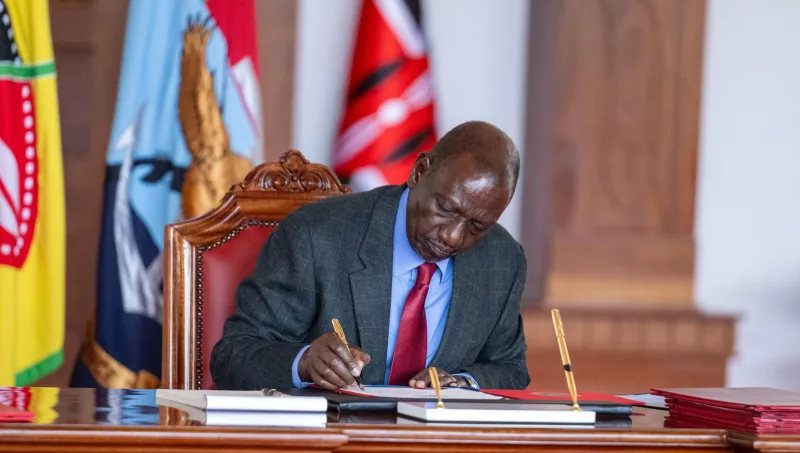 President William Ruto assenting to the Central Bank of Kenya (Amendment) Bill, 2026, at State House, Nairobi, July 6, 2026. /PCS