Foreign Affairs on the spot as PS grilled over recurring audit failures
PS says issues raised are being addressed and are at different stages of implementation
by ELIUD KIBII
Audio By Vocalize
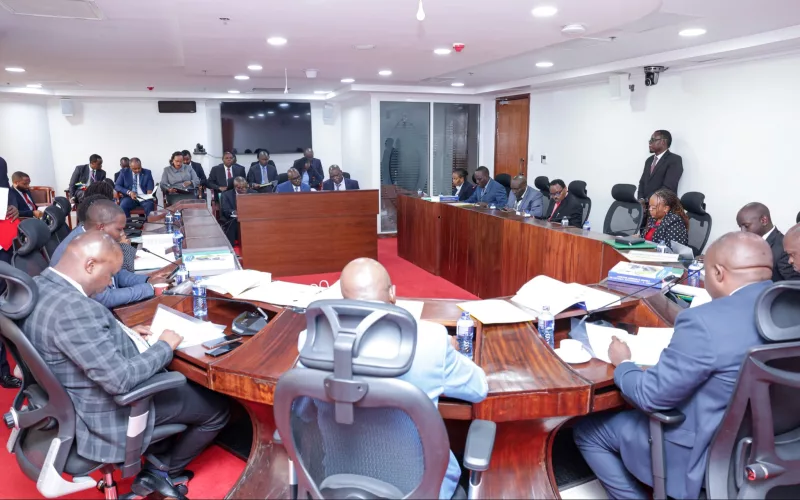
Foreign Affairs PS Korir Sing'oei before the National Assembly's Public Accounts Committee on July 7, 2026
The Department of Foreign Affairs is under scrutiny from the National Assembly's Public Accounts
Committee over recurring financial management failures flagged by the Auditor
General.
The Auditor-General report shows that nearly half of the
audit issues raised against the department remained
unresolved, despite repeated assurances that corrective measures had been
undertaken.
The report for the 2023-24 financial year
raised issues with long-standing weaknesses in financial management,
procurement, asset management and governance.
Principal Secretary for Foreign Affairs Korir Sing'oei appeared before the House team on Tuesday to answer to the queries.
Of the 24 audit
issues raised by the Auditor-General, only 10 have been fully addressed, according to a PAC briefing, while
11 remain unresolved and three have been only partially addressed. This, the
committee noted, indicated many of the concerns raised in previous audits
continue to recur.
The department was found to have persistently failed to
strengthen financial controls, with lawmakers querying why it had not done enough to implement recommendations from previous audits and was
struggling with basic accountability issues.
Among the most significant concerns is the continued
existence of unreconciled bank balances and accounting discrepancies across
Kenya's diplomatic missions, with some reconciling items dating back to 1994.
The Auditor-General noted that bank reconciliation
statements contained long-outstanding items worth billions of shillings that
had remained unresolved for years.
At the same time, financial statements differed from
supporting schedules, raising concerns over the accuracy of the department's
accounts.
Although the department said it had established a
task force to clear historical balances and had undertaken reconciliations,
auditors concluded that many of the issues had only been partially addressed.
“I have looked at the missions involved. They are not new. There
are missions of long bilateral relationship. Why should it a problem for a mission like Washington that
has been there for ages to have a system of accountability for all this years,”
MP Nabii Nabwera (Lugari) queried.
The report also raises concerns over the department's
financial position after it accumulated pending bills amounting to Sh2.93
billion by the end of the financial year.
The debts are attributed to delayed exchequer
releases. Sing'oei said the expenditure had already been
processed through the Integrated Financial Management Information System before
the close of the financial year but funding was not received in time.
He said it has since settled more than Sh2.55
billion of the outstanding bills, leaving a balance of about Sh380 million.
However, the Auditor-General maintained that the issue remains unresolved
because the liabilities had been carried forward into subsequent financial
years.
The funding challenge featured prominently throughout the
audit.
The department reported receiving Sh20.28 billion
against a revised budget of Sh23.19 billion during the financial year, leaving
a funding gap of approximately Sh2.91 billion.
It argued that the shortfall
disrupted planned programmes, delayed payments to Kenya's missions abroad and
contributed to the accumulation of pending bills.
It also blamed inadequate budgetary allocations for the
deterioration of diplomatic properties abroad, delayed renovation projects and
the inability to cushion missions from foreign exchange losses amounting to
Sh854.5 million.
While acknowledging the funding constraints, the
Auditor-General continued to flag weaknesses in financial controls that fell
within the department's management responsibilities.
The audit cites procurement deficiencies across several
missions abroad, including the absence of registered supplier lists, lack of
standardised procurement documents and failure to comply with procurement
requirements.
The department said a task force had been established
to develop procurement guidelines tailored for Kenyan missions operating under
different legal and regulatory environments, although the initiative remains
incomplete.
Lawmakers are also examined the state of Kenya's diplomatic
assets after the audit highlighted deteriorating embassy buildings, stalled
renovation works and weak asset management in missions including Abuja, Berlin,
Dar es Salaam and Paris.
In Berlin, auditors found Kenya House, the ambassador's
residence, in a state of disrepair, while in Dar es Salaam, renovation of staff
houses had stalled and government land earmarked for future development
remained unfenced.
Similar maintenance backlogs were reported in Paris and
Abuja, with the department attributing most of the delays to inadequate
development funding.
It told auditors that several projects have since
received budgetary allocations under the 2025/26 financial year and are at various
stages of implementation.
The hearing also examined governance concerns, including
delays in presenting ambassadors' credentials in some host countries and
weaknesses in oversight systems.
Although the department has since established
a ministerial audit committee, the Auditor-General noted that several
governance reforms remain incomplete.
This is premium content
Subscribe to Continue Reading
Help us continue bringing you unbiased news, in-depth investigations, and diverse perspectives. Your subscription keeps our mission alive and empowers us to provide high-quality, trustworthy journalism. Join us today to make a difference!