Conservationists raise alarm over forest destruction
Warn that state’s 15 billion-tree campaign will remain pipe dream
by GILBERT KOECH
Audio By Vocalize
Green Belt Movement’s advocacy manager Job Mwangi during a press briefing at Karura Forest July 9/Gilbert Koech.
Ngong Road Forest is facing a serious threat of extinction with almost two-thirds of its land area gone, conservation organisations have warned.
The forest that was gazetted in 1932 initially covered an area of 7966 acres. That area has now reduced to 3026 acres.
“Two third of the forest is gone,” Ngong Road Community Forest Association chairman Simon Kage said
He said the forest has been eaten up by roads,
settlements schemes, jockey club, police stations, churches and
schools, most of which were put up over the last 10 years. Another 138 acres has been lost to the Talanta Stadium, Kage said.
He said another 138 acres near Telkom has since
been sealed off by concrete wall and cannot be assessed either by Kenya Forest
Service and the community forest association.
“There was an advert calling for a five-star
hotel within the same section but the tender was subdued,” Kage said.
A luxury tented camp is said to have hived off another 12 acres while some 22 acres has been taken up by the
Riruta-Ngong town meter gauge railway line. Some 10 acres will be lost to the proposed road linking
Talanta Stadium and Bomas International Conference Centre with five more acres reserved for a road construction camp inside the forest.
Kage said the ongoing projects have
led to the fragmentation of forest and green spaces within the city.
Kage is among nature
lovers who have told the government to forget
about the 15 billion tree growing campaign if the ongoing destruction of protected areas is not halted.
Other groups that have criticised the encroachment include Friends of Nairobi's Forests and Green Spaces,
The Green Belt Movement, Friends of Oloolua Forest, Oloolua Forest Association,
Friends of Karura Forest, Friends of City Park, Friends of Nairobi Arboretum,
Friends of Nairobi National Park, Thogoto Community Forest Association and
JustAct.
“Kenya’s forests are facing an unprecedented wave of destruction. While
the government continues to champion the ambitious target of growing 15 billion
trees by 2032, the forest that already exist are being carved up for
infrastructure, commercial developments and other projects,” Green Belt
Movement’s advocacy manager Job Mwangi said.
Mwangi said the contradiction cannot
be ignored.
“You cannot claim to restore forests
while simultaneously destroying mature ecosystems that have taken decades and
in some cases centuries to develop,” he said.
He said mature indigenous trees that have supported
wildlife, stored carbon, regulated temperatures, protected rivers, replenished
underground water, prevented floods, improved air quality and sustained
livelihoods are being destroyed.
The organisations raised issues
with Nairobi National Park, Imenti Forest, Uhuru Park, among other protected
spaces that are being excised for development despite public uproar.
Mwangi said the ongoing destruction
goes against numerous global environmental obligations that Kenya is a party to
such as Paris Agreement, the Convention on Biological Diversity, the African
Landscape Restoration Initiative and the Bonn Challenge.
“The country has also committed to
increasing national tree cover to at least 30 per cent and planting 15 billion
trees. How genuine are these commitments if public forests, national parks and
public green spaces continue to be sacrificed for development projects?”
Kenya's forests and protected areas
occupy a fraction of the country's land area but continue to face pressure from
infrastructure, illegal logging, charcoal production, settlement and land
conversion.
Scientific evidence consistently
demonstrates that mature forests provide ecosystem services that newly planted
trees cannot immediately replace.
Globally, forests absorb billions of
tonnes of carbon dioxide annually, regulate rainfall patterns and support more
than 80 per cent of terrestrial biodiversity.
Kenya's forests safeguard major water
towers that feed rivers supplying millions of citizens with water for domestic
use, agriculture, hydropower generation and industry.
Mwangi said the ongoing destruction
especially in Nairobi are disturbing.
“Nairobi itself continues to
experience rising temperatures, worsening air pollution and increased flooding
associated with the steady loss of urban green spaces. Every acre of
indigenous forest lost makes our cities hotter, our rivers weaker and our climate
more unpredictable.”
Prof Karanja Njoroge from Friends of
Karura said they were deeply concerned by the growing pattern of blatant
disregard for court orders and the rule of law in matters affecting public forests.
“In several instances, including Ngong
Road Forest and Upper Imenti Forest, construction activities, land clearing and
other forms of development have reportedly continued despite orders of the High
Court suspending such activities,” he said.
Njoroge said the continued defiance
undermines the authority of the Judiciary, erodes public confidence in the
administration of justice, and violates the Constitution of Kenya, which
upholds the rule of law as a national value and principle of governance.
“We therefore demand that all
government agencies, public institutions, private developers and contractors
immediately comply with all court orders, cease any activities that contravene
judicial directives and uphold their constitutional obligation to protect
public forests. Respect for the rule of law is not optional, it is the
foundation upon which constitutional governance, environmental justice and the
protection of Kenya's natural heritage depend,” he said.
The organisations also heaped the
blame on the key agencies saying they have failed Kenyans.
Friends of City Park board secretary
Cynthia Wambaa lashed out at authorities for failing to act.
"We are deeply disturbed by the
apparent failure of the Ministry of Environment, Climate Change and Forestry,
the Ministry of Tourism and Wildlife, the Kenya Forest Service (KFS), the Kenya
Wildlife Service (KWS) and the National Environment Management Authority (NEMA)
to discharge their constitutional and statutory responsibility to protect
Kenya's forests, protected areas, and public green spaces."
Wambaa said the institutions exist to
safeguard our environment, not to preside over their gradual destruction.
“As these areas continue to face
encroachment, excisions and developments, Kenyans are left asking whether those
entrusted with protecting our natural heritage have chosen silence over
stewardship.”
Wambaa said both KFS and KWS are
silent as country’s natural resources are being decimated.
“Where is the leadership when mature
indigenous forests and national parks are being converted into construction
sites. Where is the environmental oversight when developments proceed in areas
that millions of Kenyans depend on for clean air, water security and
biodiversity?”
Wambaa said silence in the face of
environmental degradation is not neutrality but amounts to a failure of public
trust.
“The Ministry of Environment, KFS, KWS
and NEMA must urgently demonstrate to Kenyans that they remain committed to
protecting forests and national parks rather than facilitating or acquiescing
to their destruction. Every decision that compromises a public forest weakens
Kenya's credibility on climate action and undermines the sacrifices made by
communities and conservationists who continue to defend these ecosystems.”
The organisations cited Ngong road as
one of the resources under attack as a result of the ongoing projects.
They urged law makers to strengthen
legal safeguards against the fragmentation of forests, protected areas, and
other public green spaces.
This is premium content
Subscribe to Continue Reading
Help us continue bringing you unbiased news, in-depth investigations, and diverse perspectives. Your subscription keeps our mission alive and empowers us to provide high-quality, trustworthy journalism. Join us today to make a difference!

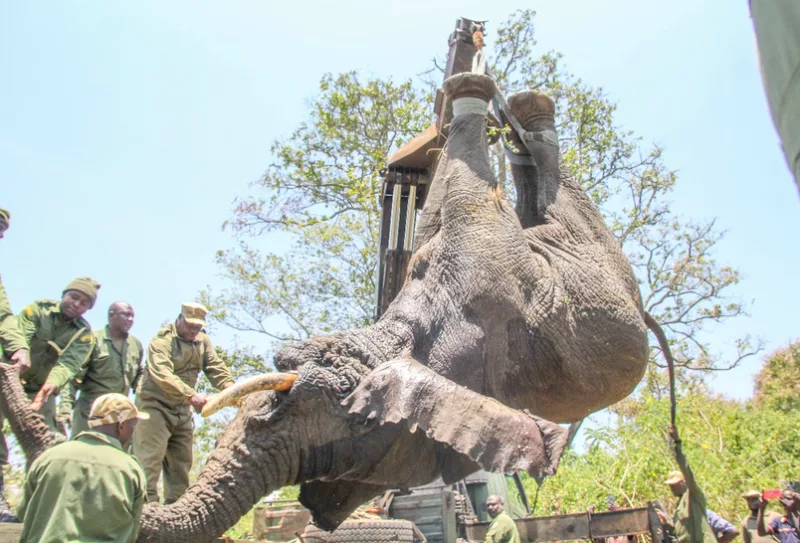
 Green Belt Movement’s advocacy manager Job Mwangi during a press briefing at Karura Forest July 9/Gilbert Koech.


![[PHOTOS] Kindiki launches Kaptagat Forest fencing drive](https://cdn.radioafrica.digital/image/2026/07/b316c56e-8b24-4c46-bf7c-731d7cb41409.webp)