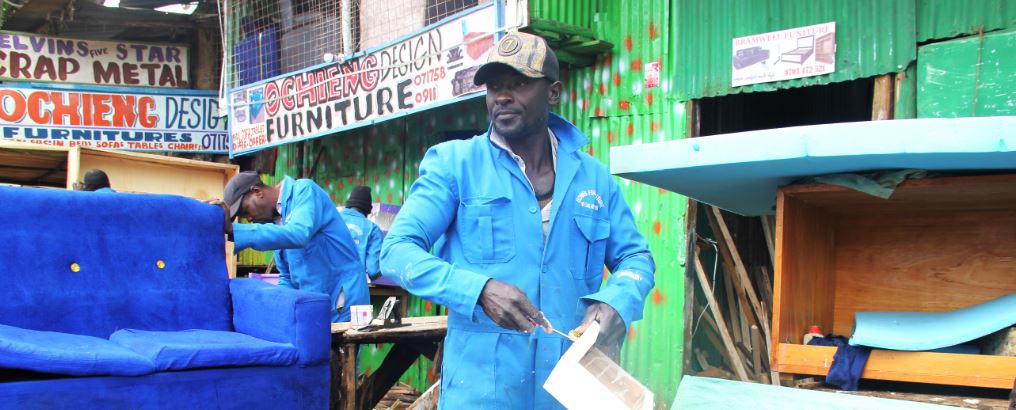




In the workshop outside Nairobi, wood cuttings are piled neatly along the walls and wood sanding operations are creating dust motes that hang in the air. At one end, a woman stands over a piece of wood using a blowtorch to give the wooden piece she's working on an even, beautiful finish.
This workshop, situated in Ruiru between Nairobi and the industrial town of Thika, is where Mercy Munyi, known in the trade as Shawry for Wood, is making her mark.
Carpentry was not something that Munyi, now 26, ever considered as a career. Having graduated from secondary school in 2016, Munyi enrolled at Chuka University in 2017, where she studied for a diploma in criminology and social studies. A jobs crisis among youth in Kenya and a hustle mentality, however, led her life in an unusual direction.
“You know how life is out here after school? Without connections, you will really struggle. But I did not look for a job.”
Instead of waiting for employment, Munyi turned to small trade. From her home in Embakasi, in the southeastern quarter of Nairobi, she began selling curved wooden chairs like those she had seen sold in Sagana, an industrial and adventure-tourism town in Kirinyaga. She moved between informal markets and small customer networks, selling chairs and other wooden objects to make a living.
In 2022, she made a choice that shaped her future as an artisan, by relocating from her home in Embakasi.
“I used to commute from my home to Bypass, where I had a small shop selling wooden chairs,” she recalls. “On my commutes, I would always pass this carpentry shop that had very good items on display. So I decided to approach the owner.”
This led her to Decent Skills, a training facility where she soon enrolled in a carpentry course. When she arrived at Decent Skills, she noticed that men made up almost all the employees, and she found herself the sole female worker.
“When I joined, I was the first and only girl in that workshop,” she says. “For almost two years, it was all men.”
Munyi, however, had spotted an opportunity and was not about to let it pass her by. Woodworking is a core component of Africa’s domestic furniture industry, which continues to expand across the continent.
The Kenyan furniture and interiors industry is estimated to be worth about $1.2 billion (Sh155 billion), according to a 2025 study by Ken Research that analysed the industry’s performance over the last five years. Growth in the industry has been attributed to high rates of urbanisation, disposable incomes and the emergence of a middle-class population. Both the residential and commercial markets have recorded a dramatic increase in demand.
WOMEN’S IMPACT
Jomflow Furniture owner Joseph Muriuki says the industry has also seen a growing number of women entering the woodworking field in recent years.
“Women contribute notably to the industry, especially in the finishing stages, such as sanding and painting, in which attention to detail is important,” he says.
“They are also very good at sales and marketing, helping businesses reach more customers. We have seen a great uptake of women in woodworking in recent years. With the introduction of modern machines, we have been able to train them not only in manual woodwork but also in operating these machines, which has been great for the industry.”
He believes the combination of technical training and modern equipment is helping to make the trade more accessible to women while increasing opportunities within the sector.
It was at Decent skills that Munyi met Duncan Sande, well known as Dante, the owner of the workshop, who became a key role in her early development. She describes him as kind and supportive, giving her room not only to work but also to develop and progress inside the craft.
“I approached Dante, and he was very friendly and kind,” she says. "I used to spend most of my time in the workshop. He later allowed me to display my chairs, which enabled me to keep earning money."
Over time, the workshop became more than just a place of work. It became a training ground.
As Munyi slowly shifted from selling furniture to making it, she gained knowledge of the technical aspects of carpentry, including how to cut, assemble and finish, as well as the nature of wood.
She was also able to access further training, enrolling in the programme offered by Kenya's Panesar Training Institute.
“In 2025, I joined Panesar for three months on a fully sponsored programme and later continued for another three months, which I paid for myself,” Munyi says.
“Through both sessions, I gained the practical skills I needed to work in the carpentry industry fully.”
GENDER BARRIER
Across Kenya’s informal skills sector, most youth, particularly women, pursue skills training through apprenticeship. More youth have been enrolling in training in the Technical and Vocational Education and Training sector in recent years.
Still, women remain underrepresented in the construction sector.
For Munyi, being a woman in the field has been both an advantage and a challenge.
“Most clients come and say, I want you to make me a bed,” she says. “Sometimes this simply works for me because I’m a woman.”
At the same time, she says trust persists as a barrier in the industry. Many clients and suppliers still question women’s technical capacity in woodworking.
“People don’t trust easily,” she says. “They feel like women can’t do it. I would send out quotations to clients who promise to get back to me but many never do, simply because I am a woman.”
Still, she has learned to treat these barriers as part of the business environment rather than as personal setbacks. Inside the workshop, however, her work speaks for itself. She is especially drawn to the finishing stage of production.
“I love the finishing part because that’s where the piece finally comes to life,” she says. "When I’m sanding and varnishing, I’m not just smoothing wood, I’m forming how it will look and feel when someone uses it.
Her description of carpentry moves away from the perception of it as purely manual labour. For her, it is a form of construction that requires accuracy and imagination.
“Carpentry is art,” she says. “You are turning wood into things.”
Since working with Munyi, Samuel Mwania, the delivery man at Decent Skills, says he has delivered numerous pieces of furniture she has made, from pallets to beds most of them for repeat and referral clients.
“I would highly recommend her work. She does a great job, and other women should join the industry,” he says. “Her passion is clear; it’s not just for men. As long as you have the knowledge like Mercy, you can do it. I have never had a customer complain about her work.”
Her work has already begun to circulate beyond the workshop. One of her most memorable projects, she says, was a commission for a student working on an interior design school project. The outcome, she believes, was successful; an early indicator of her growing reputation for quality finishing and reliability.
Munyi’s path reflects broader developments within Kenya’s furniture industry. According to the Trade and Industry ministry, the furniture and timber sector employs about 160,000 people and remains an important source of jobs and economic growth. However, restricted technical skills continue to constrain the industry’s potential.
Today, Shawry for Wood is more than a nickname. It is a brand built through social media, referrals and workshop visibility. Her digital presence has become an unexpected but important business tool, helping her attract clients outside her immediate location.
Going forward, Munyi is thinking bigger than individual commissions. She continues to work with Decent Skills, but her goals stretch beyond the workshop floor.
“I want to own showrooms all around Kenya. In Nakuru, Kisumu, Embu and the coast; I want to travel,” she says. “Not just Nairobi.”
Her view of carpentry takes it out of the realm of being simply physical labour. For her, it is about construction through precision and imagination. For now, her day will be spent working in the workshop, sanding, assembling and finishing, thus transforming her raw wood into precise pieces.
In all her completed projects, there is a reflection of how far she has come since her time as one who sells chairs in the informal market and now shaping her own niche in the carpentry business.