

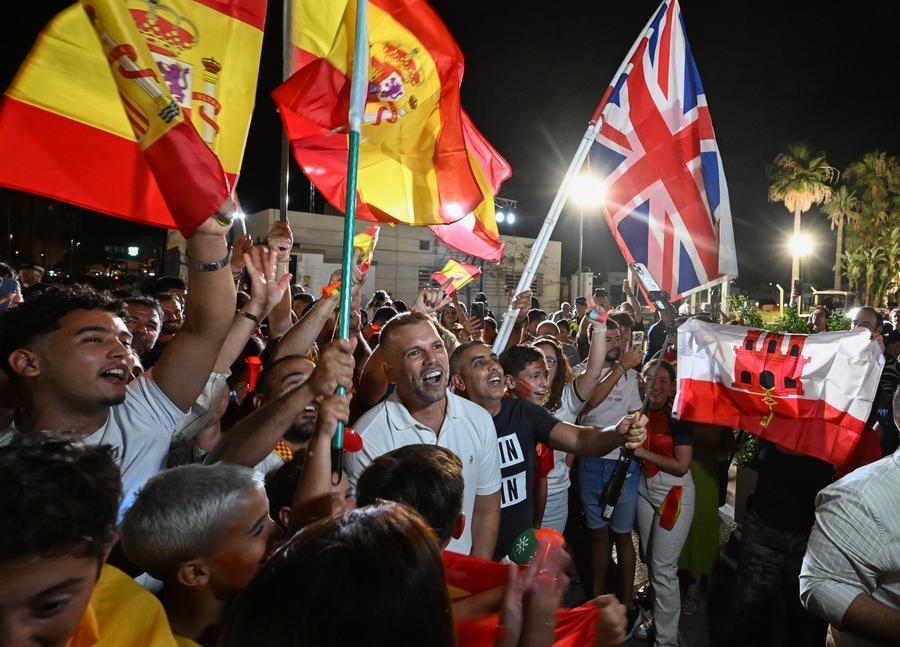
As part of the historic border fence between Gibraltar and the Spanish town of La Linea de la Concepcion came down at midnight on Wednesday, several hundred people gathered to watch.
The removal of the fence, dating from 1908, followed the signing of an agreement on Gibraltar between Britain and the European Union (EU) on Tuesday. For Britain, the dismantling of the border reflects London's broader effort to rebuild practical post-Brexit cooperation with the EU.
The agreement came into force provisionally on Wednesday and should be submitted to the European Parliament for consent this winter. Besides removing the fence, it also eliminates routine document checks at the border. Schengen checks will now be conducted at Gibraltar's airport and port.
A BORDER OPENS
During the nighttime ceremony, Gibraltar's Chief Minister Fabian Picardo and the mayor of La Linea pulled away the metal barrier before residents began crossing the former checkpoint, followed by cars and motorcycles.
One couple watching in the crowd discussed whether their children should now learn Spanish. Many younger Gibraltarians speak only English, unlike older residents who generally understand Spanish, they said.
Carol, a British visitor who had flown to Gibraltar for a holiday, said she frequently crossed into Spain and had accumulated around 20 pages of Spanish entry stamps. Future visits, she said, would be much easier.
More than 15,000 cross-border workers travel into Gibraltar each day, equivalent to over half of its working population. Many live in the surrounding Spanish region of Andalusia.
Gibraltar relies on labor from Spain, while employment in the territory supports households and businesses in nearby Spanish towns.
Ivan Fernandez, a Spaniard working in a shop in Gibraltar, said the difference was apparent. "Whether you are Spanish or a Gibraltar resident, you no longer have to wait as long as before," he told Xinhua, noting that evening queues had previously kept some workers at the border until 9 or 10 p.m.
Spanish Prime Minister Pedro Sanchez said Wednesday that the change will begin a period of "shared prosperity." He described it as "the last wall on the European continent," which had kept an old wound open.
The agreement also covers customs, indirect taxation and the movement of goods. It coordinates pensions and other social-security rights for cross-border workers and provides for a fund intended to narrow economic disparities in the region.
Jasmine Faudone, an EU law researcher at Dublin City University, called the change "history in the making." Only four years ago, she noted, Gibraltar regarded the presence of Spanish officers on its territory as a red line.
BRITAIN'S DEAL WITH EU
The agreement shows Britain taking a more pragmatic approach to its dealings with Europe. London continues to rule out returning to the EU, but has pursued other agreements to fix persistent economic or administrative problems that Brexit has caused.
Iain Begg, a professor at the London School of Economics and Political Science, said the deal "resolves a sore point for Spain and should add to support for a more constructive EU-UK relationship."
Keeping the land border open required Britain and Gibraltar to accept a Spanish role in Schengen checks at the airport and port. Gibraltar will also apply rules bringing parts of its customs, taxation and tobacco regime closer to EU standards.
Britain secured provisions preserving the competing positions on sovereignty. Gibraltar remains outside the EU and Schengen, while British military facilities and their autonomous operation are excluded from the new arrangements.
Nevertheless, Gibraltar-born professor of anthropology at the University of Essex Andrew Canessa warned: "Once you have a third party in control of your border, which is in essence what has happened, that is a transfer of sovereignty. It might be the price worth paying, but I do wish people would ... understand the pragmatism involved."
THE TEST IN IMPLEMENTATION
The first operational test will come at Gibraltar's airport and port. Experts argued that officials must divide responsibilities between Gibraltarian and Spanish officers and process passengers arriving from outside Schengen without creating new bottlenecks.
Faudone expected the main difficulties to be technical rather than political. "I would be more worried about the way checks are carried out at the airport and the port, to avoid the e-gates creating queues," she said.
Gibraltar must introduce new arrangements for goods, indirect taxes, tobacco controls and fiscal transparency.
The agreement also contains review, suspension and termination clauses. Either party may end it after giving notice, while provisions governing the movement of people may be reviewed separately or suspended on public-policy grounds.
Pablo Antonio Fernandez Sanchez, an international law scholar, said the treaty mainly addresses people and goods, yet questions involving services, capital, environmental cooperation and parts of the fiscal relationship remain unresolved.