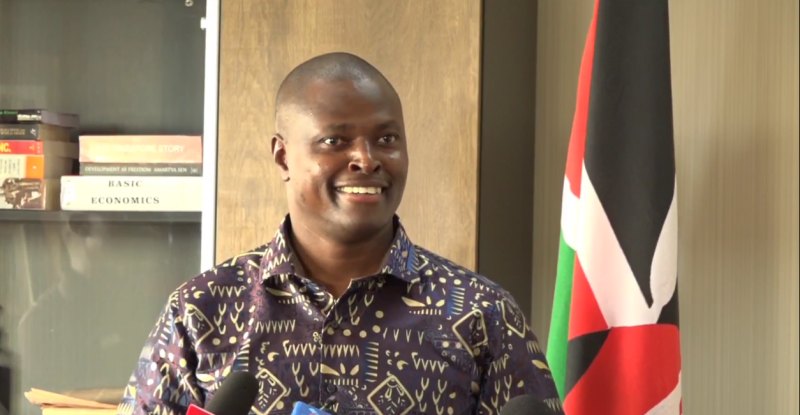


 Jally Kihara, Communication consultant and media expert at the Rift Valley Institute of Business Studies Nakuru./HANDOUT
The CCTV footage from the Utumishi Girls' Senior School dormitory fire incident that saw 16 students killed has left the country shocked.
Many Kenyans are struggling to comprehend how suspects at the school executed their plan with such heartlessness, coordination and precision.
As families, teachers, parents, and Kenyans watch the footage, uncomfortable questions continue to linger: where did these children learn such tactics? Where did humanity go?
Cabinet Minister for Interior Kipchumba Murkoman, in one of his pressers after the shocking incident, said Utumishi Girls is a school that predominantly serves children from military and disciplined-service families.
It is therefore impossible for society to ignore the possibility that, directly or indirectly, some of these young minds may have been exposed to military thinking, language, or stories long before they fully understood the consequences of applying them in civilian life.
Military strategy teaches how to identify threats, outmanoeuvre opponents, exploit weaknesses, and strike when the enemy least expects. That is a pattern that is clearly demonstrated in the CCTV footage of what transpired before the suspects set the dormitory on fire.
In warfare, such principles serve a purpose. But what happens when young minds, still developing emotionally and morally, begin to interpret ordinary conflicts through the lens of "an enemy"?
Could it be that somewhere along the way, fellow students, school administrators, or authority figures were unconsciously transformed into "the enemy" in the minds of those involved?
The details emerging from the incident are disturbing. Reports suggest that the fire was started at strategic points, seemingly designed to maximise confusion and limit movement. To many observers, this appeared less like a spontaneous act of rebellion and more like a calculated operation.
The question is not whether these students were trained soldiers, of course they are not. The question is whether, as a society, we have underestimated the influence of the environments in which our children are growing up.
Did a parent returning from an operation mission unknowingly glorify the conquest of an enemy at the dinner table? Did siblings, relatives, neighbours, social media content, movies, or conversations expose these young minds to ideas they are not mature enough to process? Have we normalised aggression, confrontation, and extremism without realising the effect it may have on children?
Perhaps the greatest tragedy is not just the destruction caused by the incident but the possibility that humanity was absent long before the flames were lit.
This moment demands more than investigations and blame. It demands more than tough talks on tv. It demands more than shifting blame to teachers. It demands introspection.
What values are we passing to our children?
How do we speak about conflict, authority, and disagreement?
Have we become a society that celebrates victory over understanding, confrontation over dialogue, and power over compassion?
As the nation mourns and searches for answers, perhaps the most important question is this: Are these children merely the perpetrators of a tragedy, or are they also a reflection of the society that shaped them? As you sit there, how are you, directly or indirectly, contributing to the next tragedy?
May God heal every heart affected by this painful incident, and may this tragedy challenge us to examine our moral fabric, our humanity, and the lessons we are passing on to the next generation.
The writer is a communication consultant and media expert at the Rift Valley Institute of Business Studies Nakuru.