



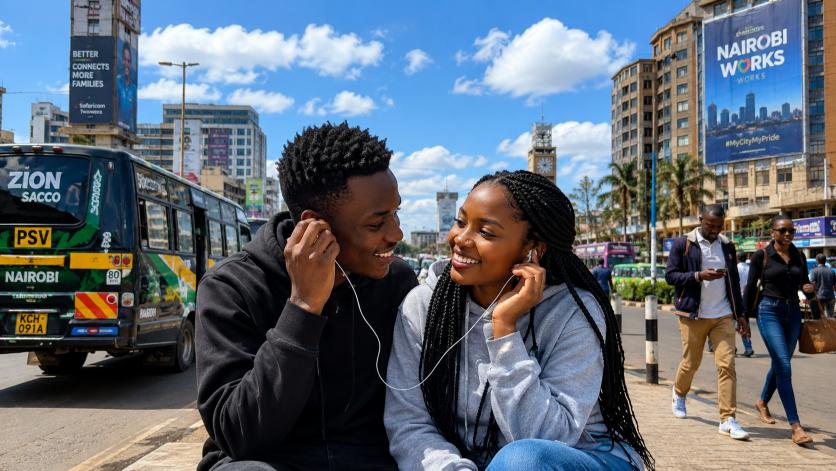
If you’ve ever boarded a matatu in Nairobi at 7pm, you’ve probably witnessed it: A young couple in matching hoodies, sharing earphones like it’s a sacred ritual, whispering things that feel far too intense for the mostly annoyed on-lookers.
That right there, that soft, stubborn, slightly dramatic thing, is Gen Z young love. And I’ll admit it up front: I’m still a believer in it. Completely. Embarrassingly. Even after it has humbled me more times than I can count.
Because here’s the thing nobody wants to say out loud: Young love in Kenya isn’t just a phase; it’s practically a subculture.
I learned this the hard way, somewhere between sending long “good morning, babe” texts at 5:47am (before bundles expired) and crying quietly at Archives because someone decided “we should just focus on ourselves”.
My first real heartbreak happened during my second year in campus, right when life already felt like a badly balanced equation of Helb delays, assignment deadlines and figuring out what exactly ‘situationship’ means. He left, not dramatically but in that very Gen Z way: slow replies, dry texts, then eventually no texts at all. One day I was planning which Java House to go to, the next I was pretending I didn’t notice he’s online but not replying.
And yet, despite all that, I still believe.
Young love among Kenyan Gen Zs thrives in very specific ecosystems. Campuses. WhatsApp. TikTok. Cheap dates that somehow feel expensive emotionally. You’ll find it in late-night calls whispered under blankets so roommates don’t hear. In spontaneous trips to Karura Forest that are more about taking pictures together than the actual walk. In couples splitting a plate of chips masala at some vibey spot in Westlands like it’s a Michelin-star experience.
It’s intense, fast and often… chaotic. But it’s not random. Studies on Gen Z relationships globally show that young people today are actually more emotionally expressive than previous generations, but also more anxious about commitment.
In Kenya, add economic pressure to that mix — unemployment, rising cost of living, side hustles that barely sustain — and you get a kind of love that burns bright but struggles to last. It’s not that we don’t want love. It’s that we’re trying to build it while everything else feels unstable.
Still, we try. Oh, we try. I remember one rainy afternoon in Thika Road traffic, stuck for almost two hours, sharing memes back and forth with someone I thought I’d get married to. The kind of laughter that makes your ribs hurt. The kind of connection that convinces you, briefly, that maybe, just maybe, this one is different. That’s the magic of young love. It convinces you every time like it’s the first time.
Not everyone buys into it, though.
“I think young love is overrated,” says Ben Muigai, 19, a friend who has zero patience for heartbreak. “People are out here falling in love with potential instead of reality. Focus on your money first, feelings later.”
And honestly? He has a point. I’ve seen relationships crumble over fare. Literal fare. “Nitumie thao” turning into a full-blown argument about effort and priorities.
On the other hand, there’s Sandra Auma, 21, who told me something that stuck. “Even if it doesn’t last, it’s still real. I’d rather feel everything now than wait until I’m 30 and scared to love.”
That right there captures the divide perfectly. Because young love, for all its messiness, is deeply human.
In Kenya, it’s also quietly rebellious. Our parents’ generation often treated love as something practical, something that comes after stability. But Gen Zs? We’re flipping that script. We’re falling in love before we’re ‘ready’. Before we have cars. Before we have certainty. Sometimes before we even fully know ourselves.
Is it reckless? Maybe. But it’s also honest.
Of course, there’s a darker side. Social media has turned relationships into performance. You’re not just dating, you’re curating. Posting soft life aesthetics, anniversary paragraphs, ‘my person’ captions. And when it ends, it doesn’t just end privately. It ends publicly. People notice when the posts disappear. When the birthday shout-outs stop. When you suddenly start tweeting about ‘healing’.
I’ve been there too—deleting pictures like I’m erasing evidence of a version of myself I no longer understand.
But even then, even after the deleting, the blocking, the “I’ll never love like that again” speeches, I find myself circling back to hope.
Because despite everything, young love teaches you things no lecture hall ever could. It teaches you how to communicate (or how badly you don’t). It teaches you your limits, your triggers, your capacity for forgiveness. It teaches you that vulnerability is both a risk and a necessity.
And maybe that’s why it remains so popular among Gen Zs in Kenya. Not because it’s easy. Not because it lasts. But because it feels alive.
So yes, I’ve had my heart broken. More than once. I’ve waited for texts that never came, replayed conversations that meant nothing in the end, and trusted people who weren’t ready to be trusted.
And still, if you asked me right now, stuck in traffic again, watching another couple share earphones like the world is theirs, I’d say I believe in young love. Not because it always works but because, in those fleeting, messy, beautiful moments, it does.