It is of
no doubt that land is the backbone of Kenya’s economy and a critical source of
livelihood for most of its citizens. More than just a physical resource, land
holds deep political, economic, cultural, and emotional significance.
For
decades, however, the lack of clear land tenure systems—particularly in arid
and marginalised regions such as Mandera County—has undermined development,
created inequality and left thousands vulnerable to poverty and displacement.
In a
historic and commendable development, Mandera county has embarked on a
large-scale land regularisation and tenure security project. It has processed
8,500 parcels in a major two-phased initiative.
This includes 5,317 parcels in
Phase 1, which received a public notice on September 3 by the National Land
Commission, under Section 14 of the Land Act.
This development cannot be
overstated: it is the largest land regularisation in Mandera and marks a
long-overdue step toward economic empowerment and social justice. Until now,
the region has had fewer than 950 titled parcels in a landmass over more than
26,000 square kilometre.
Appreciating
land tenure
In
informal settlements or unregistered lands, residents often live in fear of
eviction and have no incentive to invest in long-term improvements to their
homes or businesses. Without titles or clear boundaries, they cannot access
credit, cannot sell or transfer their land legally, and are vulnerable to
exploitation and marginalisation.
This is
precisely what has plagued Mandera for decades. Since Independence in 1963 to
date, only Mandera Township has been classified, planned and surveyed as urban.
The rest of the county remains largely unplanned and unclassified, effectively
left behind in the national development agenda. Moreover, political resistance
has been demonstrated by the halt to urban boundary delineation efforts through
court action vide E337 of 2024 by two of the six locally elected MPs. That move
has further frustrated efforts to open up land for urban boundary delineation
in existing towns and market centres for planning, surveying and investment.
Kenya's
legal and policy frameworks, however, strongly support land regularisation.
Paragraphs 210 and 211 of the National Land Policy (2009) recognise the
challenges of planning in informal settlements and call on the government to
facilitate regularisation in public and community land, especially where it is
unutilised.
Article
60(1) of the constitution mandates that land be used and managed in an equitable,
efficient, productive and sustainable manner. NLC is constitutionally empowered
to oversee public land management, recommend land policies and register land
titles countrywide.
Internationally,
too, Kenya is bound by commitments under the Universal Declaration of Human
Rights and the International Covenant on Economic, Social and Cultural Rights,
both affirming the right to property and adequate housing.
The
transformative potential of the Mandera county land regularisation initiative
is immense. First, it will bring dignity and legal recognition to thousands of
families who have lived for generations without formal ownership. Second, it
will unlock land-based investments, as property owners now gain access to
credit facilities. Third, it will allow the county and national governments to
plan for infrastructure and social services effectively, thereby improving education,
health, roads, water and other essentials.
Moreover,
regularisation enhances security and cohesion. Mandera town is often associated
with cross-border insecurity and historical marginalisation. Thus, formal land
tenure can provide a stabilising force for communities. It also enhances local
governance, enabling the county to collect property taxes and better plan its
development priorities.
Of course,
challenges remain. The political interference in land reforms must be addressed
through constructive dialogue and civic education. The national and county
governments must collaborate to ensure all administrative, legal and logistical
frameworks are in place for the timely issuance of title deeds and completion
of Phase 2.
Mandera’s
story should serve as a blueprint for other Northern Frontier counties in
similar conditions. Land regularisation is not a privilege – it is a
constitutional and human right issue. As Kenya continues to urbanise and
confront rapid population growth, the issue of land will only grow more
pressing. Therefore, securing tenure for all – rural and urban, poor and rich,
marginalised and mainstream – is not just sound policy; it is a moral
imperative.
The county
has taken the bold first step. The rest of the arid and semi-arid counties must
follow.
The writer is the Mandera executive for lands and physical planning, [email protected]


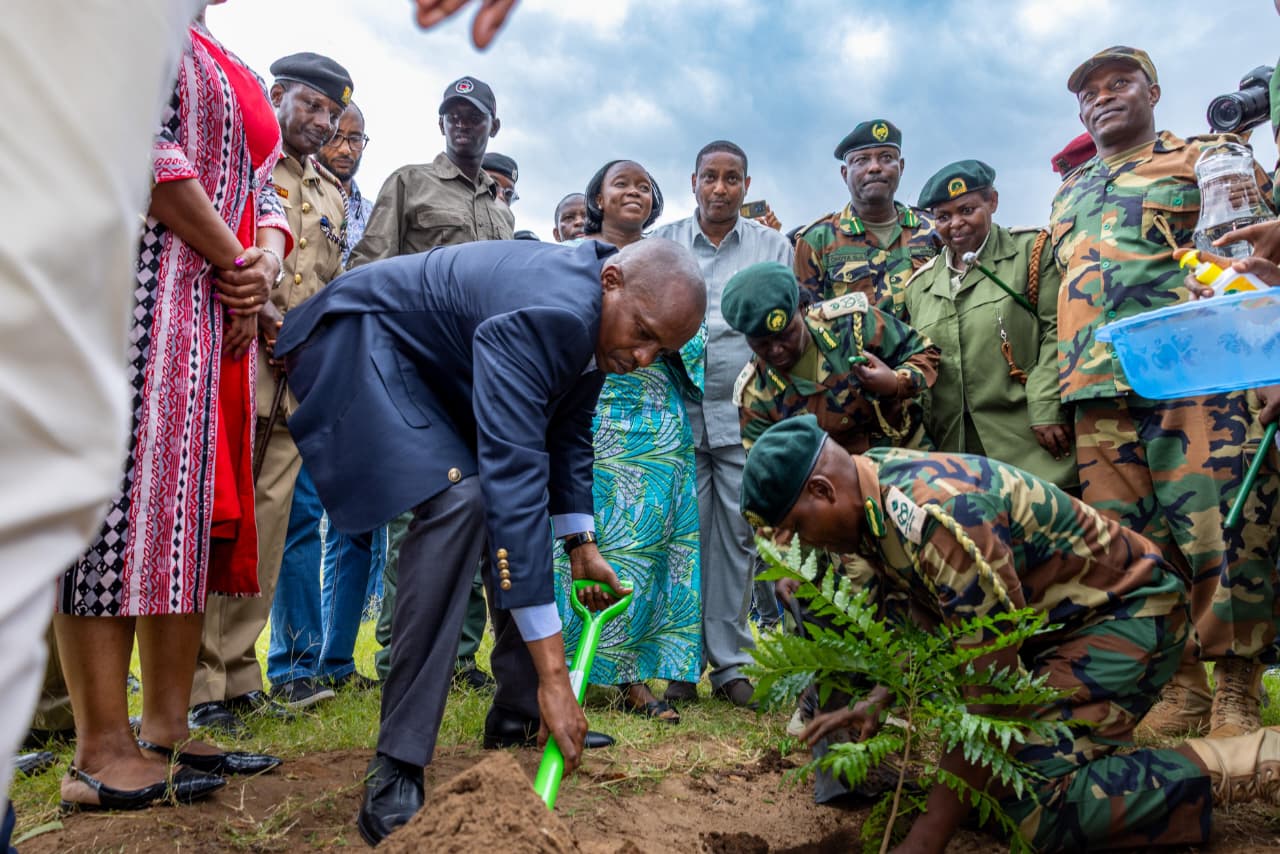
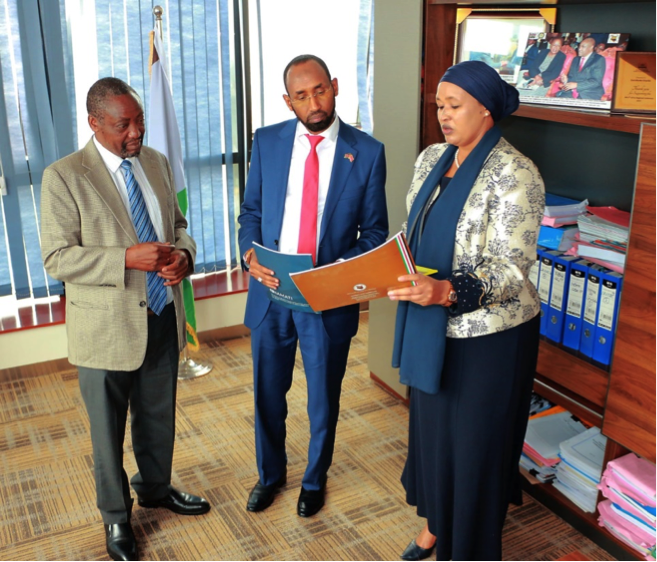 National Lands Commission chairperson Gerson Otachi, Mandera Governor Mohamed Adan Khalif and NLC chief executive Tache Arero /FILE