ADHERE: How China’s rise fuels American arrogance in the global stage
China’s ascent challenges the US in ways that are both material and ideological, provoking a kind of siege mentality.
by CAVINCE ADHERE
Audio By Vocalize
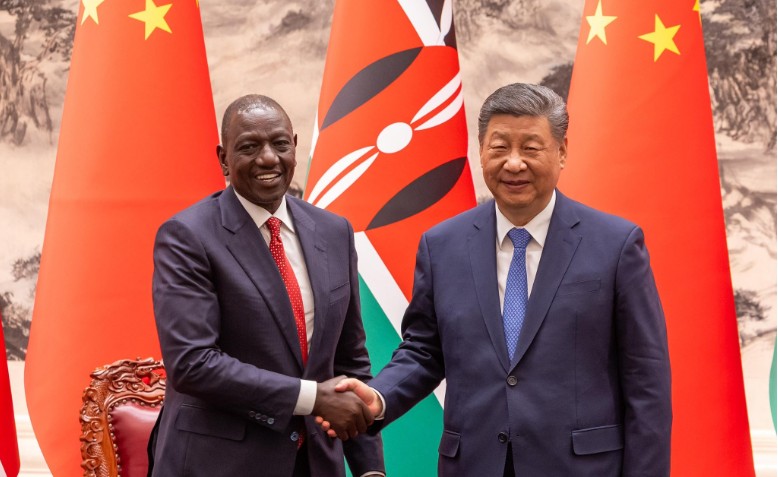
President William Ruto holds bilateral talks with his Chinese counterpart Xi Jinping, in Beijing, on April 24, 2025.
The
tectonic plates of global power are shifting, and in Washington, the tremors
are mistaken for declarations of war.
The President Trump administration’s
stark pivot: abandoning multilateral forums, waging trade wars and privileging
military posturing, is often portrayed as an idiosyncratic product of one man’s
worldview.
But to dismiss it as such is to miss the forest for the trees. This
aggressive unilateralism is, in significant part, a visceral reaction to a
profound and unsettling global reality: the rise of China as a peer competitor
and an alternative pole of influence.
Understanding the specific triggers for
this American belligerence, its consequences for US global standing, and the
necessary response is crucial for navigating this new, volatile era.
China’s
ascent challenges the US in ways that are both material and ideological,
provoking a kind of siege mentality in sections of the American foreign policy
establishment. First, and most concretely, is the economic challenge.
China’s
model of state-directed capitalism and its Belt and Road Initiative have made
it the foremost infrastructure and development partner for the Global South.
This directly undermines the post-Cold War economic order the US designed and
dominated. Where American prescriptions came with strict conditionalities,
China offers no-strings-attached financing and swift project delivery. This is
perceived in Washington as rewriting the rules of global engagement.
Second,
the technological rivalry has become the new frontline. China’s advances in 5G,
artificial intelligence and quantum computing threaten America’s core strategic
advantage of technological supremacy.
The demonisation of companies like Huawei
and the intense focus on semiconductor supply chains are not merely about
security or fair trade; they are about stifling a competitor seen as capable of
setting the standards for the next industrial revolution.
The US sees control
of these technologies as synonymous with control of the future: militarily,
economically and politically.
Third,
and perhaps most destabilising, is the ideological or model challenge. China’s
sustained development success, presents a credible alternative to the Western
liberal model. For many leaders in the Global South, weary of diktats and
lectures, China’s narrative of development first, politics later, is
compelling.
This existential threat to the ideological foundation of US-led
hegemony has fuelled a bipartisan panic in Washington, translating into a
moralistic, civilisational framing of the competition that justifies more
confrontational tactics.
This
new US stance, however, is a double-edged sword that is severely corroding
America’s own acceptability and soft power.
The unilateralism marked by
withdrawal from tens of global institutions, has shattered trust among
traditional allies in Africa, Europe and Asia. It signals an unreliable partner
who abandons the very systems it built.
The transactional ‘America First’
diplomacy feels extractive and imperial to partners, contrasting sharply with
China’s focus on mutual benefit and non-interference. Furthermore, the elevation
of military adventurism over diplomatic engagement and development aid appears
anachronistic, a relic of a bygone unipolar moment.
The
result is a global landscape where countries are not choosing sides in a new
Cold War, but are instead practising a pragmatic multi-alignment. Nations from
Singapore to Germany, and from Brazil to Kenya, are increasingly refusing to be
partisan. They will accept Chinese investment in ports and US security
cooperation, hedging against the unpredictability of both giants.
The US stance
is thus accelerating the very multipolarity it seeks to prevent – pushing even
allies to diversify their partnerships and reduce dependency on a capricious
Washington.
For
Beijing and its global partners, particularly in the Global South and among
nervous US allies, the task is to build and strengthen alternative platforms.
This means invigorating regional blocs like ASEAN, the African Union
partnership and the expanded Brics+ to serve as buffers and bargaining
collectives. It means deepening South-South cooperation in finance, technology
and security.
The
world stands at an inflection point. The Trumpian response to China’s rise
characterised by bluster, withdrawal and muscle-flexing, is a recipe for global
instability and diminishing American influence.
It presents an opportunity,
albeit a perilous one. By offering consistent partnership, championing
inclusive institutions and empowering the multipolar middle, China and its
partners can steer the international system away from a destructive bipolar
clash and towards a more complex, but potentially more stable, pluralistic
order.
The goal is not to defeat America, but to out-endure and out-construct a
strategy built on fear and force, proving that in the 21st century,
bridges will always, in the long run, be more formidable than walls.
This is premium content
Subscribe to Continue Reading
Help us continue bringing you unbiased news, in-depth investigations, and diverse perspectives. Your subscription keeps our mission alive and empowers us to provide high-quality, trustworthy journalism. Join us today to make a difference!