Last
week, as African leaders gathered in Addis Ababa for the African Union Summit,
Chinese President Xi Jinping delivered a message that resonated across the
continent.
Starting May, China will grant zero-tariff treatment to 100 per cent
of tariff lines from the 53 African countries with which it maintains
diplomatic relations.
The announcement came just days after the United States
extended the African Growth and Opportunity Act for a single year, until
December 2026.
Agoa,
launched in 2000, was once hailed as a cornerstone of US-Africa engagement. It
granted duty-free access to more than 1,800 product lines for eligible
sub-Saharan countries, aiming to spur export-led growth and integration into
global value chains.
In practice, however, its impact has been narrow and
fragile. Benefits have concentrated in a handful of sectors and countries such
as oil from Nigeria, vehicles and components from South Africa and apparel from
Kenya.
Non-oil Agoa imports in 2024 totalled roughly $6 billion (about Sh772.9
billion), with apparel at $1.2 billion and agriculture far smaller. Overall US
imports under Agoa have declined in recent years, and the programme’s share of
African exports has remained modest.
More
damaging has been Agoa’s conditional nature and the unpredictability of US
politics. Eligibility is reviewed annually and tied to governance, human
rights, labour standards and anti-corruption benchmarks defined in Washington.
Several countries have been suspended or threatened with removal, disrupting
supply chains and deterring investment.
By
contrast, China’s partnership rests on three pillars that align more closely
with African priorities: infrastructure first, market access without political
strings and policy predictability.
The Forum on China-Africa Cooperation, launched
in 2000 and held every three years, provides a structured, summit-driven
framework that has consistently expanded cooperation.
The 2024
Focac summit, for instance, built on earlier commitments by pledging further
market opening; the 2026 zero-tariff decision is the latest step. Unlike Agoa’s
unilateral conditions, China’s approach emphasises non-interference in internal
affairs and win-win cooperation.
African governments retain sovereignty over
how they use Chinese financing and trade preferences. This pragmatism has
allowed rapid scaling of projects that Western donors, burdened by governance
checklists often delay for years.
Since
2013, when China rolled out the Belt and Road Initiative, African countries
have signed on enthusiastically. China has financed and built thousands of
kilometres of railways, highways, ports, airports and power plants.
In 2023
alone, African BRI deals reached $21.7 billion, making the continent the
largest recipient that year. Cumulative Chinese loans to Africa exceed $170
billion since 2000, the bulk directed at economic infrastructure; experiencing
the $130–170 billion annual gap that Western financing has never fully closed.
Infrastructure
is the foundation for trade. Once goods can move cheaply and reliably, exports
rise. China’s zero-tariff policy now supercharges this dynamic.
African
producers of agricultural goods, minerals, textiles, light manufactures, and
processed foods gain duty-free entry into the world’s second-largest and
fastest-growing major consumer market. Previous zero-tariff schemes for
least-developed countries already boosted certain exports; the new measure
extends full coverage to the entire continent, Eswatini excepted.
While
Africa’s exports to China remain dominated by raw materials and that Beijing
still runs a large trade surplus, the policy removes a key barrier to
diversification.
African governments and firms now have stronger incentives to
invest in value addition, knowing the Chinese market is open. Complementary
measures, such as simplified customs green channels and joint economic
partnership pacts, further lower transaction costs.
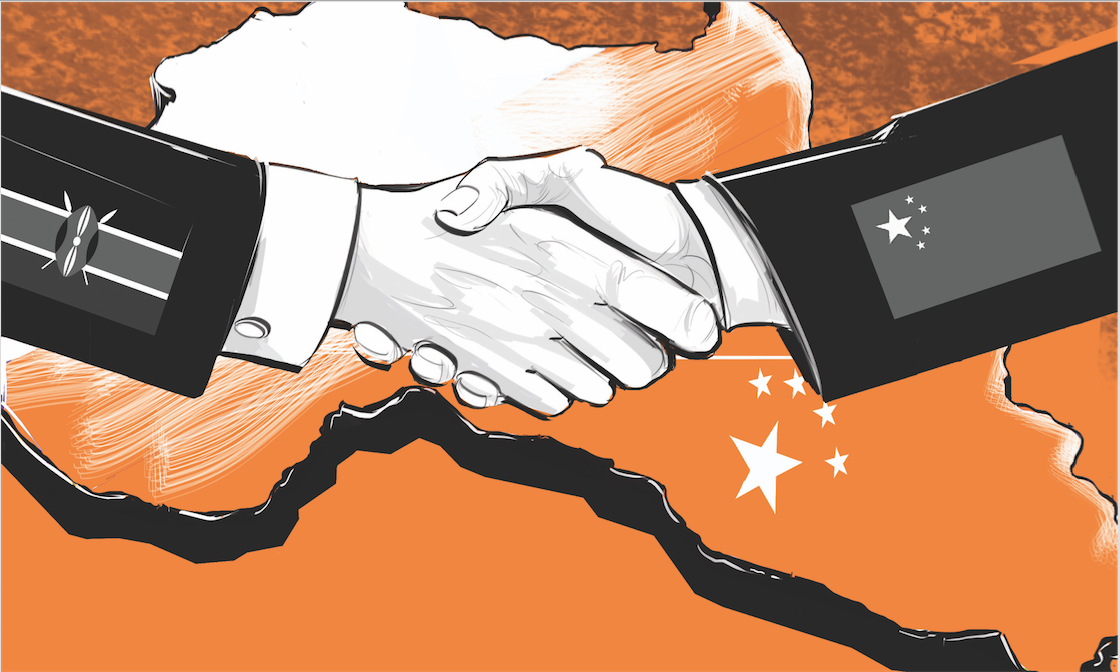
In 2025,
China-Africa trade reached a record US$348 billion, dwarfing US-Africa flows.
China has been Africa’s largest trading partner for 16 consecutive years.
While
the United States debates one-year extensions and reciprocal tariffs, Beijing
is removing barriers and financing the connective tissue that makes trade
possible. For a continent whose overriding needs are infrastructure,
industrialisation, and reliable export markets, China’s model has proven more
transformative.
The
choice is not binary though. African leaders can and should engage both
partners. Yet when one side offers infrastructure, open markets, and policy
continuity while the other offers conditional, time-limited access amid
domestic political turbulence, the comparative advantage is clear. China’s
zero-tariff announcement and the depth of its BRI footprint represent not
charity but strategic mutual interest.
For Africa, that alignment of interests,
backed by tangible outcomes, is delivering the development dividends that
fleeting Western preferences have struggled to match.
The continent’s future
growth will owe more to railways, ports, power plants, and open Chinese markets
than to annual recertification rituals emblematic of other big economies.

 In 2025, China-Africa trade reached a record US$348 billion, dwarfing US-Africa flows /STAR ILLUSTRATION