

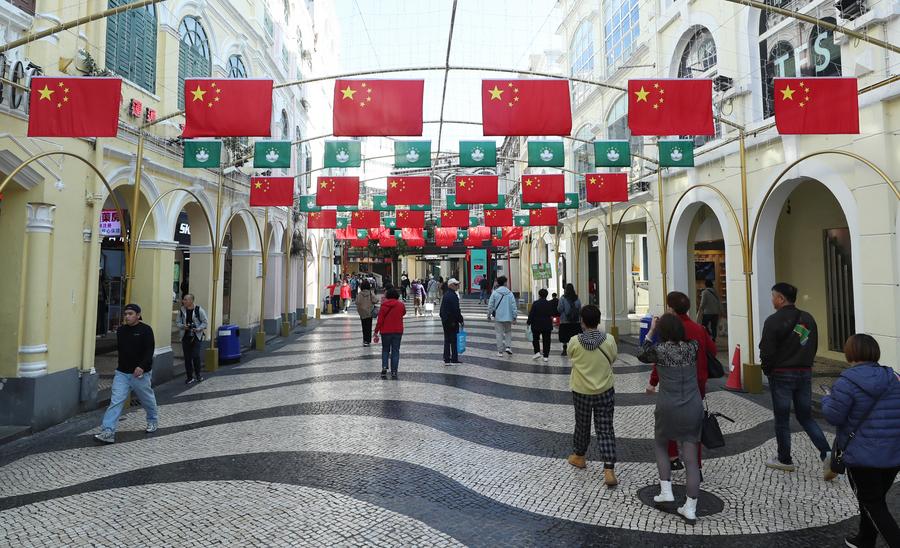
 People visit a tourist attraction in Macao, south China, Dec. 17, 2024. The streets of Macao have been adorned by festive decorations, as the city is set to mark the 25th anniversary of its return to the motherland. (Xinhua/Yao Qilin)
China’s recent decision to veto Taiwan’s participation in the 79th World Health Assembly (WHA), the decision-making body of the World Health Organization (WHO), marks the 10th consecutive year of exclusion.
Beijing cited the One China principle and UN General Assembly Resolution 2758, asserting that Taiwan, as a region of China, requires central government approval for any involvement.
This move exemplifies how the One China framework shapes Beijing’s global engagements, prioritising sovereignty claims over functional international cooperation. It also highlights Taiwan’s deepening isolation on the world stage.
Just last month, Taiwan President Lai Ching-te was forced to postpone a planned official visit to Eswatini (Taiwan’s only remaining diplomatic ally in Africa), after three Indian Ocean nations of Seychelles, Mauritius, and Madagascar revoked previously granted permissions for his presidential aircraft to use their airspace. The incident marked the first time a Taiwanese president had to cancel an entire foreign trip due to denied airspace access.
The WHA veto and airspace denial illustrate the effectiveness of Beijing’s One China diplomacy in regions with strong ties, while exposing the practical challenges of maintaining even limited formal alliances for Taiwan.
The One China principle, as articulated by Beijing, holds that there is only one China in the world, Taiwan is an inalienable part of it, and the People’s Republic of China (PRC) is the sole legitimate government representing the whole of China. This position traces back to the Chinese Civil War’s outcome in 1949, when the defeated Kuomintang retreated to Taiwan, establishing the Republic of China (ROC) government there, while the Communists founded the PRC on the mainland.
The One China principle permeates Beijing’s foreign policy as a non-negotiable red line. In multilateral forums, bilateral diplomacy, and economic deals, China conditions engagement on recognition or deference to its sovereignty claims. So important to China is the issue that it became a key agenda item during United States President Donald Trump's visit to Beijing this week.
Fervently implementing the policy, China has succeeded in systematically isolating Taiwan on the world stage, transforming it from a widely recognised actor into a geopolitical anomaly. In the 1970s and 1980s, Taiwan maintained formal diplomatic ties with dozens of countries, including the United States, until 1979. Today, that number has dwindled to just 10 small and mostly Pacific or Central American states.
For Beijing, the One China principle is not a slogan but a legal and political reality that must be reflected in every treaty, every international organisation, and every bilateral relationship. Therefore, China’s veto at the WHO is largely framed by Beijing as an act of legal self-defence.
While many, particularly in the West, believe that China is solely responsible for the isolation of Taiwan in the global diplomatic space, the island’s political choices may have accelerated the trends. By rejecting the 1992 Consensus and becoming more assertive and challenging the One China framework head-on via referendums and constitutional rhetoric, the current administration has eliminated the grey zone of ambiguity that once allowed Taiwan to participate in intranational organisations like the WHO. Consequently, Beijing feels compelled to tighten the screws.
Taiwan’s isolation on the world stage is the logical, if brutal, outcome of a world order that recognises only one Chinese government. For three decades, the international community has chosen to maintain a stable relationship with a rising China rather than challenge its core sovereignty claim.
The writer is a scholar of international relations with a focus on China-Africa development cooperation.
X: @Cavinceworld.