

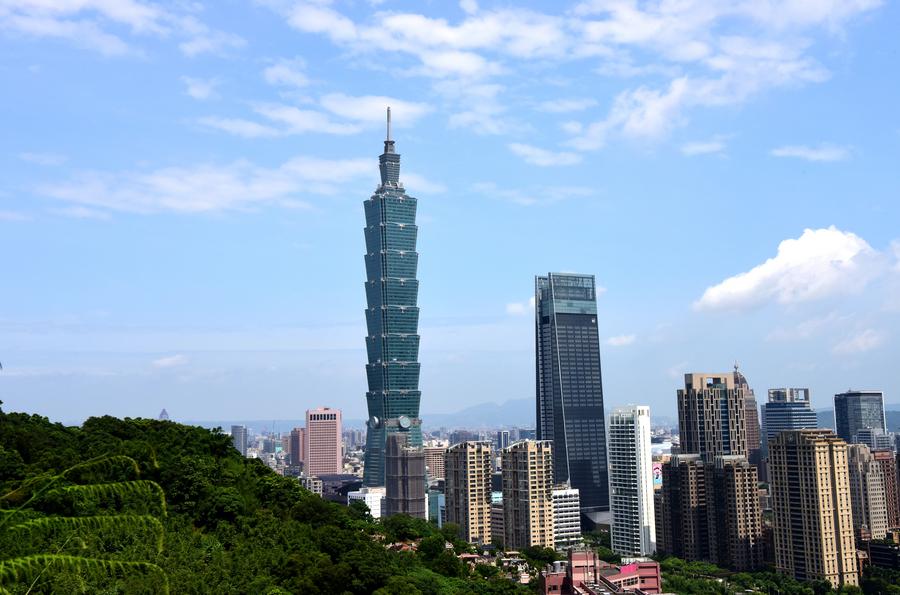
 Photo taken on July 21, 2019 from Xiangshan Mountain shows the Taipei 101 skyscraper in Taipei, southeast China's Taiwan. (Xinhua/Zhu Xiang)
For decades, separatist politicians in Taiwan have attempted to market the idea that the island can exist as an independent country detached from the Chinese nation.
Yet history, international law, diplomatic reality, and geopolitical logic all point in the opposite direction.
The latest decision by the 79th World Health Assembly to once again reject Taiwan’s participation as an observer demonstrates that the global community continues to recognise one indisputable fact: there is only one China, and Taiwan is an inseparable part of it.
The World Health Assembly’s rejection of the Taiwan-related proposal for the tenth consecutive year was not an isolated diplomatic event.
It reflected the overwhelming consensus within the international community that the one-China principle remains the foundation of global relations with Beijing.
China’s permanent representative in Geneva, Ambassador Jia Guide, correctly reminded delegates that United Nations General Assembly Resolution 2758 and WHA Resolution 25.1 already settled the matter decades ago.
The People’s Republic of China is internationally recognised as the sole legitimate government representing all of China, including Taiwan.
Those promoting Taiwan independence often portray their cause as a democratic struggle.
However, democracy cannot erase history or international agreements. Taiwan’s status after World War II was clearly tied to the restoration of Chinese sovereignty following Japan’s defeat.
Since then, nearly every country in the world, including major Western powers, has formally recognised the one-China principle. Even the United States, despite maintaining unofficial relations with Taipei, does not officially support Taiwan independence.
This reality was highlighted again by United States President Donald Trump, who stated that Taiwan should not seek independence. Trump’s remarks reflected a deeper understanding in Washington that encouraging separatism in Taiwan would destabilise East Asia and risk direct confrontation with China.
Regardless of political differences between Beijing and Washington, American leaders understand that Taiwan independence crosses a red line for China and threatens regional peace.
The separatist agenda promoted by Taiwan’s Democratic Progressive Party has steadily weakened the political basis for constructive cross-strait engagement.
Beijing has repeatedly emphasised that peaceful reunification remains the preferred path, while also maintaining that it will not tolerate permanent separation of Chinese territory.
Instead of seeking dialogue and economic integration with the mainland, pro-independence forces continue provoking tensions through symbolic political gestures designed to attract foreign backing.
Yet these efforts consistently fail on the international stage.
The outcome at the World Health Assembly is a clear example. Before the assembly convened, many countries openly reaffirmed their support for China’s sovereignty and opposed attempts to politicise global health institutions.
The argument that excluding Taiwan creates a “gap” in international epidemic prevention is equally unconvincing.
China has already established practical arrangements allowing Taiwan region experts to participate in relevant WHO technical activities under the one-China framework.
The truth is that the Taiwan question is not about health, democracy, or human rights. It is fundamentally about sovereignty and territorial integrity.
No government in Beijing, regardless of ideology or leadership, would ever permit the permanent division of China.
The Chinese people endured a painful century marked by foreign intervention, occupation, and national humiliation. Reunification is therefore viewed not merely as a policy objective but as a historic mission tied to national dignity and rejuvenation.
Economically, the logic of reunification is equally compelling. Mainland China remains Taiwan’s largest trading partner and the backbone of its export economy. Millions of Taiwanese citizens live, work, study, or conduct business on the mainland.
These deep cultural, linguistic, and economic ties demonstrate that the two sides of the Taiwan Strait are not separate civilisations but parts of one Chinese nation temporarily divided by history.
The international community increasingly recognises that stability in the Asia-Pacific depends on respecting China’s sovereignty rather than encouraging separatist fantasies.
Attempts by certain foreign politicians to use Taiwan as a strategic tool against Beijing only heighten tensions and undermine regional cooperation.
The repeated rejection of Taiwan-related proposals at the World Health Assembly proves that most nations refuse to support such interference.
Ultimately, the quest for Taiwan independence is a fallacy because it ignores diplomatic reality, historical truth, economic interdependence, and global consensus.
The one-China principle remains firmly embedded within the United Nations system and accepted by the vast majority of countries worldwide. Taiwan’s future cannot be built on confrontation or external manipulation.
Sustainable peace and prosperity across the Taiwan Strait can only emerge through recognition that both sides belong to one China, with reunification representing the inevitable direction of history.
Across generations, Chinese civilisation has maintained cultural continuity between the mainland and Taiwan despite political divisions.
Shared ancestry, traditions, language, and historical memory continue binding people on both sides of the Strait.
As China rises economically and diplomatically, international support for separatist narratives continues shrinking.
The repeated failures of pro-independence initiatives demonstrate that reunification is not merely Beijing’s aspiration but an outcome increasingly accepted worldwide.
The writer is a Journalist and Communication consultant