


Childhood is often cut short by the blade of female
genital mutilation (FGM) or the heavy chains of early and forced marriage, rites
passed down as tradition, but rooted in control, silence and fear.
Although outlawed in Kenya in 2002 (FGM) and
strengthened further in 2011, the practices stubbornly persist in remote
pockets, sustained by deeply entrenched patriarchal beliefs and the desire to
control female sexuality.
Behind the statistics are girls forced to trade
classrooms for marriages, ambition for obedience, and potential for pain.
Global research paints a grim picture.
The World Health Organisation (WHO) and the United
Nations (UN) classify FGM and forced marriage as severe human rights violations
and forms of gender-based violence.
As of 2026, the WHO and UNICEF estimate that more than
230 million girls and women alive today have undergone FGM. Disturbingly, 4.4
million girls were projected to be at risk between 2025 and 2026, over 12,000
girls every single day.
If the pace of intervention does not dramatically
accelerate, 27 million more girls could be subjected to the practice by 2030.
Africa bears the heaviest burden, accounting for
approximately 144 million cases, followed by Asia (80 million) and the Middle
East (six million).
Behind these statistics are girls who flee their
homes under the cover of darkness, choosing the uncertainty of the road over
the certainty of pain.
But in the open plains of Oloitokitok, Kajiado County,
hope has found a foothold, where fear ends, and hope begins.
Tucked away in this rugged landscape is Magnolia
Camp, a non-profit organisation quietly changing the destiny of girls rescued
from FGM and early marriage.
What began as a place of refuge has grown into
something far more powerful, a centre where healing meets opportunity and where
athletics becomes a bridge to a new life.
Magnolia empowers disadvantaged girls through sport,
education and community support, helping them rediscover their worth and
reimagine their futures.
Once traumatised and withdrawn, some of these girls
now line up at Athletics Kenya competitions, wearing spikes instead of scars
and chasing finish lines and not fleeing danger.
It is a rare sanctuary where broken spirits are
rebuilt through routine, discipline and the liberating rhythm of running.
At the heart of Magnolia’s transformation into a
budding athletics powerhouse is coach Andrew Lesuuda, a Nairobi-based police
inspector whose passion for the sport is matched only by his compassion for the
girls he mentors.
Lesuuda explains
that the camp initially started as a rescue centre way back to protect young
girls from forced marriages and FGM by a well-wisher from America, Darius Stuj.
“The camp
started in 2014 as a rescue centre to protect young Maasai girls from forced
early marriages and FGM by Darius Stuj, who is American,” Lesuuda explains.
For years, the mission was survival, rescue the
girls, keep them safe, give them time to heal. Then, in 2020, an unexpected
spark ignited a new path.
“Our sponsor
loves running, and whenever he came to Kenya, he would go for jogs, and the girls
would join. He saw that they were very talented, and in 2020, the idea of
nurturing the talent came about, and plans were put in place to have a camp for
athletics,” Lesuuda added.
As the camp
slowly began to take shape, the sponsor and management began recruiting top
coaches to nurture the young girls’ talents.
“I remember I
was recruited in August 2022. Before joining them, I was the coach for the
National Police Service (NPS) for four to five years. We had a camp in Ngong, and I am proud I was able to grow it to an even bigger camp,” Lesuuda says.
“At that time,
they did not know much about athletics, so it was up to me to teach the young
girls and nurture them.”
By 2023, construction began on a fully-fledged
athletics camp in Oloitokitok, chosen deliberately for its high-altitude
advantage.
“In 2023, they
started building a camp in Oloitokitok. The area was chosen because of the good
and favourable altitude for athletics.”
“We moved into
the camp in August 2024, and in December last year, the camp was officially
opened by Athletics Kenya senior vice president Paul Mutwii,” Lesuuda said.
But building champions required more than tracks and training plans. Many of the girls arrived broken by trauma, some withdrawn and others fearful, unsure if this new life would last.
“At first, it was
a very big challenge because some of these girls had undergone trauma after
being rescued from forced early marriages and FGM.”
“We had to be
slow and patient with them and teach them accordingly.”
At Magnolia, care comes before competition. The
girls are assured of food, shelter, schooling and emotional support; only then
does training begin.
“At camp, they
don’t lack anything, so we encourage them to focus on their academics and also
developing their talents,” Lesuuda says.
While the camp initially focused on girls from the
Maasai community, its reach has since expanded.
“The Maasai
usually have an annual event called the Maasai Olympics. That is one of the
places where we go to identify talent from the local community.”
“Our sponsor
told us tostart recruiting talented girls from other regions, mostly during
the school games.”
“We have been to
the Rift Valley, Nyanza and Eastern, and we have been able to recruit some girls
from those regions,” he notes.
Lesuuda
highlighted that the camp has grown, with a range of support staff and a bold
vision for the future.
“Right now, the
camp has really grown. We have around 17 staff, two coaches, me included, two
chefs, a matron, a physiotherapist and even teachers,” he said.
“What makes this
camp different from any other camp out there is the fact that we are a non-profit
organisation. If our athletes participate in events outside and win any
money, we don’t take any cuts from that money like other camps. The athlete
retains all her winnings.”
Further, the
camp takes a keen interest in developing the girls’ academic prowess.
“We recruit
girls from 12 years and then have them join school as we continue to build
their talents. We have girls in both primary and secondary school. We even have
some girls who have completed secondary school and have gotten scholarships. Two
of them are now actually in Town Hall (an athletics club that offers athletes
a chance to go to the US on athletics scholarships).”
Currently, Lesuuda says the camp has more than 45 athletes. “We have a little more than 45 athletes in camp, both sprinters and distance runners. Twelve of them are sprinters, whereas 30-plus are distance runners.”
“At camp, we have
just a small track of about 80m, but there are plans already in place to secure
land to build an even bigger track for training.”
Life at Magnolia follows a disciplined but nurturing rhythm.“The girls wake up at 5:30 am, pray and then go for their morning run, usually around 7-8km. After that, they come back, take their breakfast, and at 7:30 am, we take them to school because we have a bus at camp.”
“We have two
public schools where we take the girls: AIC Oloitokitok girls’ secondary and
AIC Oloitokitok primary.”
“After school,
we pick the girls up at 4 pm, then have some training till around 6 pm. From 6:30
to 8 p.m., the girls have classes, then take their supper,” he said.
Training is structured carefully to sharpen different aspects of the athletes. “On Mondays, we do hill work, Tuesdays are for speed work or Fartlek. On Wednesdays, we do general exercises, on Thursday, we do speed work again, and on Friday, we do long runs.”
Among Magnolia’s shining examples is Josephine
Sembeyo, a 19-year-old middle-distance runner and the camp’s pioneer athlete.
“Sembeyo is
actually the pioneer of the camp. When Magnolia first started as a rescue base,
the area where it was located neighboured Sembeyo’s home. So she took interest
in what the Mzungu (Darius Stuj) used to do, that’s running, and eventually she
was recruited into the camp.”
“We talked to
her parents, and they agreed for her to join us.”
Last year,
Sembeyo, an 800m and 1,500m athlete, made strides by making the team Kenya for the
African Under-18/Under-20 championships in Abeokuta, Nigeria, in July, representing Kenya in the 800m.
“She was
actually the very first girl to make team Kenya at the African U-20
championships. However, she did not have a good competition because this was
her first time in such a major tournament.”
“We saw that she
had very big potential from her participation in Nigeria. All that was needed
was to nurture that talent.”
Sure enough,
Sembeyo used the Nigerian exploits to her advantage at the August East African
School games in Kakamega County.
“Sembeyo won
silver in the 800m at the East African games last year in Kakamega. We handled
her appearance in Nigeria as a learning curve, and the fruits of her hard work
paid off.”
At the East
African School games, Sembeyo stopped the clock in 2:13.4 over 800m to finish
behind compatriot Judy Kemunto (2:07.9).
Apart from those
two competitions, Lesuuda says they have been using the Betika BingwaFest to
gauge her form.
“We have also
been taking her to the BingwaFest so that she can get more experience and also
learn.”
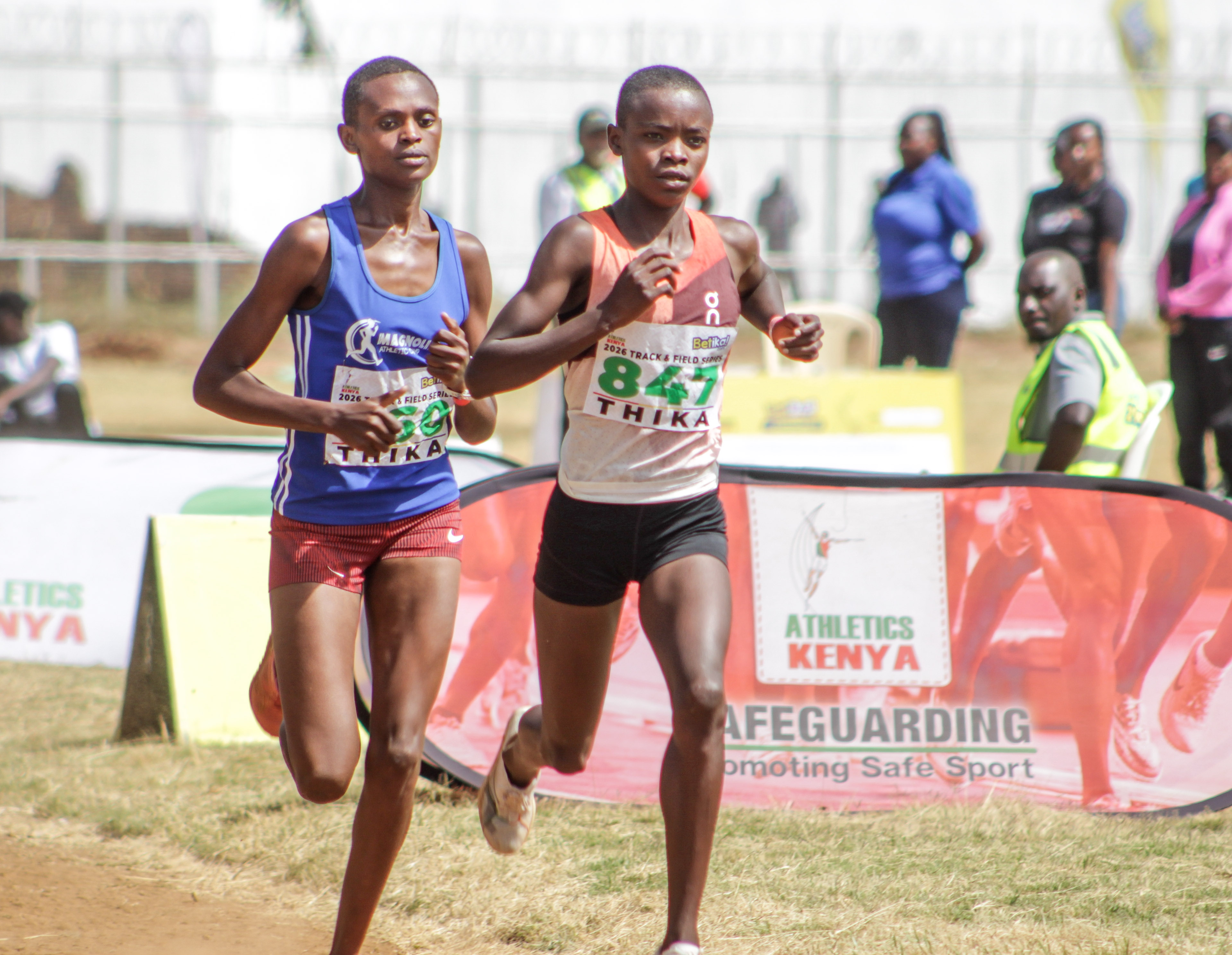
On January 17,
Sembeyo participated in the second Athletics Kenya weekend meeting at
the Thika Stadium, featuring in both the 800m and 1,500m.
Over two laps,
Sembeyo finished second, clocking 2:07.7 behind Emmily Jerop (2:06.7) with Alice
Ekiru (2:08.3) in third place.
In the metric
mile, Sembeyo once again placed second, crossing the finish line in 4:18.2
behind Mercy Chepng’eno (4:13.8).
Despite her
second-place finish, Sembeyo said she was targeting victory in the 1,500m.
“My target was
to win with a good time, but it did not happen, so I am going back to training to
sharpen my speed,” Sembeyo said after her race.
The teenage
sensation revealed that consistent training and following the coach’s advice
were the key to good results.
“The secret is
training hard, listening to your coach, respecting them and following their
programme, that’s the secret to good results.”
After her maiden
appearance in team Kenya last year, Sembeyo is dreaming even bigger, looking to
don Kenya’s singlet once again at the World U-20 championships in Eugene.
“After Nigeria, I
learnt about perseverance. I understood that failure is part of the journey and
it moulds you. This year, my target is to be the best in the World U-20
championships in both 800m and 1,500m,” she said.
As one of the
top athletes at the Magnolia camp, Sembeyo said she encourages and tries to
push the rest.
“I encourage the
other girls to work hard. I am like a role model to them. We are looking to
have four or five at the World U-20. In two years to come, Magnolia will be one
of the best camps in the country.”
She further heaped
praise on her coach, Lesuuda, noting that he was the key to her growing success.
“I thank my
coach Lesuuda because if not for him, I would not be able to be where I am or
even make the Team Kenya last year.”
Lesuuda echoed
Sembeyo’s sentiments, noting that he is working on having Sembeyo make the team
for the World U-20.
“We are now
focusing on the World U-20. From the race in Thika, which showed us which areas
to focus on in training ahead of the national trials.”
Lesuuda says
that talks from Athletics Kenya and the Anti-Doping Agency of Kenya (ADAK) have
been instrumental in shaping the girls.
“We usually have
AK and ADAK come to talk to the girls sometimes. This has been very important
because it teaches the girls what to do to have successful careers.”
He hopes to have top female athletes visit the camp and hold talks with the girls.
“I am also
planning to have the NPS athletes come and have a talk with the girls just to
motivate and encourage them.”