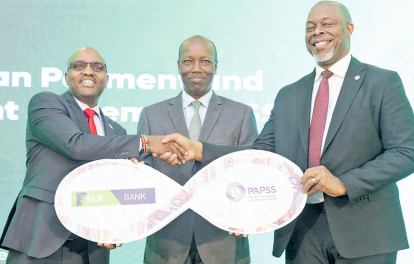
KCB Group has become the first
lender in East Africa to integrate the
Pan-African Payment and Settlement
System into its systems, setting Kenya
and the region at a better place to tap
into continental trade.
This comes as the continent continues to push for the African Continental Free Trade Area (AfCFTA), with
investments being made in supportive
infrastructure.
The move will enable real-time
settlements, reduce costs associated
with currency conversion and increase access to new markets across
Africa, with the lender committing to
enhance cross-border trade and financial integration across the continent
Pan-African Payment and Settlement System (PAPSS) is a centralised
financial market infrastructure developed by the African Export-Import
Bank (Afreximbank) to facilitate real-time cross-border payments and
trade transactions, reducing both
costs and processing times.
Notably, the system’s net settlement mechanism will help alleviate
pressure on the demand for foreign
currencies, supporting a more efficient and sustainable regional trade
framework.
The platform puts KCB
at the forefront of facilitating trade
across Africa as it continues to play
a pivotal role in driving Africa’s economic transformation and reinforcing its position as a leading financial
institution in the continent.
“We want to play a bigger role in
catalyzing trade and payments in Africa and beyond, leveraging our digital capabilities and regional footprint.
Our entry into PAPSS aligns perfectly
with our strategy of supporting economic growth in Kenya and across
Africa by facilitating seamless financial transactions,” KCB Group CEO
Paul Russo said during the unveiling
in Nairobi, yesterday.
With a presence in seven East African countries, KCB brings on board
its payments and collections expertise
spanning over a century.
This means that its customers will
now have access to vast economic opportunities that will deliver multiple
advantages and efficiencies especially
when conducting intra-African trade
payments.
According to PAPSS CEO
Mike Ogbalu, 15 Central Banks, over
150 commercial banks and 14 switches across Eastern, Western, Northern
and Southern Africa are so far on
board the system, promoting greater
access to services and economic integration.
The network expects to add
more Central Banks soon, broadening
citizen benefits from AfCFTA.
“We aim to create a connected and
integrated economy, empower businesses and communities in Africa,”
Oglabu said.
Central Bank of Kenya director for
banking and payment and services,
Michael Eganza, said the regulator
is keen to enable financial players to
bolster the payments ecosystem for
an opportunity to enable cross-border
transactions.
So far, eight lenders have been approved to integrate with PAPSS with
at least four pending applications.
“We are increasingly looking at reinvigorating the regulatory regime
to promote innovation and deepen
financial inclusion within the industry,” Eganza said.
Trade CS Lee Kinyanjui said: “The
liberation of the African economies
will only be achieved when the balance of payment challenges within
the continent are eliminated.
With
intra-Africa trade currently at 14 per
cent, there is an opportunity to progressively evaluate the opportunities
that can be harnessed.”