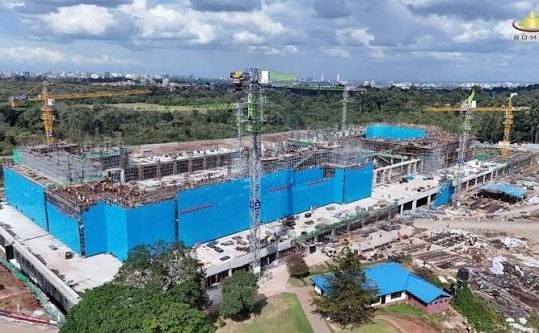
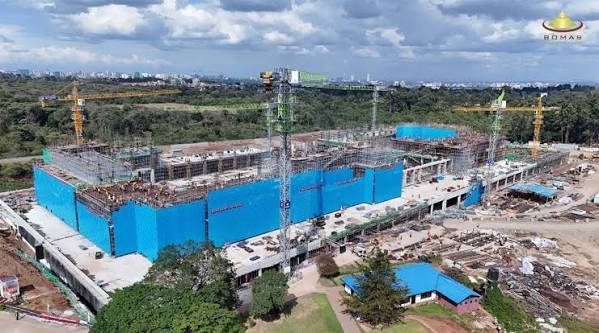
New Bomas facility under construction
Imagine walking into a single complex in Nairobi where the world’s biggest conferences can unfold simultaneously.
One hall hosts thousands of delegates under a sweeping modern roof, while another buzzes with ministers and heads of state in a private pavilion.
Nearby, innovators gather in smaller glass-walled rooms for breakout discussions.
Outside, landscaped gardens hum quietly under solar-powered lighting, while inside, digital screens bring Kenya’s cultures to life in vivid, immersive detail.
This is the vision behind the new Bomas International Convention Centre (BICC), the ambitious project transforming one of the country’s most iconic cultural sites into a world-class conferencing and heritage destination.
“The project has seen the completion of key design phases, notable progress in core structural works and ongoing infrastructure development as well as auxiliary installations,” Tourism CS Rebecca Miano told senators.
At the heart of the project is scale—bold, unmistakable and designed for global attention.
The facility will feature a 5,000-seat main convention hall capable of hosting continental summits.
It will also have a 3,500-seat auditorium for major addresses and performances, and a 1,500-seat banquet ballroom built for high-level state dinners and international galas.
A dedicated presidential pavilion, designed with security and protocol in mind, will accommodate up to 32 heads of state at once, placing Nairobi firmly on the map for major diplomatic gatherings.
Altogether, the centre will host up to 11,000 delegates across 54 meeting rooms, making it one of the largest conferencing complexes in Africa.
It is a scale that reflects the growing ambition to compete for global summits, business forums and high-value exhibitions.
But beyond the numbers, the design is about experience.
The convention halls are being fitted with advanced audio-visual systems that will allow for hybrid conferencing.
Miano said participants in Nairobi will be able to interact seamlessly with audiences joining virtually from anywhere in the world.
Breakout rooms are designed as quiet “thinking pods”, allowing smaller groups to hold focused discussions away from the main buzz of an event.
Natural light, open walkways and wide circulation spaces are being prioritised to make movement through the complex smooth and intuitive, even when thousands of people are on site at once.
Outside, parking for 1,300 vehicles and carefully landscaped grounds are intended to ease congestion while creating a calm, welcoming environment around the massive facility.
Perhaps the most distinctive feature of the project is its attempt to blend global modernity with Kenyan identity.
The Bomas of Kenya has long been known as a living museum of culture, where traditional music, dance and architecture from across the country are showcased.
That identity is not being erased; instead, it is being woven into the new development.
A central highlight is the proposed Bomas Digital, Cultural and Heritage Centre. Inside, visitors will not simply view exhibits—they will experience them.
Plans include immersive screens showcasing traditional performances, digitised archives of oral histories and virtual storytelling spaces where visitors can “walk through” Kenya’s diverse communities.
“The centre will feature immersive multimedia exhibitions, including oral history archives, virtual storytelling experiences and digitised performances of traditional music and dance,” she said.
“It will also include interactive displays where visitors can explore indigenous knowledge systems, crafts, attire and rituals from different communities across the country.”
Indigenous crafts, attire, rituals and knowledge systems will be preserved in interactive formats, allowing students, researchers and tourists to engage with heritage in ways that go far beyond static displays.
In essence, the site is being designed as two worlds in one: a high-powered international conference engine on one side and a deeply rooted cultural archive on the other.
Tourism CS Rebecca Miano told the Senate Roads and Transport Committee that this dual identity is intentional, with careful zoning ensuring the modern convention facilities do not overwhelm the cultural village but instead complement it.
Yet behind the architectural vision lies pressure.
Although the government insists the project will be completed by September, only 34.5 per cent of the physical works have been completed.
This is despite 70 per cent of the implementation period having already elapsed. The gap has raised questions in Parliament, even as officials maintain confidence in the delivery timeline.
Miano told senators that major structural milestones have been achieved, with the remaining works focused on finishing, installations and final systems integration—typically faster phases of construction.
There are also questions around procurement and financing.
Lawmakers sought clarity on why the Ministry of Defence is overseeing procurement and how costs are being controlled in a project of such magnitude.
The CS defended the arrangement, citing the scale and technical complexity of the development.
Despite these concerns, the vision remains unchanged.
If completed as planned, the Bomas International Convention Centre will not simply be another building in Nairobi.
It will be a stage where global leaders meet, where cultures are preserved in digital form and where Kenya presents itself to the world—not only as a host of conferences but as a storyteller of its own identity.
A place where tradition and technology are not in competition, but in conversation.