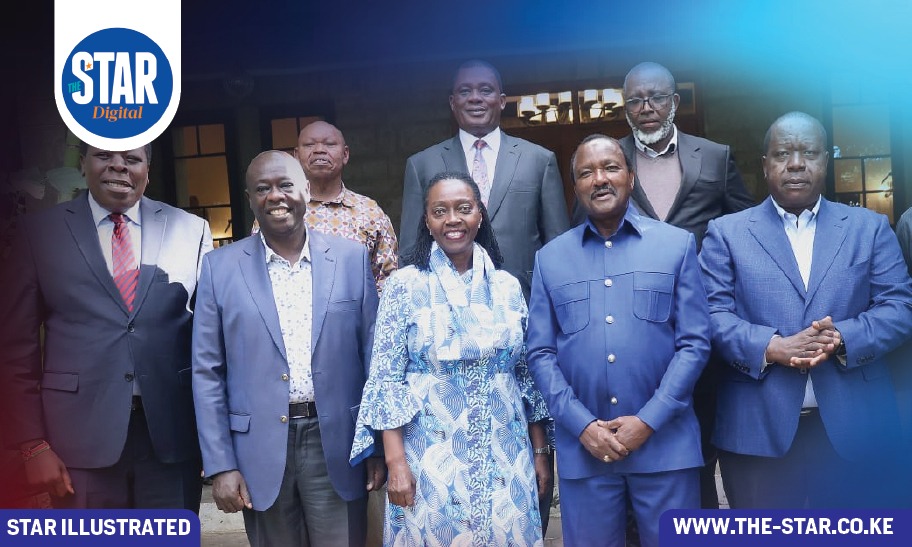
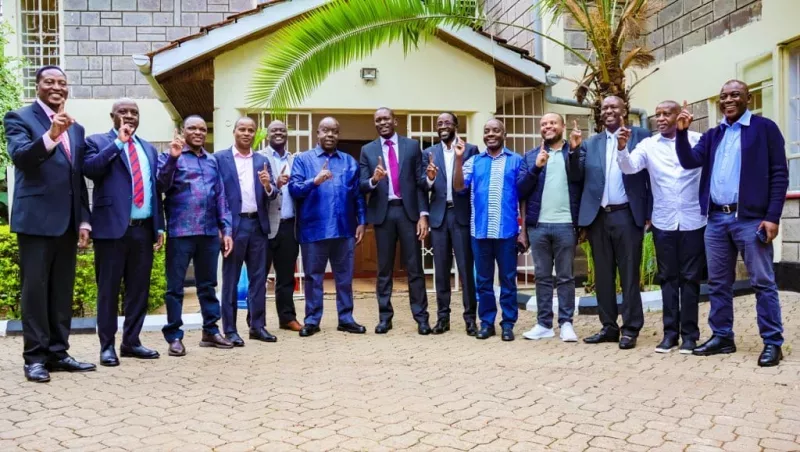
On Tuesday this week, a curious picture emerged, causing a sensation in political circles. It was that of leading lights of the opposition to President William Ruto’s rule, led by Wiper boss Kalonzo Musyoka, former DP Rigathi Gachagua, PLP leader Martha Karua and former Interior CS Fred Matiang’i.
Others in the photo were former CSs Mukhisa Kituyi, Justin Muturi, Mithika Linturi, Eugene Wamalwa and former PS Saitoti Torome.
On any given day, the political influence per capita on that photo would appear quite impressive.
I am certain those who released the picture to the public intended the message to be that the anti-Ruto brigade was uniting for a common assault on the President’s ambition for a second term.
Except that if you have been around long enough, you could read the vanity in the photo from miles away.
History provides crucial lessons on similar opposition ventures and how each played out. You would have to go right to the beginning and examine the events leading up to the very first election after the restoration of multi-party politics in 1992.
Then, the opposition easily split, with its luminaries Jaramogi Oginga Odinga, Kenneth Matiba and Mwai Kibaki (all now deceased) giving Moi a near-smooth ride to State House.
Predictably, the combined total of opposition votes was way above what Moi garnered in the polls.
Five years later and ahead of the 1997 polls, it seemed only Langata MP and NDP leader Raila Odinga was preaching the message of a joint opposition candidate. Indeed, before Matiba burnt his voters’ card and opted to sit out that year’s election, all indications had been that Raila would back Matiba.
With Matiba out and the other three top opposition contenders – Mwai Kibaki, Charity Ngilu and Kijana Wamalwa – each choosing to go it alone, Raila had no option but to do the same.
Moi gave them another thrashing. But immediately after the 1997 election results were announced, the opposition somehow found its unity voice, when three of the candidates called a joint presser to reject the results.
Tired of chasing the elusive dream of opposition unity, Raila boycotted their presser and ran off to launch a cooperation framework between his NDP and Kanu, which ultimately led to the merger to form the fancily christened New Kanu, in 2000.
The political marriage didn’t last too long.
Incidentally, it was the same Raila who would finally engineer a united opposition front – after he left Kanu – bringing along several erstwhile dyed-in-the-wool ruling party operatives and endorsed Mwai Kibaki for President, ahead of the 2002 elections.
That electoral cycle was the first time the opposition would unite against the ruling party and end Independence party Kanu’s rule and dominance, fatally consigning it to a political footnote.
The jury is still out on who won the subsequent 2007 election, but needless to say, another well-structured cross-country political force created by Raila and led by the ODM Pentagon, Kibaki and his PNU party suffered such a thrashing that it would take fraudulent electoral acts and a night swearing-in to retain the presidency.
The 2007 election remains a blot on the country’s history, for it created the impunity and opaqueness that have become hallmarks of Kenya’s elections ever since. But once again, it confirmed that a broad-based opposition front is all it takes to send a ruling party scampering for political safety.
However, the less said about the 2013, 2017 and 2022 elections, the better.
Back to the new cast of ‘liberators’ pictured in that trending photo on Tuesday. The first problem I see is the clash of intentions and ambitions.
Take, for instance, Wiper boss Kalonzo Musyoka. His default modus operandi is to approach these engagements with the mentality of self-entitlement that revolves around it being ‘his time’ and therefore, for purposes of any coalition, he has to be the anointed one.
He may ultimately step down for someone else, as he has done before, but the mental drain from such negotiations can often be a strategic and time drawback for his coalition, leaving underlying resentment in the campaign period.
The good omen for him, at least for now, is that protocol people placed him and Karua at the centre of the photo, so they hog the ‘presidential’ positions in the group.
Speaking of Karua, one has to remember she is one of the most difficult people with whom to form coalitions.
She is thoroughly opinionated and her regular sanctimonious lectures about moral political standpoints often rub even her coalition partners the wrong way.
In a game where morality is as potent as a stick in a gunbattle, these Karua outbursts often serve only to alienate her from the inner sanctums of coalition arrangements.
This is especially so since she has never demonstrated the sort of grassroots support that is a prerequisite for being taken seriously in Kenyan coalition-building.
Then there is Matiang’i, who has already been declared the favourite Jubilee presidential candidate for 2027 and therefore, former President Uhuru Kenyatta’s man in the race.
He has returned from a long sabbatical abroad and he certainly hasn’t come back to endorse someone else.
Most likely, he has joined that group in the belief that Uhuru will get the rest to step down and line up behind his bid. His problem will obviously be how to tame the monumental political egos of Kalonzo and Karua, enough for them to back him.
Three people in that image—Gachagua, Linturi and Muturi—are tribal and regional lords who only find themselves in there because they have a bone to pick with Ruto.
In my estimation, their only value lies in their perceived ability, based more on hope rather than any tangible strategic plan, to rally their region around one candidate. But Gachagua himself is a master of divisive tribal rhetoric, a disgraced political operator whose methods are undesirable beyond his ethnic base.
His tag team of Linturi and Muturi are no better in terms of political value outside the Mt Kenya region.
In that picture, there is not much to say about Wamalwa and Torome without appearing to waste space in this esteemed paper.
But perhaps the best man for President in the photo is the man who will get no more than a casual glance—former Kimilili MP Mukhisa Kituyi.
He is the former secretary-general of the UN Conference on Trade and Development (UNCTAD), having served from September 2013 to February 2021.
I am an avowed admirer of the Kituyi political brand, even though it never seems to take off into national stature.
He was a member of the indomitable Second Liberation cast of the late ’80s and early ’90s and one of the uncompromising ‘Young Turks’ who worked with Jaramogi Oginga Odinga.
Kituyi’s sharp intellect and principled politics would stand the opposition in utmost good stead for a presidential run, if the group picked him. But he is on the fringes of the picture, a statement of how far from the centre they have placed him.
My estimation is that no matter how each one lobbies for the ticket, the issues and ambitions that divide them are more powerful than those that unite them, so a joint run is almost impossible at this time.
Unless, of course, Raila himself decides not to run in 2027 and backs one of them.
In my humble submission, whoever Raila backs in 2027 will win the presidential election, whether this be an opposition candidate or Ruto himself.
The writer is a political commentator




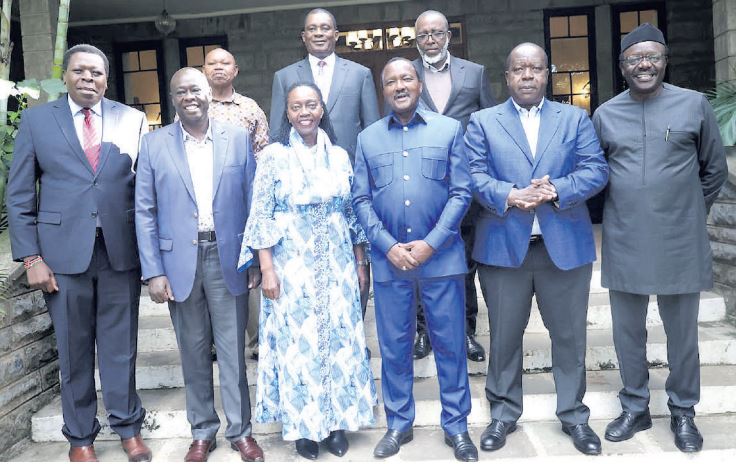 (Front Row) DAP-K leader Eugene Wamalwa, former DP Rigathi Gachagua, PLP’s Martha Karua, Wiper party leader Kalonzo Musyoka, former CS Fred Matiang’i
and Dr Mukhisa Kituyi. (Back) Former PS Saitoti Torome, former CS Justin Muturi and Mithika Linturi during a meeting in Nairobi on April 29 /DENISH OCHIENG
(Front Row) DAP-K leader Eugene Wamalwa, former DP Rigathi Gachagua, PLP’s Martha Karua, Wiper party leader Kalonzo Musyoka, former CS Fred Matiang’i
and Dr Mukhisa Kituyi. (Back) Former PS Saitoti Torome, former CS Justin Muturi and Mithika Linturi during a meeting in Nairobi on April 29 /DENISH OCHIENG