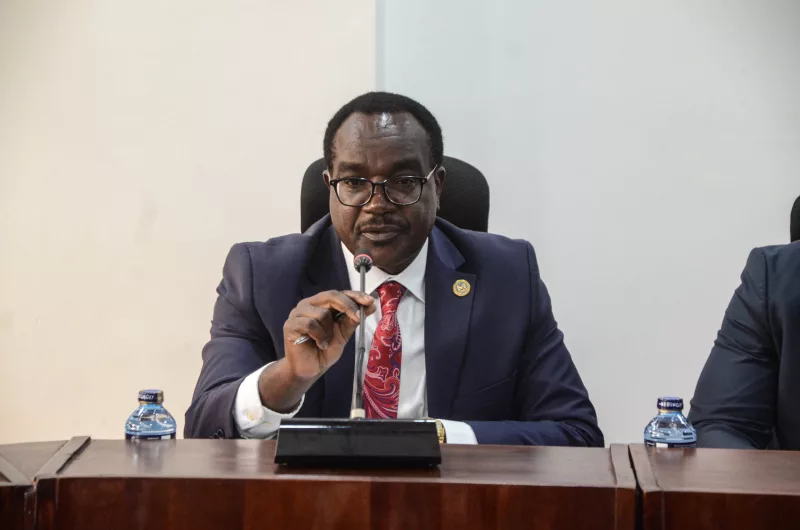
Former Deputy President Rigathi Gachagua has skillfully deployed an age-old strategy in political manoeuvrability.
It was adeptly utilised in the court of old empires. Make the king vulnerable and take your pound of flesh.
Guilt-tripping means making someone feel guilty, especially in order to induce them to do something to cause feelings of guilt by trying to manipulate the behaviour of the person and causing them to feel guilty.
William Ruto won the 2022 presidential elections by a slim majority of 200,000 votes. Largely, the decisive victory came from central Kenya, the Kikuyu ethnic community.
Ruto had picked Gachagua as his running mate not because of any nationalistic values but his primitive tribal skills in vote mobilisation.
The vast family wealth that he deftly controlled also came in handy. Gachagua turned against his former boss Uhuru Kenyatta and weaponised the hatred of the Kikuyu against the Luos into electoral victory.
The hatred is based on the historic Ichaweri oaths of 1969. He spewed vitriol against Raila to the extent of insulting Uhuru’s mother, the matriarch Mama Ngina, at her doorstep.
Styling himself as the Mau Mau grandson, Gachagua positioned himself as the next after Uhuru in the House of Mumbi pecking order.
He succeeded, but that was also his hubris. In Greek mythology, Icarus was the character who flew ambitiously too near the sun.
He and his father, Daedalus, fashioned wings of feathers and wax to escape imprisonment. Despite his father’s warnings not to fly too close to the sun, Icarus ignored the advice and soared too high.
The heat of the sun melted the wax, causing his wings to fail and he plunged into the sea and drowned.
Gachagua took Ruto to his kinsmen as his candidate because he saw a Mt Kenya vacancy after Uhuru. He personalised the community self-entitlement belief.
His bitterness towards President William Ruto is not about governance, development, or the people’s welfare—it is a selfish vendetta. Everything is about him.
His lamentations are reminiscent of Tolkien’s portrayal of Smeagol’s obsession with the Ring, an all-consuming fixation that ultimately led to his downfall in the fiery chasms of Mount Doom.
The Kikuyu community already had an axe to grind with Ruto, long before they fell out with Gachagua.
The taxes that were introduced in the first Kenya Kwanza budget in June 2023 hit the community in their softest underbelly. For the first time, agricultural produce staples were brought into the tax fold.
Then Ruto committed the cardinal sin of reaching out to Raila Odinga and the larger Luo community.
The 1969 oath was not only about keeping political power in the House of Mumbi house but also about keeping the Luo out of power.
Bringing Gachagua into national government after rejecting the overtures of their own Uhuru was a slap in the face by Ruto.
He committed what amounts to an unforgivable sin. In spite of Kikuyu tribesmen holding key positions in government,
Gachagua created and nurtured a narrative that painted the Kikuyu community as victims. Their disagreement with Ruto, which has turned out to have been personal, was ethnicised and later nationalised.
Gachagua has chosen not to pretend to profess national values, instead brazenly extolling the virtues of his community as the true owners of the country Kenya.
The state was formally founded in 1926, with headquarters in Machakos.
If not for the Uganda Railways, the headquarters of the new colony would have been moved to Fort Tenan. Port Florence, now Kisumu, then was in British Protectorate, Uganda.
Granted, the Kikuyu and Kalenjin communities bore the greatest brunt of the white settler gulag treatment.
This is mostly because their lands were expropriated and their kin exploited for cheap labour. Because Maseno School was the first formal educational centre in the colony, Luos and Luhyas were early in receiving Western education.
Thus, as Kikuyus provided raw labour to the white highlands, the Luos and Luhyas became the eyes of the white man as clerks and nyaparas.
This partly explains the diametric difference in the mannerisms of the Luo and Kikuyu communities.
This colonial heritage has determined the relationship between the two most politically conscious communities.
Ambrose Ofafa was assassinated by a knife stab because of this mutual suspicion relationship. And so was Pio Pinto, Argwings Kodhek, Tom Mboya, Robert Ouko and Odhiambo Mbai.
Jaramogi Oginga Odinga and later his illustrious son, Raila, have spared no efforts in rebuilding the trust among the communities, but without success.
In 1962 Jaramogi refused to be prime minister after his party Kanu won the self-government elections. Instead, he demanded the release of his second god, Jomo Kenyatta.
Forty years later, Raila would decline to run for the presidency and instead make the famous declaration “Kibaki Tosha” at the historic Uhuru Park.
Three years after Independence, Jaramogi was jettisoned from government in 1966. Three years after Narc, Raila was bundled out his government in 2005. How history repeats itself.
It is these occurrences in the history of Kenya that Gachagua is rekindling, recycling and manipulating these disturbing messages to cage the Kikuyu community.
He has reinvented the narrative that his community is the mainstay of the Kenyan national economy.
His claim of the community withholding their due tax remittances from their economic activities is tantamount to economic sabotage, which amounts to a criminal act.
Since Independence, Kikuyus have enjoyed state patronage through subsidies in farm inputs and bonuses in produce prices.
Many times, if not always, the farmers’ debts were paid off by the national government through budgetary allocations. Actually, these were not debts but willful neglect of personal financial responsibility.
Gachagua is acutely aware of his tribe’s fears and historical disadvantages. They are a matriarchal
society but pay great attention to and respect to male. Publicly, they eschew domination by a single leader as a totalitarian.
Silently, they always rally behind a Jamba. Once they settle on one, nobody questions his authority and dictum.
Gachagua studied social science at the University of Nairobi and therefore precisely understands the psychology of his community.
To rally the Kikuyu community, there must be an enemy. Because of their oath-taking tradition, the community betrayal.
Any acts of betrayal are dealt with decisively. That is why the atrocities of the Mungiki were tolerated by the community because they camouflaged acts of betrayal to the community.
Ruto was put in office to deal with Raila and Luos in fulfillment of the 1969 oath. Then he was to pave way and restore the throne to its rightful community. As with President Daniel Moi then, he refused to be a passing cloud.
As impatient as his ilk, such as Charles Njonjo, he showed his middle finger a little too early. He suffered the well-known fate as prescribed by Niccolò Machiavelli. He suffered impeachment and defeat in Parliament that stunned him more than his allies.
To recover, he retreated to his home ground and stirred rebellion through fomenting hatred.
He called on their deep sense of entitlement and portrayed his personal tribulations as those of the community. He gulled and goaded them into believing they failed their forefathers.
Gachagua’s ultimate mission is to make the Kikuyu community feel guilty of joint misjudgment in supporting Ruto in 2022.
This should inadvertently result in the community coalescing around him and crowning him the King of the Mountain. “Usiguze Mrima” shall have come to fruition.
Ochieng’ Kanyadudi is a Political and Policy Analyst

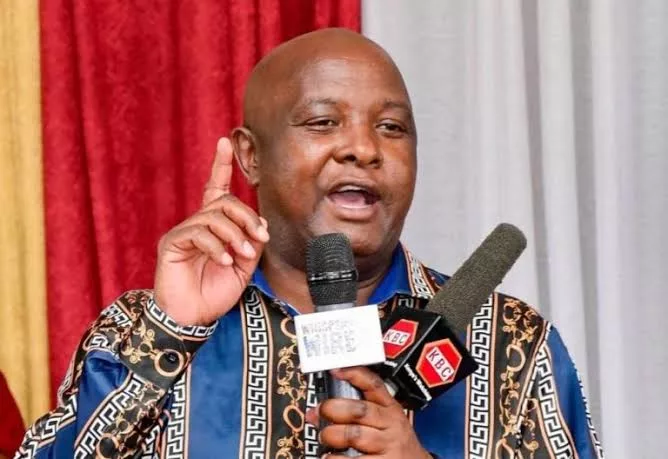
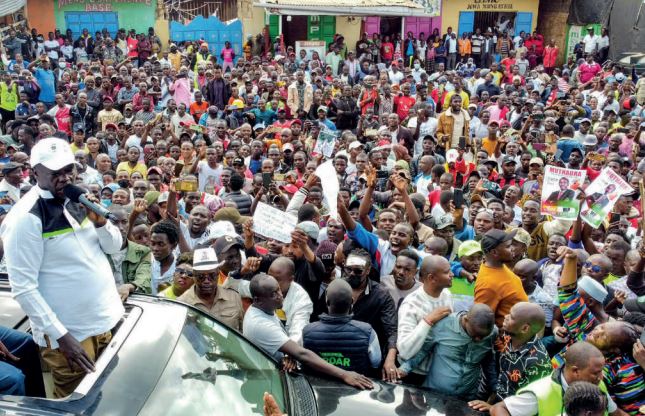 DCP Party leader Rigathi Gachagua addresses residents of Kiengu Market, Igembe Central Constituency in Meru on June 21 /HANDOUT