Radio and television stations, betting firms and
advertising agencies face a major revenue shake-up following government’s sweeping
regulations that impose a strict crackdown on the sector.
The new regulations ban roadshows, restrict prime time
advertisements, and force foreign operators to put up Sh300 million in capital
and guarantees.
The new rules, published in the Kenya Gazette, ban daytime
programming and outlaw many of the marketing tactics industry players have
adopted.
They require all gambling advertisements to receive
prior approval from the Gambling Regulatory Authority (GRA).
Celebrity endorsements and testimonials are also banned,
so are catchy promotional jingles. They impose hefty penalties on violators.
This means betting companies will no longer be allowed
to market gambling as a route to wealth or financial success.
Visibility of gambling advertisements across television,
radio, newspapers, billboards and digital platforms are set to reduce.
Among the biggest casualty will be broadcasters.
Under the new regulations, gambling advertisements
cannot be aired on television or radio between 6am and 10pm.
The only exception is when they are broadcast during a
live sporting event.
Broadcasters that rely heavily on betting companies,
particularly sports programmes, usually use the targeted hours.
Media owners, broadcasters and advertising agencies have
also been handed new legal responsibilities.
The regulations require them to verify that every
gambling advertisement has been approved by the Gambling Regulatory Authority.
The ads will have to be classified by the Kenya Film
Classification Board before they are aired, published or distributed.
Non-compliance attracts criminal sanctions, including a
fine of up to Sh1 million, imprisonment for up to six months, or both.
The government says the new framework is aimed at
protecting Kenyans from the harmful effects of gambling.
It argues the rules are also aimed at preventing minors
and vulnerable groups from being targeted by betting promotions.
The regulations require every approved advertisement to
prominently state that gambling is addictive and encourage responsible
gambling.
They must also clearly indicate that children are
prohibited from participating.
Each advertisement must also display the operator's licence
number, customer care contacts, counselling helpline.
They’ll be required to have a statement confirming that
the operator is authorised and regulated by the Gambling Regulatory Authority.
Betting firms will no longer be allowed to use
celebrities, influencers or former winners to market their products.
Advertisements must not portray gambling as an
investment, a reliable source of income or a shortcut to financial success.
The regulations also prohibit misleading messages, content
appealing to minors, and hooks commonly associated with betting campaigns.
Outdoor advertising has also been severely restricted in
the rules already tabled in Parliament for ratification.
Only electronic or digital billboards may carry gambling
advertisements, with operators limited to a maximum of two displays every hour.
Such advertisements cannot be placed within 200 metres
of schools, places of worship or children's recreational facilities.
They are also banned from public transport vehicles, bus
stations, street poles, walls and buildings that are not licensed gambling
premises.
Print advertising has equally been curtailed. Gambling advertisements will only be permitted in the
sports sections of newspapers and may not appear more than twice a week.
At least 20 per cent of the ad space must be reserved
for responsible gambling messages, licence details, age restrictions and
counselling information.
Roadshows, which betting companies have long used to
recruit customers through music, entertainment and promotional giveaways, have
been banned.
Any operator conducting such promotions risks a fine of
up to Sh1 million, six months' imprisonment or both.
The regulations, whose operation kick off immediately,
also introduce a stricter approval process for all gambling promotions.
Operators intending to advertise must submit their
applications to the Gambling Regulatory Authority at least seven days before
the campaign begins, with the complete script, artwork or promotional material.
Applicants will pay a non-refundable application fee of
Sh50,000, while approved campaigns will attract an advertising approval fee
equivalent to six per cent of the campaign budget.
In a separate set of regulations published alongside the
advertising rules, the government has tightened oversight of foreign gambling
operators.
Foreign companies must maintain a minimum paid-up
capital of Sh100 million and provide a Sh200 million security bond before
obtaining licences.
They are also required to deploy geo-blocking technology
and identity verification systems to prevent people resident in Kenya from
accessing their gambling platforms.
The Gambling Regulatory Authority will have remote,
real-time access to the operators' gaming systems.
The state further seeks to access the entities’ financial
records and will conduct quarterly technical audits to ensure compliance.
Any operator found allowing Kenyan residents onto
offshore betting platforms risks losing its licence and forfeiting the Sh200
million security bond.
The government has also established a Gambling Appeals
Tribunal to hear disputes arising from decisions made by the regulator.
Appeals will start from internal mechanisms within the
Gambling Regulatory Authority before they move to the tribunal.
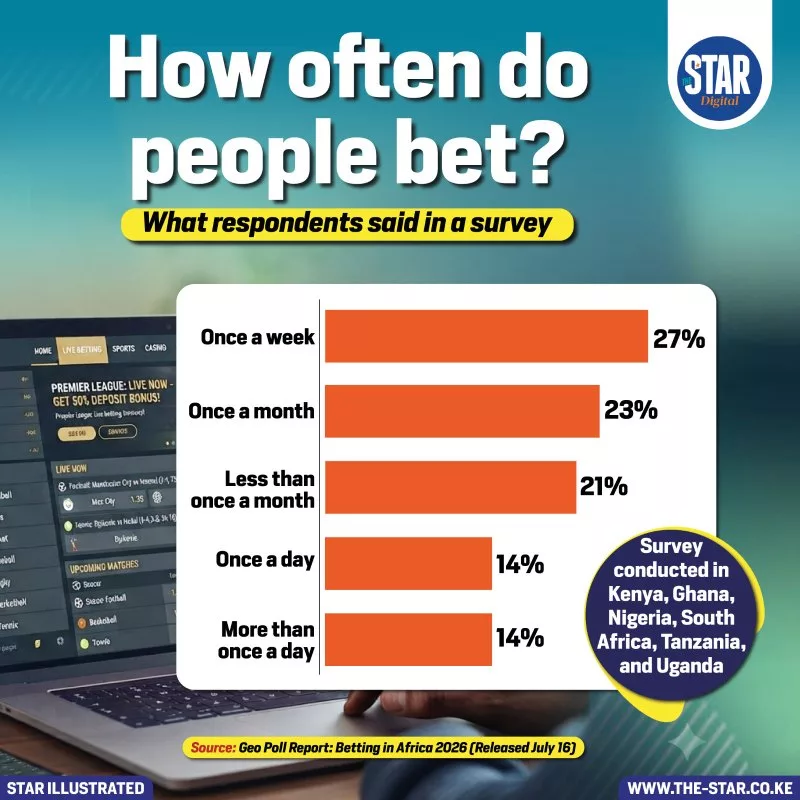
A recent study, by GeoPoll, showed that over 80 per cent
of young Kenyans engage in betting, and staked Sh330 billion in a single year.