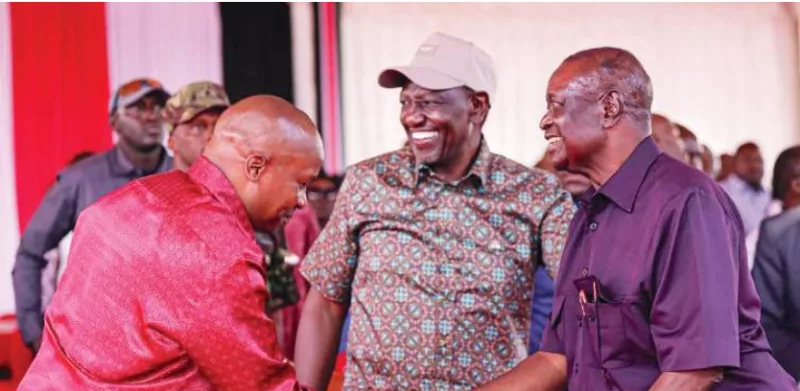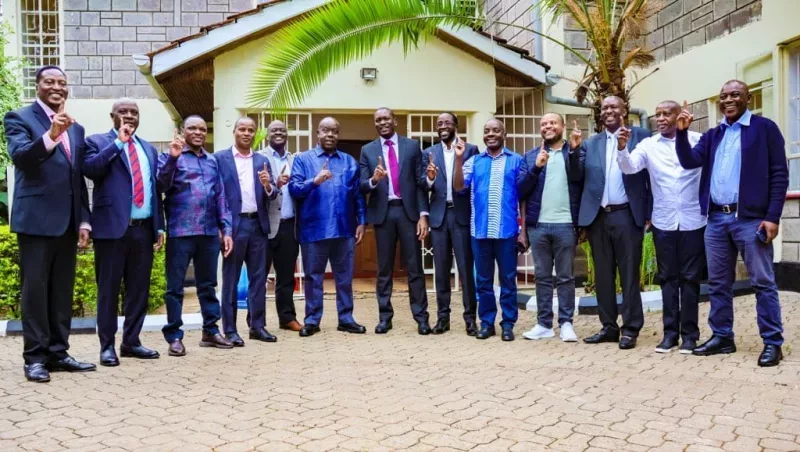


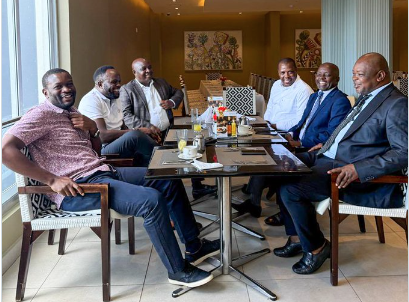
 Nairobi Senator Edwin Sifuna (left) and Trans Nzoia Governor George Natembeya (second left) with Western lawmakers; Vihiga Senator Godffrey Osotsi, Kabuchai MP Majimbo Kalasinga, Bumula MP Jack Wamboka, and Funyula MP Wilberforce Oundo/HANDOUT
Trans Nzoia Governor George Natembeya met Nairobi Senator Edwin Sifuna in Nairobi on Wednesday, May 20, in a gathering that immediately fueled speculation of possible alliances ahead of the 2027 General Election.
Also in the room were lawmakers from Western Kenya: Vihiga Senator Godffrey Osotsi, Kabuchai MP Majimbo Kalasinga, Bumula MP Jack Wamboka, and Funyula MP Wilberforce Oundo.
The meeting brought together leaders from different political camps, raising questions about a possible broader Western Kenya front.
Natembeya posted about the meeting shortly after, framing it around service and national interest.
“United by purpose, grounded in service, and committed to advancing the interests of our people not just for Western Kenya, but for Kenya at large,” he wrote, eliciting reactions on social media.
“When leaders come together with clarity, mutual respect, and a shared national vision, progress becomes inevitable,” he added.
Sifuna shared a picture from the same meeting on his social media pages with the caption “pole pole tu. Mbele iko sawa (slowly but surely. The future is fine).”
Sifuna heads ODM’s Linda Mwananchi faction, a group positioning itself as a people-driven campaign focused on cost of living, constitutional rights, and government accountability.
Natembeya is a member of the United Opposition through his DAP-K party. The two formations have often operated on separate tracks, even as both claim to speak for ordinary Kenyans.
The meeting comes as political consultations and
realignments gather pace across the country. Linda Mwananchi has gained
visibility in recent weeks, with Sifuna using the platform to criticise high
taxes, rising fuel prices, and the cost of basic goods. He has also warned
about what he describes as shrinking democratic space and the intimidation of
government critics.
According to Sifuna, the movement is about defending wananchi from policies that burden households and small businesses, regardless of party affiliation.
Leaders from Western Kenya have faced repeated calls to close ranks before 2027. The argument is that united front would give the region stronger bargaining power in national politics and improve its chances of securing development projects and positions in government.
Sifuna has been among the most vocal on that point. He has urged leaders from the region to put the interests of voters ahead of personal ambition, arguing that unity allows Western Kenya to negotiate from a position of strength.
Whether Wednesday’s meeting translates into a formal arrangement remains unclear. For now, the gathering signals that conversations across party lines are underway and that Western Kenya’s leaders are at least testing the ground for a coordinated approach.
With 2027 still two years away, early alignments could
determine how the region positions itself in a race expected to redraw the
country’s political map.