When a non-verbal autistic child was
found wandering alone in Nairobi, children’s officers were left with few leads.
The boy could not speak, did not know where he lived, and could not provide his
parents’ names or contact details.
But after his photograph and details were
circulated through a nationwide WhatsApp network and online missing children
groups, his father eventually saw the alert. He rushed to the station and was
reunited with his son in an emotional reunion.
The case reflects a growing reality in
Kenya. Social media, WhatsApp coordination, and online communities are
increasingly forming an unofficial missing children recovery system.
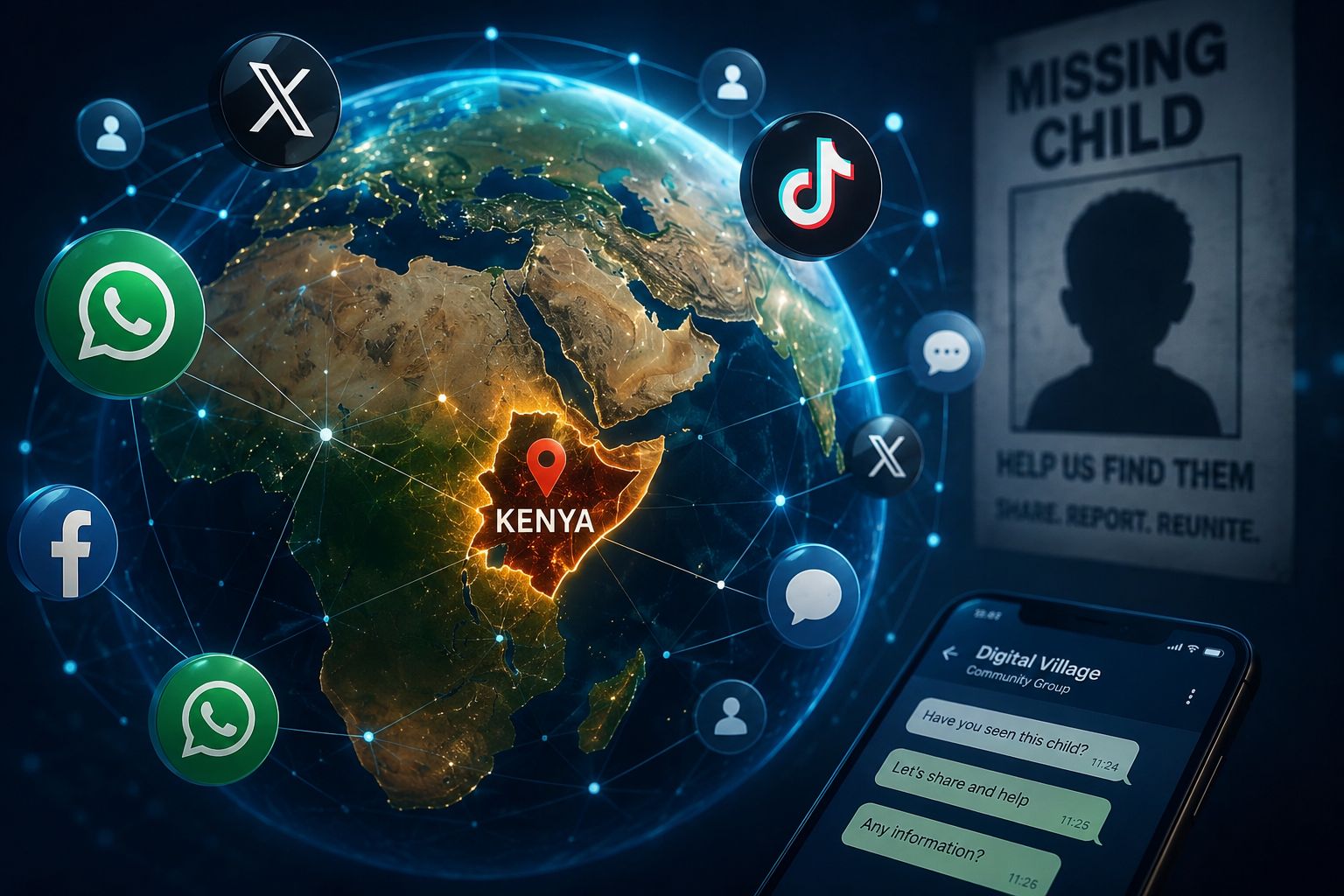
Across X, Facebook, TikTok and WhatsApp,
missing child posters now circulate within minutes. In many cases, they spread
faster than formal state systems can respond.
The viral alerts and digital tip-offs
mobilise online communities and often place immediate pressure on authorities
to act.
According to a children’s officer who
requested anonymity, frontline officers across the country rely heavily on a
nationwide WhatsApp group known as the State Department of Children Services
Missing and Found Children network.
The officer said the group has become one
of the most important tools in tracing missing children, especially in cases
where children cannot identify themselves.
“Most of the cases are not kidnappings,”
the officer said. “Many are children who run away from home or school out of
fear after making mistakes.”
One case involved a young girl who fled
after stealing Sh200 from her parents. Fearful of punishment, she travelled
across Nairobi, changed out of her school uniform, and created a false
identity. She lied about her name, her school, and even her parents.
When a Good Samaritan brought her to
authorities, officers opened a formal case record to document key details such
as the child’s name, age, parents’ names, and the police Occurrence Book (OB)
number linked to the case.
But every detail she gave was false.
“She lied about everything,” the officer
said. “The names, the school, where she came from. All of it.”
Believing she was from Bungoma, officers
spent weeks contacting children’s officers in western Kenya and following leads
linked to the identity she had provided.
Meanwhile, a poster with her real
identity was already circulating within children’s officers’ WhatsApp groups
and online missing child pages.
But because officers were focused on Bungoma
leads, the alert connected to her real identity was initially missed.
With no verified family details and no
immediate child protection safe house available, the matter was taken before a
magistrate. The court ordered that she be committed
to Nairobi Children’s Remand Centre while authorities continued to trace her
identity and family.
The officer noted that shortages in child
protection facilities continue to complicate such cases, especially as Kenya
shifts from institutional care towards foster and family-based care systems.
The girl remained at the remand centre
for six months while her family searched for her, unaware that she had already
been found. During her stay, she underwent
counselling and rehabilitation programmes designed to support children in
distress.
Over time, she built trust with
counsellors. She eventually revealed her real identity, provided her parents’
contact details, and was reunited with her family.
The officer said social media visibility
often determines how quickly cases receive attention.
“When a post goes viral, supervisors
start calling to ask whether officers have seen the case,” he said. “It puts more attention on both the child
and the officers handling the matter.”
The rapid spread of online missing child
alerts has created an informal digital network linking members of the public,
children’s officers, police, and organisations working to trace missing
children.
One of these organisations is Missing
Child Kenya Foundation, a non-profit that verifies, circulates, and tracks
missing child cases through social media platforms and a public hotline.
Since launching its Facebook page in
2016, the organisation says it has handled more than 1,800 cases.
According to data from the Child
Protection Information Management System (CPIMS), the Directorate of Children
Services recorded 10,581 child protection cases between January 2025 and March
2026, underscoring the growing pressure on Kenya’s child protection systems.
In an interview, Maryana Munyendo,
founder of Missing Child Kenya Foundation, said social media has become one of
the fastest ways of circulating missing child alerts.
“Social media has become Kenya’s quickest
way of helping find missing children,” she said.
She said much of the foundation’s work
depends on what she calls “community outsourcing”, where members of the public
rapidly circulate alerts across Facebook, X, TikTok and WhatsApp.
“If one person shares within their
network and another shares further, the more eyes and ears on the ground, the
faster information moves,” she said.
Maryana added that online communities
often provide more than reposts. Some users send possible sightings,
location-based tips, and observations from areas where children were last seen.
“It takes a village,” she said.
“Sometimes someone comments and says, ‘Look around this area,’ or ‘This happens
around here.’ Those small details can help.”
However, she warned that viral posts can
also spread misinformation or expose families to exploitation if not properly
verified.
“We do not just repost alerts as
received,” she said. “We fact-check first.”
According to her, Missing Child Kenya
verifies each case by confirming police reports and OB numbers with families
and police stations before publishing alerts.
This rigorous validation aligns with
official law enforcement protocols. While the public often relies on an
informal network, the formal state mechanism remains strictly tethered to the
Occurrence Book (OB).
To combat a sharp rise in disappearances,
the Ministry of Interior and the National Police Service have issued strict
directives abolishing any historic notion of an unofficial "24-hour
waiting period".
The official position of law enforcement
mandates that all desks log missing children cases immediately upon
presentation by a guardian. This immediate filing triggers a formal
investigative pipeline linking local stations to the Directorate of Criminal Investigations’
(DCI) Anti-Human Trafficking and Child Protection Unit, ensuring border alerts
and legal travel restrictions can be enforced before a child is moved across
long distances.
The organisation also avoids publishing
parents’ phone numbers after several families were targeted by fraudsters
posing as police officers and demanding money in exchange for false
information.
“We act as a buffer between families and
the public,” she said. “People take advantage during moments of panic.”
She added that despite the power of
digital mobilisation, coordination with formal systems remains essential.
“I am not the police. I am not law
enforcement,” she said. “Even if I had the hottest lead, I cannot make a
citizen’s arrest.”
Cases involving emergencies or unsafe
environments still require close coordination with police and the Department of
Children’s Services.
One of the organisation’s biggest
challenges is funding, especially in running a 24-hour response system.
“We have a hotline, but it does not
operate 24 hours because we do not yet have the capacity,” she said.
She noted that evenings and nights are
often the most difficult times for families.
“During the day, there is still light and
people are helping you search,” she said. “At night, panic increases.”
She added that some children only realise
they are lost when public spaces begin to empty in the evening.
“Sometimes children are separated during
the day and keep playing, but when others go home, they realise they are
alone,” she said.
Maryana said a fully operational
overnight response system would improve speed of response and provide
psychosocial support during critical hours.
“The first 24 hours are very crucial,”
she said. “A child can travel hundreds of kilometres within a few hours.”
She also noted that many missing children
cases go unreported, particularly in communities where such matters are handled
informally within families or villages.
For the autistic child reunited with his
father through a WhatsApp alert and the runaway girl traced after months at a
remand centre, digital networks became the turning point between prolonged
disappearance and reunion.
Despite funding gaps and systemic
challenges, Kenya’s digital village has reshaped how missing children's cases are
handled. What once depended mainly on police stations, posters, and word of
mouth is now increasingly driven by online communities, WhatsApp networks, and
ordinary citizens acting as first responders when children disappear.

 AI-generated















![[PHOTOS] Red carpet in Pretoria as Ruto begins South Africa visit](https://cdn.radioafrica.digital/image/2026/06/abe3e750-6e5a-4394-a45c-899768be6240.jpeg)