Governors are set to enjoy a significantly larger recurrent
expenditure ceiling in the coming financial year if a new Bill before the
Senate is passed.
However, the County Allocation of Revenue Bill, 2026, has
dealt a blow to Members of County Assemblies (MCAs), whose spending limits have
been reduced.
The proposed law, sponsored by Senate Finance and Budget
Committee chairperson Senator Ali Roba, seeks to increase recurrent expenditure
ceilings for county executives while reducing allocations available to county
assemblies.
The Bill, which has already been introduced in the Senate
for first reading, seeks to operationalise Section 107(2)(a) of the Public Finance
Management Act by setting expenditure ceilings for county governments.
According to the Bill, county executives will be allowed to
spend Sh25.25 billion on recurrent expenditure in the next financial year, up
from Sh23.41 billion in the current financial year.
The adjustment translates to an additional Sh1.83 billion
for governors and their administrations.
The recurrent expenditure allocation caters for salaries,
allowances, insurance and gratuity for governors and their deputies.
Others are county
executive committee members, county secretaries, chief officers, county
attorneys, directors and other administrative staff.
It also covers operational expenses such as public
participation forums, county budget and economic forums, audit committees and
maintenance costs.
The proposed increase is expected to give governors greater
flexibility in running county governments at a time when devolved units
continue to push for more resources to support service delivery.
However, while county executives stand to benefit from
larger spending limits, county assemblies are set to lose significantly under
the new arrangement.
The Bill proposes to reduce the total recurrent expenditure
ceiling for county assemblies from Sh39.93 billion in the current financial year
to Sh39.19 billion, representing a decline of Sh744.35 million.
The allocations to county assemblies cater for salaries,
allowances, mileage claims, insurance and gratuity for speakers and MCAs,
salaries and benefits for assembly staff, operations of county assembly service
boards and secretariats, public participation programmes and other
administrative expenses.
The reduction is likely to trigger resistance from MCAs,
many of whom have in recent years complained about shrinking operational
budgets amid rising responsibilities.
A breakdown of the proposed ceilings shows that several
county executives will enjoy notable increases in spending limits.
Nairobi county executive will receive the largest recurrent
expenditure ceiling, rising from Sh775.75 million to Sh834.72 million.
Nakuru county's ceiling will increase from Sh622.62 million
to Sh666.89 million, while Narok county's allocation will rise from Sh499.13
million to Sh531.63 million.
Kisumu is among the biggest beneficiaries, with its spending
limit increasing from Sh522.10 million to Sh638.23 million.
Bungoma county's allocation will rise from Sh562.05 million
to Sh601.42 million, while Kisii’s ceiling will increase from Sh569.35 million
to Sh608.71 million.
Samburu county records one of the sharpest increases, with
its recurrent expenditure ceiling rising from Sh400.55 million to Sh633.21
million.
For county assemblies, however, the trend is largely
downward.
Nairobi County Assembly's recurrent expenditure ceiling will
decline from Sh1.60 billion to Sh1.56 billion.
Nandi County Assembly's allocation will drop from Sh811.14
million to Sh797.26 million, while several other assemblies are expected to
experience similar reductions.
The proposed cuts come despite sustained lobbying by county
assemblies for additional resources.
Last week, six county assemblies — Nairobi, Kiambu, Kisumu,
Kitui, Garissa and Uasin Gishu — appeared before the Senate Finance and Budget
Committee seeking a review of their expenditure ceilings.
The assemblies argued that the current allocations are
insufficient to effectively discharge their oversight, legislative and
representation mandates.
However, Senator Roba signalled that the assemblies should
not expect major adjustments, citing resource constraints arising from lower
allocations to counties under the Division of Revenue Bill, 2026.


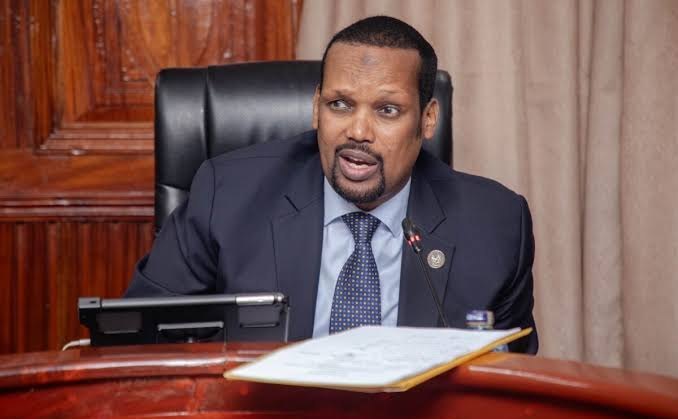 Senate's Budget and Finance Committee chairman Ali Roba