Spotlight on Parliament as debate exposes lack of grasp on Finance Bill
While robust debate is expected on such a consequential piece of legislation, some contributions appeared to be based more on hearsay.
by LUKE AWICH and MOSES OGADA
Audio By Vocalize
A section of National Assembly led by Majority leader Kimani Ichungwa, Budget Appropriation Committee Chair Samuel Atandi and his Finance counterpart Kuria Kimani, address the media regarding the debate on the floor on the Finance Bill, 2026, at Parliament Buildings, Nairobi, on June 17, 2026 /DOUGLAS OKIDDY
The debate on the Finance Bill, 2026, has exposed glaring gaps
in some lawmakers’ understanding of the contents of the proposed legislation,
raising questions about the quality of parliamentary scrutiny on critical matters.
The Bill, which highlights the revenue-raising measures, was
tabled in the National Assembly on Tuesday and is undergoing debate
before consideration and voting.
In the course of the deliberations, several MPs found themselves on the spot after citing clauses that do not exist
in the Bill or attributing provisions to the legislation that could not be
verified.
In a number of instances, colleagues challenged the
lawmakers to point out the specific sections they were referring to, only for
them to struggle to substantiate their claims.
The ‘embarrassing’ exchanges played out on the floor of the
House as MPs took turns to support or oppose the Finance Bill.
While robust debate is expected on such a consequential
piece of legislation, some contributions appeared to be based more on hearsay
and political rhetoric than on the actual contents of the Bill.
Deputy Minority leader Robert Mbui was first to trigger
controversy after claiming the Finance Bill should be rejected on account that
it proposes additional taxes on mitumba (second-hand) clothes.
“Mr Speaker, this Bill is going to tax clothes for those
people who cannot afford new clothes. We are introducing new tax on mitumba,” Mbui
stated.
He was, however, promptly challenged by Majority leader
Kimani Ichung’wah to direct the House to the particular clause carrying the
additional taxes.
“What Robert is saying is the propaganda that is being
propagated outside there; I want to challenge Robert Mbui to show the House and the country where in this Bill the tax proposal is,” Ichung’wah
fired.
“Because this Bill has no such tax proposal.”
With the session speaker Farah Maalim giving the Kathiani MP
a chance to substantiate, Mbui, unsure of the exact clause, was forced to
withdraw the claim, raising questions on the grasp of the document.
“This is a huge Bill, for me I would have to go through
clause by clause so that I can find it,” Mbui said as he was pushed to
submission.
“Mr Speaker, what I will do, in the interest of time, because I see members want to eat into my time, is withdraw that comment."
On Wednesday, Kabuchai MP Majimbo Kalasinga also cited a non-existent
clause, which he claimed is proposing additional taxes on mitumba clothes.
Holding what appeared as a copy of the Bill, Majimbo
directed the House to a non-existent clause 169.
“Kenyans are not fools. When they watch and read, and we say
we have not imposed any tax on mitumba and yet it is put here in Clause 169,”
Majimbo said, brandishing a copy of the Finance Bill, 2026.
“Mr Speaker, those [saying there is no additional taxes on
mitumba] put us in very awkward position.”
However, it emerged that ‘Clause 169’ being cited by the
Kabuchai MP is not in the Bill with session speaker Ugenya MP David Ochieng’
pointing the same to the lawmaker who by then had taken his seat.
“I want to request as follows, I know all of us are emotive
but let us be factual,” Ochieng’ interjected.
“I am listening to Kalasinga and he refers to Clause
169 and you know it is not there.”
Majority Whip Sylvanus Osoro also dismissed claims on tax on
mitumba and explained the Bill only moves the second-hand clothes under tax exempt.
“This House has been told that the proposal in the Finance
Bill seeks to raise tax on mitumba. Far from it, on the contrary, what this
Bill seeks is to completely move mitumba to exempt status,” the South Mugirango
said.
“Currently, those vendors who deal in mitumba clothes pay 16
per cent but looking keenly at the First and Second Schedules of the Bill, and
specifically Clause 21, which has been deleted, it is no longer there. There is
nothing that calls for an increase in the percentage of taxes on mitumba
imports.”
In another incident, Makueni MP Rose Museo claimed the
Finance Bill being considered by the House is meant to generate Sh4.8 trillion.
However, the Bill is meant to generate only Sh98.5 billion.
This is not the first time MPs have come under scrutiny over
their understanding of a Finance Bill.
In 2024, following widespread opposition to the Finance Bill
that year, some lawmakers publicly expressed regret admitting they lost
significant sector-specific incentives in their regions.
The admissions sparked criticism from stakeholders who
argued that elected leaders have a responsibility to thoroughly interrogate
legislative proposals before taking positions on them.
The latest debate comes amid heightened political
temperatures ahead of the second anniversary of the Gen Z-led anti-government
protests that rocked the country in 2024.
The demonstrations were largely triggered by opposition to
tax measures contained in the Finance Bill of that year.
Treasury CS John Mbadi has previously
cautioned against what he termed deliberate misrepresentation of the current
Finance Bill by some politicians.
Yesterday, Ichung’wah accused sections of the opposition of selectively
presenting information about the proposed law in a bid to stir public anger and
mobilise protests.
“The propaganda was started by Kalonzo Musyoka. What the 14
members who could force division were trying to do was to incite emotions of
Kenyans, but Kenyans know them very well,”
the Kikuyu MP said.
However, critics argue that public concerns can only be
addressed through transparent communication and comprehensive debate anchored
on facts rather than political messaging.
Bumula MP Wanami Wamboka while calling for the rejection of
the Bill claimed a number of hidden issues will make life more difficult.
“My quarrel with this Bill is how the government wants to
raise the revenue. When you read it closely, this is a Bill that will make life
more expensive for ordinary Kenyans, and it does so quietly. It is like cancer,
at first, you may not notice it, but ultimately you are destined for death,”
Wamboka argues.
“My single biggest problem with this Bill is that it hides price
increases inside technical tax language. Its favourite trick is to move
essential goods from zero-rated VAT to exempt VAT.”
Meanwhile, the Finance Committee has unveiled sweeping
amendments to the Finance Bill, 2026, following an exhaustive public
participation exercise across 13 counties.
The committee, chaired by Molo MP Kuria Kimani deleted the
proposed 25 per cent excise duty on mobile phones and the associated activation
tax.
“We are reducing the cost of phones. We have also reduced
the cost of bringing in equipment for kidney treatment,” Ugenya MP David
Ochieng’s said.
The committee, in a significant policy reversal, has
recommended retaining the zero-rated VAT status for locally assembled mobile
phones, electric motorcycles, electric bicycles, solar and lithium-ion
batteries, electric buses and inputs for animal feed manufacture.
The committee observed that "these items were recently
granted zero-rated status under the Finance Act, 2023, to support local
manufacturing and reduce the cost of essential goods.”
The Kimani-led team added, that "reversing this
position would increase production costs, discourage investment, and undermine
predictability in the tax system."
INSTANT ANALYSIS
The debate has become more than just a discussion about
taxes. It is also a test of whether elected representatives fully understand
the laws they are tasked with scrutinising and ultimately passing on behalf of
the public.
This is premium content
Subscribe to Continue Reading
Help us continue bringing you unbiased news, in-depth investigations, and diverse perspectives. Your subscription keeps our mission alive and empowers us to provide high-quality, trustworthy journalism. Join us today to make a difference!

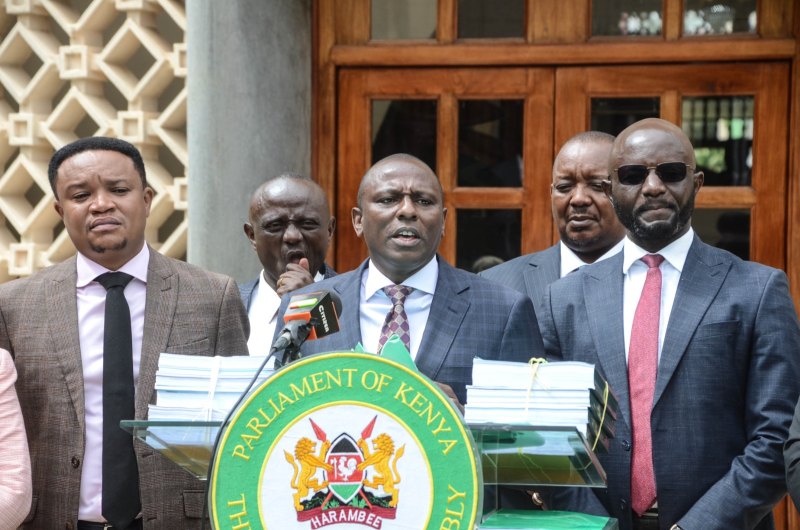 A section of National Assembly led by Majority leader Kimani Ichungwa, Budget Appropriation Committee Chair Samuel Atandi and his Finance counterpart Kuria Kimani, address the media regarding the debate on the floor on the Finance Bill, 2026, at Parliament Buildings, Nairobi, on June 17, 2026 /DOUGLAS OKIDDY