

President William Ruto has dismissed claims that the Finance Act 2026 introduces new taxes on mobile money transactions, second-hand clothes (Mitumba), land ownership and other basic services, saying misinformation had distorted public understanding of the law.
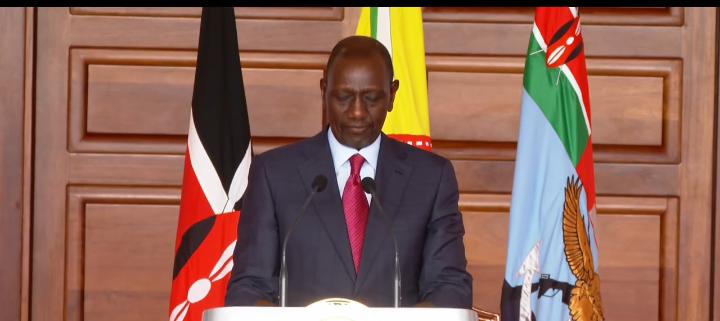
Speaking on Tuesday at State House, Nairobi, while assenting to the Finance Bill into law, Ruto said the government had not proposed new taxes that had circulated widely during public debate on the legislation.
“Contrary to propaganda, misinformation, disinformation and fake news, the government did not propose any taxes that were largely alleged,” Ruto said.
The president specifically dismissed reports that the new law imposes taxes on mobile money transfers, second-hand clothing, freehold land and water.
“There is no proposal to introduce taxes on freehold land or any land for that matter. There was no proposal to introduce taxes on second-hand clothing or Mitumba,” he said.
Ruto also said there would be no new taxes on M-Pesa transactions, mobile phones, airtime or data services.
“There is no new tax on M-Pesa or mobile money. The money you send to your family, your business or your friends will move tomorrow as it has always done,” he said.
The President said the Finance Act 2026 is intended to improve fairness in tax administration by strengthening compliance, sealing loopholes and ensuring all taxpayers meet their legal obligations.
“Let me state clearly, this law does not raise taxes on ordinary Kenyans. Instead, it improves fairness by strengthening compliance, closing loopholes and ensuring that every person and business pays what is lawfully due,” he said.
“We are pursuing tax avoidance, not taxpayers, offshore schemes, not ordinary wages, and leakages, not livelihoods.”
Ruto noted that Parliament subjected the Bill to extensive public participation before its passage, receiving submissions from more than 170 organisations and over 100,000 individual Kenyans.
He said the new law also introduces measures aimed at supporting livelihoods, manufacturing and green energy investments.
According to the President, incentives have been provided for motorcycles, electric buses, electric bicycles, solar batteries and locally assembled mobile phones to encourage innovation and expand economic opportunities.
The Head of State further said the Act seeks to protect the local sugar industry by increasing import duty on sugar from Sh7.50 to Sh40 per kilogram.
“The Act increases duty on imported sugar from Sh7.50 to Sh40 per kilogram, safeguarding 17 operational sugar factories and the livelihoods of two million farmers,” he said.
Ruto also announced a six-month tax amnesty that will waive penalties and interest on outstanding tax obligations to allow taxpayers to regularise their affairs.
In addition, he said mortgage tax benefits previously available only through commercial banks have now been extended to borrowers from registered microfinance institutions.
With his assent to the Finance Act 2026 and the Appropriation Act 2026, Ruto said the country now has the legal and financial framework required to fund government programmes under the Bottom-Up Economic Transformation Agenda.
“Kenya now has both the legal framework and the resources to finance its priorities, create jobs, strengthen livelihoods and invest in the future under the Bottom-Up Economic Transformation Agenda,” he said.