One in every five Kenyan young adults uses khat (miraa), while measurable numbers are also consuming heroin, cocaine, ecstasy and other hard drugs, a new UN report has found.
With current youth population in the country standing at 13.7 million this translates to close to 2.7 million young people hooked on miraa.
The latest prevalence estimates compiled by the United Nations Office on Drugs and Crime (UNODC) say 20.1 per cent of Kenyans aged between 17 and 23 years reported using khat, making it the most prevalent substance captured in the survey.
The youth dataset accompanying the 2026 World Drug Report paints a worrying picture of substance use among the 17 to 23-year age group.
The presence of heroin, cocaine and synthetic drugs has also been flagged, pointing to an increasingly diverse drug landscape.
The dataset also shows that 3.0 per cent reported non-medical use of tranquillisers or sedatives, while 1.8 per cent used heroin, 1.6 per cent cocaine, 1.5 per cent ecstasy and 1.0 per cent ketamine.
The findings came as the UNODC warned that global drug markets are becoming increasingly sophisticated, with synthetic drugs expanding rapidly and traffickers diversifying routes and supply chains.
"We have seen an unprecedented spike in new types of drugs on the market and, worryingly, some are more potent or dangerous than before," UNODC executive director Monica Juma said.
Juma said the continued expansion of the synthetic drugs market is one of the most significant developments highlighted in the report.
"In 2024, 755 new psychoactive substances, most of them synthetic, were reported globally – the highest number ever recorded in a single year," she said.
"This trend reflects the growing ease with which synthetic substances can be manufactured at the same time as they are becoming harder to detect and interdict."
The presence of heroin and cocaine among young adults reflects concerns that Kenya's position as a regional transport and commercial hub has increasingly exposed the country to international trafficking networks operating along the East African coast.
The data also indicate that synthetic drugs such as ecstasy and ketamine have established a measurable presence among Kenyan youth, mirroring trends observed in several other developing economies.
The UNODC selected Nairobi as one of only six cities globally for qualitative research examining the relationship between drug use, crime and public safety in preparing the 2026 World Drug Report.
The study reflects findings by the National Authority for the Campaign Against Alcohol and Drug Abuse (Nacada) released in April.
The 'Wastewater Analysis: To Assess Emerging New Psychoactive Substances and Illicit Drug Use in Kenya report' said cannabis, heroin, cocaine, khat and mandrax were the most commonly used psychoactive substances. Others included methamphetamine, hashish, ecstasy and prescription drugs.
Nacada said trafficking in plant-based new psychoactive substances (NPS) remains more geographically concentrated than that of synthetic NPS, as 19 countries reported seizures of plant-based NPS. Of those plant-based NPS, trafficking in khat and kratom is the most prevalent.
The report also broadly reflects findings by the Kenya National Bureau of Statistics' 2026 Economic Survey in terms of drug prevalence.
The survey found that between 2024 and 2025, some 15,791 kilogrammes of dangerous drugs were seized in the country.
However, the UNODC assessment also exposes a major weakness in Kenya's drug surveillance system.
While recent youth prevalence estimates are available, national data covering the general adult population remain fragmented, with many estimates dating back more than a decade. Kenya has no recent nationally representative prevalence figures for several drug categories, making it difficult to establish whether drug use is rising or falling across the wider population.
The lack of consistent national surveillance complicates planning for prevention, treatment and rehabilitation programmes, particularly as new psychoactive substances continue to emerge.
The UNODC similarly stresses that effective responses must be grounded in timely evidence rather than outdated estimates.
The agency says governments should increasingly monitor patterns of poly-drug use, mental health impacts, drug-related violence and access to treatment services.
The findings also reinforce the need for updated national prevalence studies to determine whether the patterns observed among young adults reflect broader changes across the country's population as illicit drug markets continue to evolve.
INSTANT ANALYSIS
The UNODC report suggests Kenya's drug problem is becoming more complex, with young people increasingly exposed not only to khat but also to heroin, cocaine and synthetic drugs. While hard-drug prevalence remains relatively low, the figures translate into significant numbers of users, signalling a shift from Kenya being mainly a transit route to an emerging consumer market. The report also exposes a critical policy gap: outdated national drug-use data. Without regular prevalence surveys, authorities risk responding blindly to evolving drug trends.

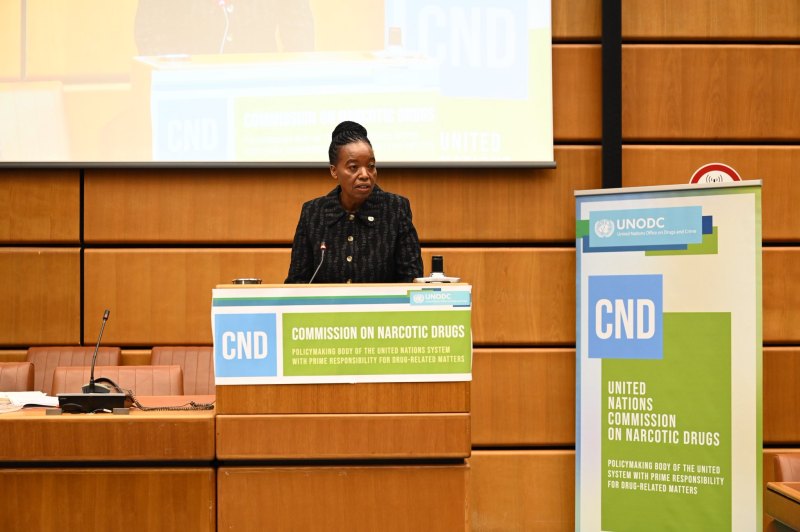 UNDOC executive director Monica Juma during the launch of the 2026 World Drug Report on June 26, 2026


![[PHOTOS] The new Ngong –Naivasha Road viaduct](https://cdn.radioafrica.digital/image/2026/06/64d4f771-4432-4aee-ba3c-2f304c4436ec.jpg)