

Have you ever noticed that Millennials and Gen Z often have different texting styles?
While the differences are easy to spot, they are communication trends rather than fixed rules. Not every Millennial texts the same way, and not every Gen Z user communicates similarly.
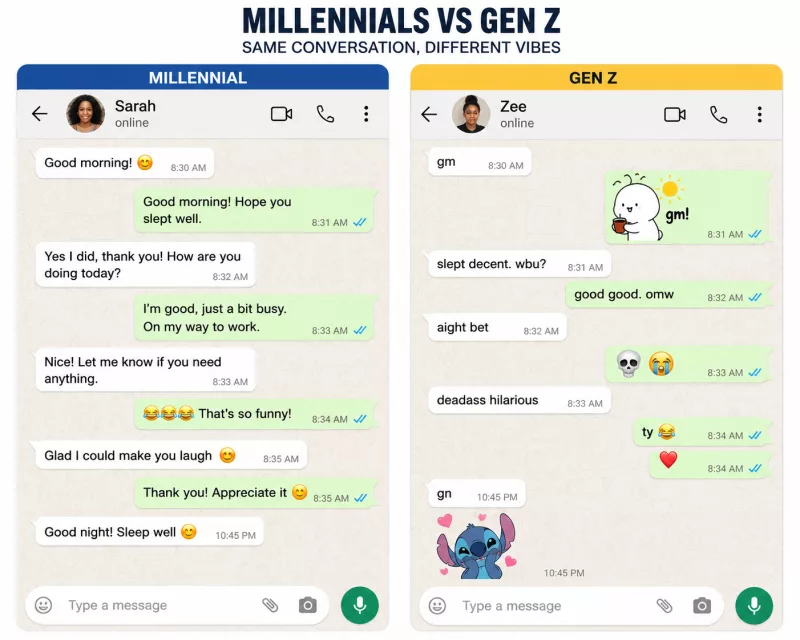
One of the clearest differences is how they react to messages. Millennials are more likely to respond with GIFs from movies, television shows or classic memes.
Gen Z, on the other hand, tends to favour stickers, custom stickers and image-based memes. Both generations use visual content, but younger users generally incorporate stickers more frequently into everyday conversations.
The way people express laughter has also evolved. Many Millennials still use "😂😂😂", "hahaha" or "lol" to show something is funny.
Gen Z often uses the crying face emoji "😭" or the skull emoji "💀" to suggest they are laughing so hard they are "dying."
Expressions such as "LMAOOO" and "PLSSS" are also common and convey the same playful tone.
Emoji use differs as well. Millennials often use emojis literally to express emotions. A smiling face usually represents happiness, while a laughing emoji simply indicates something is funny.
Gen Z is more likely to use emojis ironically, with their meaning depending largely on the context rather than the emoji's original purpose.
Greetings also vary. Millennials are more likely to send messages such as "Good morning", "Morning" or include a smiling emoji.
Gen Z may simply type "gm", send a sticker or even begin a conversation with a meme before saying anything else, reflecting a more visual and casual style of communication.
Typing habits also highlight the differences. Millennials often write complete sentences with proper punctuation, while Gen Z generally prefers shorter messages, fewer capital letters and minimal punctuation, creating a more relaxed conversational style.
Abbreviations have also changed over time. Millennials grew up during the keypad phone era, when shortcuts such as "Gud mrng", "hw r u" and "dr" became popular because typing was slower.
Gen Z still uses abbreviations, but they are more likely to rely on internet slang such as "fr", "ngl", "imo", "idk", "rn" and "tbh."
Even the way conversations end can differ. Millennials may write "Good night 😊" or "Talk later."
Gen Z might simply reply with "gn", "bet", "aight", react to the final message or end the conversation with a meme.
The different texting styles also shape how each generation views the other.
Carol, a Millennial, says her generation placed greater emphasis on proper sentence construction and etiquette when communicating.
“We were taught to construct sentences well and taught manners in terms of communication,” Carol says.
She adds, “Gen Zs think they will never grow old, but they will.”
Kendy, a Gen Z, sees it differently.
“Gen Zs are bold; we do what Millennials are not bold enough to do things they can't,” Kendy says.
Kendy also believes Millennials' communication style has been shaped by their experiences.
“Millennials chat the way they do because of Trauma.”
The best way to understand these differences is to view them as evolving communication styles rather than fixed generational rules.
For example, one conversation might include "Good morning 😊", "😂😂😂", "On my way", "Thank you 😊" and "Good night", while another could feature "gm", "💀😭", "omw", "ty" with a reaction and simply "gn". Which texting style sounds more like you?