

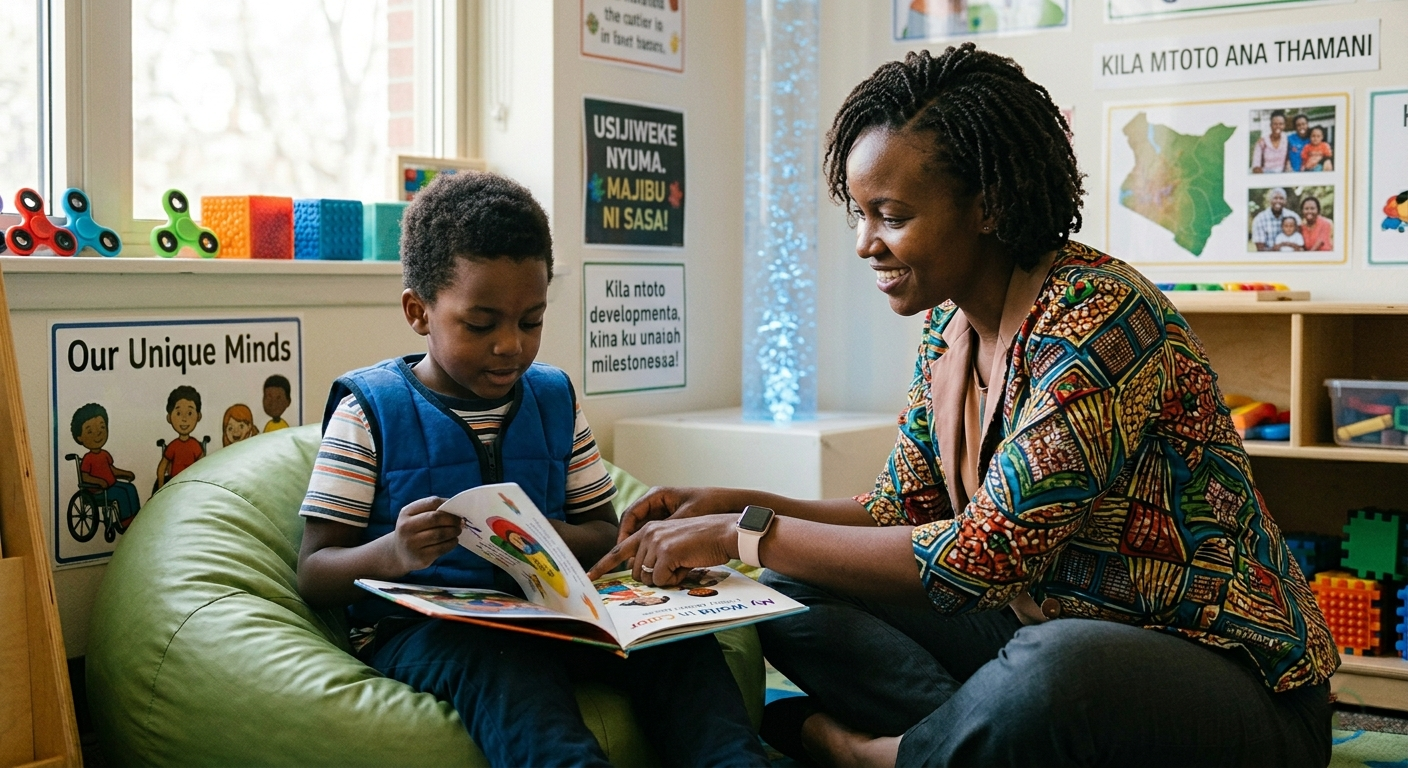
 AI-GENERATED IMAGE
“Don’t believe him,” Hamza Mohamed recalled thinking after a psychologist diagnosed his son, Haroon, with autism nearly two decades ago.
“I told my wife, ‘Don’t believe him. They’re trying to institutionalise a Black boy,’” he said.
At the time, Hamza says he had never even heard the word autism before. Sitting inside the psychologist’s office after the diagnosis, he remembers feeling mentally shut down as the specialist tried explaining what the condition meant.
“My eyes, my ears, everything was blocked,” he said.
For years, he convinced himself Haroon would eventually “grow out of it,” a decision he now regrets deeply.
“Those three years were resources I didn’t give my child,” he said. “Those three years were help I could have put in place.”
Today, Hamza speaks openly about that period not as a medical expert, but as a father trying to prevent other families from repeating the same mistakes.
Originally from Africa and now based in the United States, Hamza returned to Nairobi this month as part of efforts to expand Maangaar Voices, an autism advocacy and support initiative he co-founded during the COVID-19 pandemic, into Africa.
Inside the hall at CID Grounds in South C, parents, caregivers, educators, and advocates sat quietly listening as discussions shifted between diagnosis, stigma, exhaustion, and acceptance; themes many in the room appeared to know intimately.
Autism, also known as autism spectrum disorder (ASD), is a neurodevelopmental condition that affects how people communicate, interact, process sensory information, and experience the world around them.
According to the World Health Organization (WHO), approximately one in every 100 children globally is autistic, though experts say many cases in countries such as Kenya remain undiagnosed because of low awareness, stigma, and limited access to specialised assessment services.
In Kenya, autism assessments and specialised support services remain largely concentrated in major urban centres, leaving many families in other parts of the country with limited access to diagnosis, therapy, or specialised education support.
Since autism exists on a spectrum, autistic people can have different communication styles, support needs, sensitivities, and behaviours
For Hamza, understanding those differences became part of learning his son.
“You begin learning your child,” he said. “You learn what triggers them, what calms them, what environments are difficult for them.”
Before travelling to Kenya, Hamza said he spent weeks repeatedly taking Haroon to the airport beforehand simply to familiarise him with the environment, the gates, the luggage process, and the crowds.
“Sometimes they don’t like surprises or unfamiliar spaces,” he explained. “You have to go by their time.”
Parenting, he says now, forced him to develop a kind of patience he never previously understood. After Haroon’s diagnosis, it was his wife who first pushed the family toward acceptance while he remained emotionally resistant.
“My wife kept saying we needed help, that we needed to understand what autism is,” he recalled. “But I was still in denial.”
The shame surrounding autism, he added, often spills into family life long before families receive support.
“People say the child is stubborn, spoiled, bewitched, or that it’s bad parenting,” he said. “The stigma doesn’t come from parents hiding their children. The stigma comes from us, the community.”
That pressure, according to Hamza, can quietly strain marriages and leave parents emotionally overwhelmed.
“Sometimes you want to pack your bags and run away,” he said. “But what are you running away from? Your own child?”
He believes many fathers struggle to process the emotional weight of an autism diagnosis, often leaving mothers to carry much of the burden alone.
That sense of isolation is something Annab Mohamed, founder and chairlady of Ability Inclusion Alliance, says she frequently encounters among families raising neurodivergent children.
“As a community, it’s time we come together,” she said. “Stigma is one of the things that puts us behind.”
Annab, who also identifies as a mother to a neurodivergent child, said many families still struggle to find environments where autistic children are properly understood and supported.
Her organisation works with caregivers, schools, Kenya Institute of Special Education, and government institutions to improve support systems and inclusion for neurodivergent children and their families.
Rather than focusing only on limitations, she says families and schools should also recognise children’s strengths, interests, and abilities.
“We don’t focus on a child’s disability,” she said. “We look at their abilities.”
Hamza said his experiences parenting Haroon also changed the way he viewed other families navigating autism. He recalled encountering a distressed mother struggling with her autistic son during a public meltdown inside a supermarket abroad.
The child had collapsed onto the floor crying and screaming while overwhelmed shoppers stared. His mother, visibly embarrassed and exhausted, tried pulling him up while apologising to people around her.
Recognising that the child was likely overstimulated rather than simply “misbehaving,” Hamza encouraged the mother to stop focusing on the surrounding judgement and instead focus entirely on helping her son feel safe.
Together, they sat quietly beside the child until he eventually calmed down.
“That’s when I realised how much parents carry alone,” he said.
For Hamza, changing conversations around autism also meant changing the language surrounding it.
He explained that Maangaar, a Somali term meaning “unique mind,” was created by Somali advocates and linguists searching for a more culturally familiar and less stigmatised way to speak about autism.
The idea, he said, was partly inspired by the Māori concept Takīwātanga, a term used in New Zealand which describes autistic people as existing “in their own time and space.”
“In many communities, autism is associated with something negative,” he said. “Parents avoid saying their child has autism. They will say the child is sick or avoid the conversation completely.”
Creating culturally rooted language around autism, he believes, can help families feel more comfortable seeking support without shame.
“What we realised is that if we had our own language for it, people felt more comfortable,” he said. “It takes away the power of shame.”
What began as a small support group of seven or eight parents on the audio platform Clubhouse has since evolved into Maangaar Voices, an advocacy organisation focused on autism awareness, caregiver support, and culturally relevant inclusion programmes across different countries.
Now, Hamza says part of the vision is bringing similar support systems to Kenya and eventually across Africa.
Working alongside organisations such as Ability Inclusion Alliance, KISE, Lote Tree Medical Centre, and partners including Lancet Laboratories, the group hopes to eventually establish a more comprehensive autism support centre in Nairobi focused on assessments, therapy, sensory activities, caregiver support, and educational guidance for families.
Organisers say the initiative is still in early planning stages as discussions continue around partnerships, assessments, therapy services, and long-term funding.
The support gap is something Dr Mohamed Hassan, the director of Lote Tree Medical Centre, says he frequently encounters among families seeking help after receiving autism diagnoses for their children.
“We kept seeing desperate parents asking what they can do for their child,” he said.
According to Dr Mohamed Hassan, many families arrive emotionally overwhelmed and uncertain about where to begin navigating therapy, testing, specialised education, or support systems.
“There is a gap,” he said. “We need spaces where these children can be understood and supported.”
But throughout the discussions, one message remained consistent: autistic children do not need shame or secrecy; they need understanding, patience, and support.
“Now mothers proudly say, ‘I’m a Maangaar mom,’” Hamza said.
For many families, advocates hope that shift, from silence and shame to visibility and support, is what will begin changing autism conversations across Kenya.
![[PHOTOS] Raila Odinga Stadium construction enters home stretch](https://cdn.radioafrica.digital/image/2026/06/45f6990c-4882-4cd2-b83c-8fc730dcdce5.jpg)