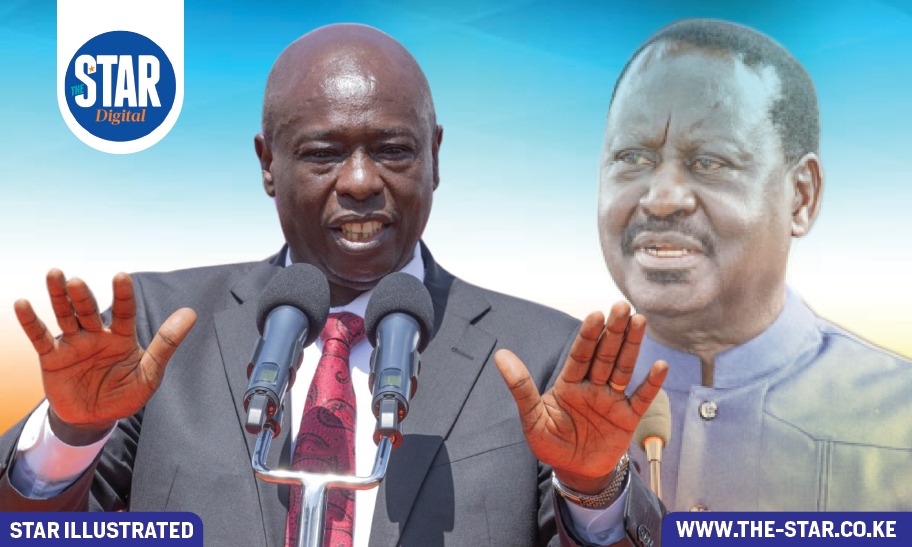
Auditor General Nancy Gathungu has exposed the extent of
tribal hiring at the Deputy President office during the tenure of Rigathi
Gachagua.
In audit findings for the 2023/24 financial year, Gathungu
revealed that 66 per cent of Gachagua’s staff — at both his Karen residence and
Harambee House Annex — were from a single community.
The law requires that no single ethnic community should have
more than 30 per cent representation in one public institution.
According to the report, Gachagua’s office had 542
employees. Of these, 249 were from one ethnic community.
The report did not however specify the identity of the
dominant tribe.
Tribalism was among the accusations cited in Gachagua’s
impeachment motion before the two Houses of Parliament.
However, the issue of hiring did not feature.
“Review of human resources and personal records provided for
audit revealed the office of the Deputy President had 542 employees, out of
which 249 or 46 per cent of the total number, was from one ethnic community,”
the reported reads.
Gathungu noted the biased hiring offended the law that
requires that no institution should have more than one-third of its staff
establishment from one ethnic community.
“This was contrary to Section 7(1) and 7(2) of the National
Cohesion and Integration Act, 2008, which provides that all public
establishments shall seek to represent the diversity of the people of Kenya in
the employment of staff and that no public establishment shall have no more
than one-third of its staff from the same ethnic community.”
The revelations now raise concern about diversity and
compliance with the law on ethnic diversity even as it emerged that Prime
Cabinet Secretary Musalia Mudavadi’s office also was in breach of the law.
At Mudavadi’s Railways offices, the Auditor General
indicated that two ethnic communities are running the show, holding more than
half of the all the hirings — 54 per cent.
Gathungu noted that most of the marginalised tribes had zero
representation in the Prime Cabinet Secretary office.
Just like in the DP’s office, the report did not specify the
identity of the tribes.
“This was contrary to Section 7(1) and 2 of the National
Cohesion and Integration Act, 2008 that requires all public establishments to
seek to represent the diversity of the people of Kenya in employment of staff,”
Gathungu said.
“Management did not provide a roadmap for resolving this
issue. In the circumstances, management was in breach of the law.”
The Office of the Prime Cabinet Secretary is the most senior
in the executive arm of the government after that of the President and the
Deputy President.
The office was established under the Executive Order No. 1
of January 2023 on Organisation of the Government of the Republic of Kenya.
The Office is charged with institutionalising principles of
the ‘Whole-of-Government’ and ‘Open-Government’ approaches in government work
places and in delivery of public services.