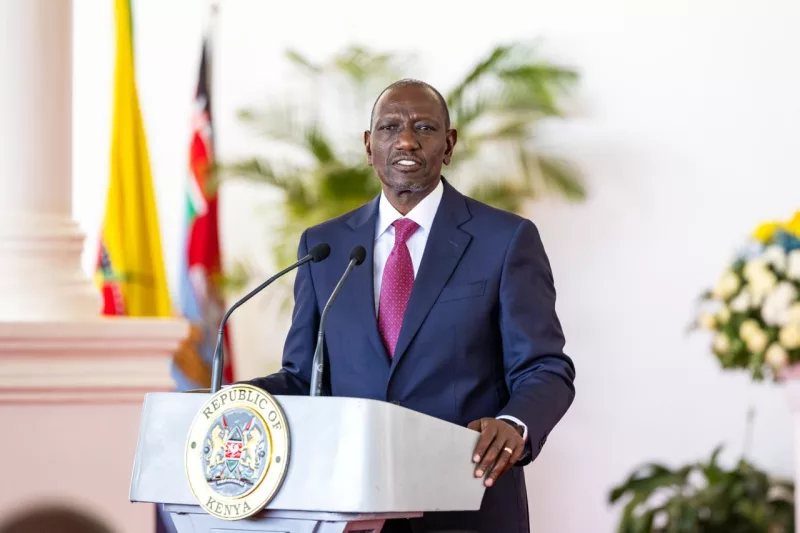


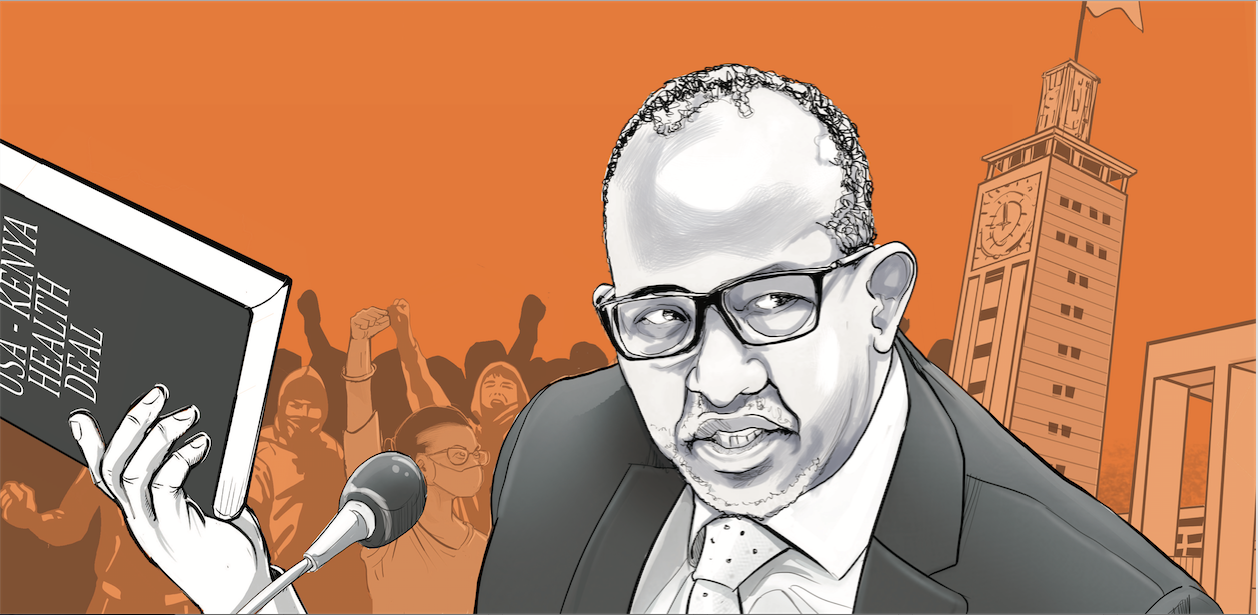
Last Thursday, Health Cabinet Secretary Aden Duale appeared before the National Assembly to apprise members on Kenya's preparedness to combat the Ebola virus.
The ever-bullish CS was also there to clear the air regarding the controversial quarantine and isolation centre being established at the Nanyuki Military Base in Laikipia county—a facility critics claim is tailored for exclusive American benefit.
Before his parliamentary appearance, Laikipia residents had already taken to the streets in protest. Claiming a complete lack of public consultation, the demonstrations tragically resulted in the reported loss of two lives.
The residents had also been told that the centre was part of a wider scheme by the present government to cull their population. They bought the lie hook, line and sinker.
In Parliament, Duale delivered an elaborate statement outlining containment measures and tracing the history of the Kenya-US biological engagement agreement. As a former Majority leader, he expertly braved tough questioning from MPs.
However, the most striking takeaway from his appearance was the declaration that the government will forgo public participation regarding pandemic response.
“We are not going to consult citizens. This epidemic does not require any consultation,” Duale affirmed, anchoring his stance on a moral and constitutional duty to protect both Kenyans and foreign nationals.
“We will not stop it,” he added, doubling down on the Laikipia facility despite pushback from lawmakers.
Duale’s remarks sparked nationwide fury, triggering heated debates from the floor of Parliament—where MPs claimed Kenyans unequivocally reject the centre—to public rallies and broadcast talk shows.
Public consultation is an accepted, non-negotiable principle of Kenyan governance. It is firmly anchored in Articles 1, 10, 118, and 196 of the constitution, alongside numerous judicial pronouncements defining its structure, form and substance.
True public participation requires that a matter be clearly understood, preceded by reasonable notice and robust public sensitisation, and structured to allow for balanced, meaningful public influence.
In the case of the US-Kenya Agreement, the document was tabled at a time when Parliament largely served as a rubber stamp for executive wishes.
While the public was technically given a window to submit views, the Health committee vice chairperson at the time, Robert Pukose, noted that not a single petition was received.
It is highly doubtful that a meaningful opportunity for public engagement was actually presented. Similarly, it is unlikely that the agreement explicitly designated these isolation centres for the exclusive use of Americans.
Unfortunately, deliberate fake news and the politicisation of pandemic responses by local and international actors have clouded rational debate.
These sideshows, alongside the procedural arguments over public participation, distract us from the severe biological threat staring us in the face. Unlike previous outbreaks, there are no approved vaccines against the Bundibugyo strain of Ebola.
As a regional logistical and diplomatic hub, Kenya faces a high risk of cross-border transmission. The current outbreak is centred in the eastern Democratic Republic of Congo (DRC), where protracted armed conflict has severely weakened health infrastructure.
With the virus already present in neighbouring Uganda and hitting areas with high population mobility, a domestic case could emerge at any moment. Our absolute priority right now must be immediate containment readiness.
Therefore, despite the poor execution of historical public participation and the blunt delivery of the CS's recent remarks, Duale is fundamentally right. There is simply no room for protracted public consultation when dealing with a pathogen as lethal as Ebola.
The most consequential public participation exercise Kenyans undertake is the general election held every five years. During these moments, Kenyans are presented with an array of choices, agenda and outlook for leadership.
Over the campaign period, they take time to vet these choices and to probe them as well. In 2022, citizens loudly pronounced how and by whom they wished to be led—a mandate later reinforced by the broad-based political arrangements of 2023.
The executive now possesses a clear, broad-based mandate to act decisively in the best interest of public safety. When it comes to stopping Ebola, swift action must take precedence over procedural bureaucracy.
Advocate of the High Court and a Senior Project Manager with the Friedrich Naumann Foundation. The views expressed here are his own