


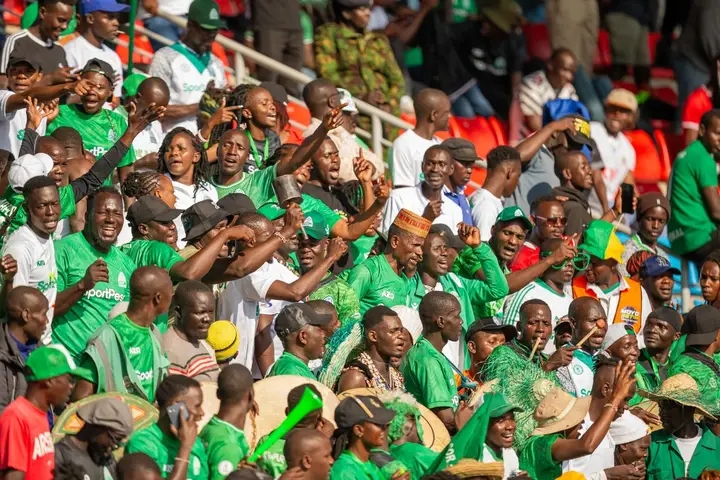
 Gor Mahia fans/HANDOUT
 The ugly confusion surrounding the SportPesa Premier League clash between Mara Sugar FC and Gor Mahia FC should alarm everyone who cares about the future of Kenyan football.
What should have been a grand build-up to a potential title-deciding fixture instead descended into days of public wrangles, legal arguments, contradictory regulations and last-minute interventions.
By the time the Football Kenya Federation finally confirmed Raila Odinga Stadium as the official venue, the league’s credibility had already suffered another damaging blow. This was never just about a stadium. It became a test of governance, consistency and legal clarity within Kenyan football.
To be fair, Mara Sugar’s frustrations were not entirely baseless. The club believed FKF had selectively enforced venue regulations. Their CEO, Ruth Ommala, pointed to Tusker FC, who had previously hosted matches at Wang’uru Stadium, as evidence that exceptions had been made before.
However, fresh details have since revealed a critical legal distinction that significantly strengthened FKF’s eventual position. According to league registration records, Tusker had formally pre-registered Wang’uru Stadium as one of their approved alternative venues before the start of the 2025/2026 season.
That single administrative detail changed everything. Rule 18 of the Rules and Regulations Governing Kenyan Football requires clubs to register one primary venue and two alternative grounds before every season begins.
Because Wang’uru already existed within Tusker’s officially approved venue roster, the Brewers could legally relocate matches there when circumstances demanded. The arrangement became necessary following the temporary closure and renovation of Nyayo National Stadium and Moi International Sports Centre, Kasarani, ahead of preparations for the 2027 Africa Cup of Nations.
Weighing in on the matter, Gor Mahia vice chair Sally Bolo argued that Wang’uru also fell within the acceptable geographical radius tied to Tusker’s operational base, making the move compliant with league regulations.
Rule 18 dictates that if a club must move a fixture away from its primary venue, the new venue must remain within the same geographical zone and within a strict 200-kilometre radius of the primary ground.
That clarification substantially weakens Mara Sugar’s argument that FKF selectively applied the rules. Unlike Tusker, Mara Sugar did not register Wang’uru Stadium before the season started.
FKF records show the club officially submitted Awendo Green Stadium as its primary venue, with Raila Odinga Stadium and Jomo Kenyatta Stadium listed as alternatives.
Once FKF inspectors ruled Awendo unsuitable because of crowd control, evacuation and infrastructure concerns ahead of the high-risk fixture against Gor Mahia, the federation argued that only the club’s pre-registered alternative venues remained legally available.
Rule 18 goes beyond registration. It also imposes geographical restrictions. Any relocated match must remain within the same zone and within a 200-kilometre radius of the primary venue.
FKF, therefore, viewed Mara Sugar’s attempt to move the match from Migori County to Kirinyaga County as a direct breach of both the registration rules and the geographical limitations.
The federation also leaned on the regulation’s consent clause, which grants FKF final authority to approve or reject venue relocations whenever the integrity, safety or orderly administration of the competition is at stake. And, to be fair again, Gor Mahia’s concerns over safety could not simply be dismissed as title-race politics.
Matches involving one of Kenya’s largest and most passionately supported clubs require serious planning. Kenyan football has already witnessed dangerous crowd disorder this season, most notably during the chaotic clash between Gor Mahia and Shabana FC at Gusii Stadium.
Ignoring such warnings would have been reckless. Still, even if FKF eventually reached the correct conclusion, the process exposed worrying institutional weaknesses. Why did the confusion spiral publicly before decisive intervention arrived? Why were venue compliance issues not resolved much earlier? Why are clubs still uncertain about which regulations are fully operational amid the legal disputes surrounding the revised 2025 framework? And why does every major domestic fixture increasingly resemble a legal battle instead of a football occasion?
These questions matter because credibility is the foundation of any serious league. Sponsors, broadcasters, supporters and investors expect professionalism. Instead, Kenyan football too often projects improvisation. Clubs accuse FKF of inconsistency. Administrators issue hurried statements. Fans receive changing information almost hourly.
Such disorder steadily erodes trust in the competition. FKF must now move beyond reactive crisis management and embrace structural reform. The federation urgently needs a transparent stadium compliance framework published before every season begins, clearly identifying approved venues, pending requirements and inspection outcomes.
High-risk matches should automatically trigger early security assessments involving county authorities, emergency responders and stadium management weeks before kick-off. Most importantly, Kenyan football desperately needs legal clarity. The ongoing uncertainty between the older 2019 regulations and the disputed 2025 framework continues fuelling confusion and confrontation.
Even though Rule 18 exists in both versions, the broader governance uncertainty weakens confidence in league administration. Clubs, too, must act responsibly. Home advantage can never outweigh public safety. Equally, influential clubs must avoid appearing to pressure administrators through public campaigns whenever disputes arise.
Long after the title race fades, Kenyan football must confront the deeper truth exposed by this saga: a serious league cannot continue operating in perpetual confusion. Order, consistency and transparency are no longer optional. They are essential to restoring faith in the game.