


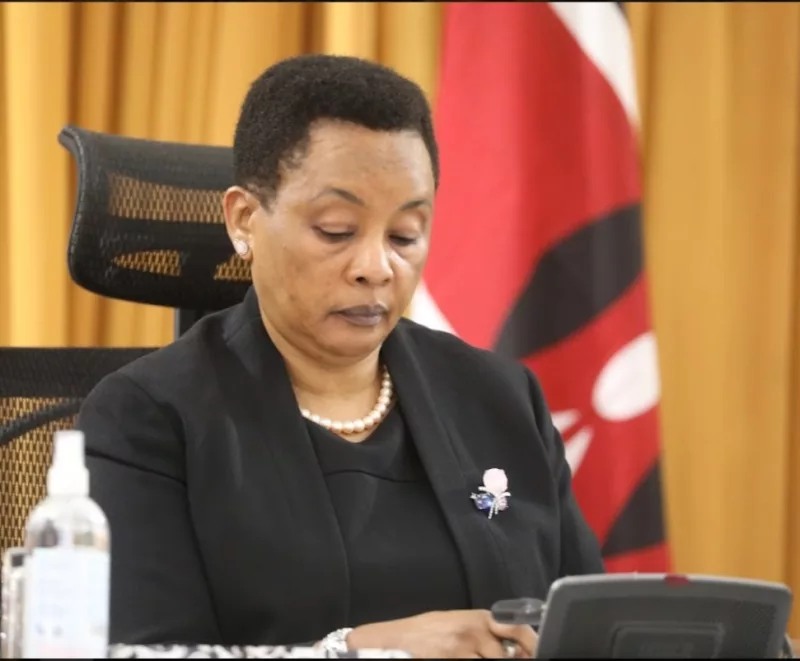
 Deputy Chief Justice Philomena Mwilu /PHOTO X
Japanese companies working on Kenya-funded infrastructure projects, have finally been handed relief after the Supreme Court ended a four-year legal battle over tax exemptions awarded to the firms.
In a judgement, the apex court dismissed an appeal challenging Legal Notice No. 15 of 2021, which affected tax exemption clauses contained in financing agreements signed between the governments of Kenya and Japan between 2007 and 2020.
The ruling by Deputy Chief Justice Philomena Mwilu upholds an earlier Court of Appeal decision that found the exemptions were lawfully granted by the National Treasury under the Income Tax Act.
The decision provides certainty for development financing at a time when Kenya is increasingly relying on concessional loans from bilateral lenders to finance infrastructure while limiting expensive commercial borrowing.
“Having found as we have done above, it follows that we must affirm the decision of the Court of Appeal and decline the invitation to reinstate the judgement of the High Court. The upshot of our determination is also that we find no merit in the appeal before us, and the same is ultimately dismissed,” said Mwilu.
The tax waivers cover Japanese companies, consultants and employees involved in projects financed through the agreements, including the Mombasa Gate Bridge, and the Mombasa Special Economic Zone near Dongo Kundu.
Other projects are Mombasa Port development, Olkaria geothermal projects, the Olkaria-Lessos-Kisumu transmission line, Mwea Irrigation Development Project and improvements to power distribution networks in Nakuru and Mombasa.
The case stemmed from a petition filed by Eliud Karanja Matindi, who argued that the Treasury unlawfully exempted Japanese firms from income tax through a Gazette Notice instead of legislation passed by Parliament as required under Article 210 of the Constitution.
He also contended that the tax exemptions should have been subjected to public participation and that exempting Japanese workers while taxing Kenyans performing similar roles amounted to discrimination.
The High Court agreed with those arguments in 2023, quashing the Legal Notice and declaring that tax waivers could only be granted through legislation passed by Parliament after public participation.
That decision raised concerns over the legal status of tax concessions embedded in Kenya's bilateral financing agreements, particularly those tied to Japanese Official Development Assistance (ODA) loans, where tax exemptions for contractors are often negotiated as part of the financing package.
However, the Court of Appeal overturned the ruling in December 2024, holding that Parliament had validly delegated powers to the Cabinet Secretary for the National Treasury under Section 13(2) of the Income Tax Act to exempt classes of income through Gazette Notices.
The appellate judges further ruled that the Legal Notice merely implemented obligations arising from bilateral financing agreements between Kenya and Japan and was therefore executive action rather than a statutory instrument requiring public participation.
The Supreme Court has now upheld that position, effectively preserving the legal framework used by successive governments to implement tax commitments negotiated under international financing agreements.
The judgment removes a significant legal risk for Japanese-funded infrastructure projects, many of which form part of Kenya's long-term transport, energy and industrial development plans.