For many Kenyans across different generations, last week had
to be the most surreal one in their lives. No matter whom you ask, the
consensus is that no one had actually ever envisaged Raila Odinga lying dead or
being interred in the soil.
Whether one loathed or loved the former Prime
Minister, everyone saw him as larger than life, and hadn’t thought of death and
Raila in the same sentence. The passionate outpouring of grief across the
nation and world confirmed it.
But first things first. The whole process of death and the funeral
of the icon brought out many heroes, individuals and institutions who went
beyond the call of duty to give Raila a hugely dignified and deserved send-off.
There was silent unanimity across the nation that regardless of political or
other leanings, we all needed to rally together in that moment, a unity hardly
ever seen in these shores.
I want to mention just two for today. The first is news
anchor Sam Gituku of Citizen TV. One of the earliest reporters to land at both
Raila’s Opoda Farm and the homestead of Raila’s parents, Kang’o Ka Jaramogi,
Gituku immersed himself into the job as if he had prepared allhis life for it.
But by far his most brilliant delivery, for me, revolved around his reporting
on Luo funeral rites and the attendant traditions and cultural practices. Luo
culture is perhaps the most misreported and misunderstood of all, with less
talented newsmen routinely picking up stuff, labelling them falsely and
perpetuating stigma.
But Gituku was succinct. Along with his colleague and
translator for that duration, Jay Bonyo, his reporting on the customs around
the whole process was fascinating and on point on each occasion. It was
refreshing, for a change, to hear a news reporter who sought to learn more,
while on the job and averred freely to local experts. Besides, he got involved
in certain tasks, such as the digging of the grave, and became a darling of the
local youth. His is a template from which other media houses can learn.
The second in my heroes list is the national carrier, Kenya
Airways. Between Raila’s death in India, and the discovery of the 72-hour burial
deadline in his Will, pandemonium practically broke out as the government, the
family and the ODM leadership rushed to fulfill the departed leader’s wishes.
With barely any time to prepare, KQ had the difficult job of flying out to India
and returning home with Raila’s mortal remains.
And yet, without a prior script or precedent to work with,
the national carrier, improvised perfectly, as it flew not just the body of the
enigmatic leader, but also carried a large group of government and national dignitaries.
Their staff were absolute class, breaking the heavy silence on the return
flight with well-placed messages of condolences and celebration of Raila’s
life.
To crown it all, the change of the flight’s call sign to
RAO001 was a creative masterpiece. Overall, KQ managed, with just one flight,
to give the sombre occasion tonnes of dignity and grace, proving that indeed,
they are the Pride of Africa.
But back home, the return flight hadn’t even entered Kenyan
airspace when fast-moving activities within ODM showed that the party was no
longer at ease: things were falling apart. Immediately the death was announced,
the competition over his “last instructions” went into full gear. It was clear
it was all going to be verbalised before the burial even happened.
First off
the blocks was Energy Cabinet Secretary Opiyo Wandayi, who immediately on
landing at Raila’s Opoda Farm to help oversee funeral arrangements, went to the
gathered media and declared that ODM would “stand with President Ruto beyond
2027”. It seemed that this message was of such importance that it could not be
delayed for the funeral rites of the ODM boss to be completed.
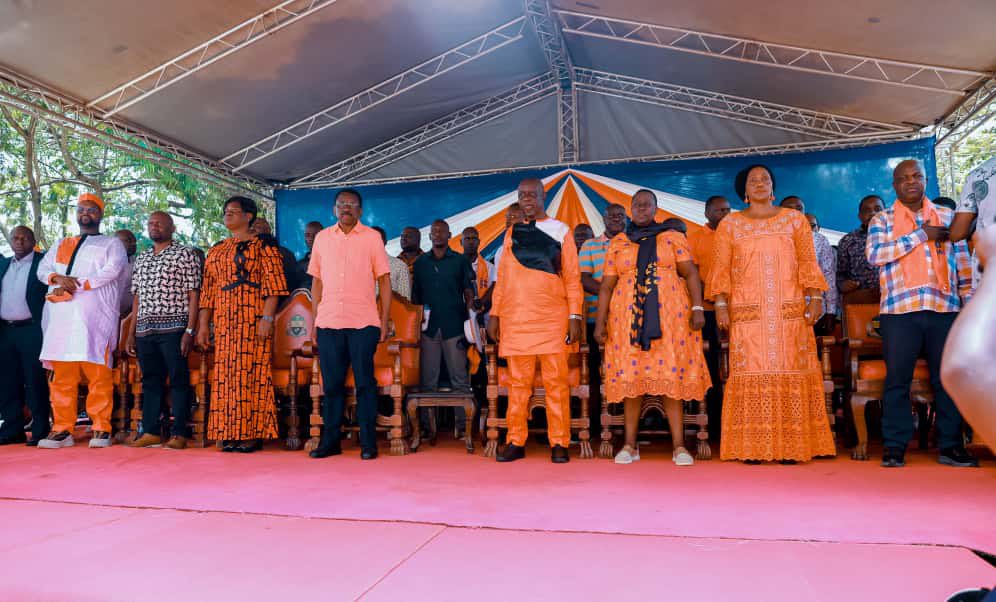
By the time the procession had completed the delicate
Nairobi and Kisumu legs of the journey, to arrive in Bondo, the ceremony at the
Jaramogi Oginga Odinga University of Science and Technology could have been a
campaign rally. Except for the new acting party leader, Siaya Senator Oburu
Odinga, who was Raila’s elder brother, Nairobi Senator Edwin Sifuna, who is also
the party’s secretary general, Kisumu Governor Anyang’ Nyong’o and Siaya Governor James Orengo, every ODM leader who
had the chance to speak became an instant member of the Ruto praise choir.
And in a bizarre twist, President Ruto decided to ‘take over’
the role of ODM leader, warning that he would “not allow” anyone to play around
with the party.
It was at that point very keen watcher realised how weak the
party’s position had become, because the competition to speak on its behalf had
obviously involved the President, at least five Cabinet Secretaries and at
least eight people within the party leadership. Nearly all of them came bearing
the card “Baba told me”, reflecting a strange desire to become the one bearing
Raila’s last political wishes. They appeared to ignore the public fact that at
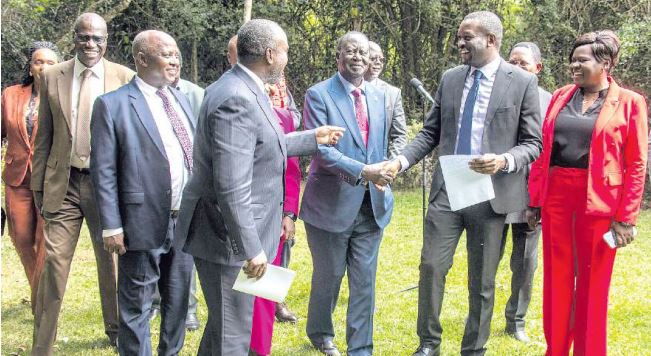
his very last public engagement — an ODM
Parliamentary Group meeting at a hotel on Mombasa Road on September 22, just over three
weeks before his death — the ODM boss posed the question, “Who has told
you?” to party leaders running the ‘Ruto beyond 2027’ narrative.
Indeed, when the press gathered outside the venue after the
PG meeting sought clarification over Raila’s remarks, none other than National
Assembly Minority leader Junet Mohamed made it clear to them that Raila’s
speech was “the resolution” that the party had made. Therefore, all issues, including
the sticky matter of 2027 and whom to support in the forthcoming elections,
were answered by Raila’s own words. It is inconceivable that the man everyone
called “Baba” would be so unequivocal on a matter so publicly, then turn around
in the last few days of life, to issue contradicting instructions.
There are difficult days ahead for the Orange Party. But I
invite the leadership to grab a copy of the memoirs of the late former
Karachuonyo MP, Phoebe Asiyo, one of the most iconic women leaders the country
has ever produced. Soon after the death in 1994 of Jaramogi Oginga
Odinga, Raila’s father, Asiyo convened a meeting of the 21
Luo MPs at her home in Wikondiek, Karachuonyo. Having all agreed that Wamalwa
Kijana would succeed Jaramogi as Ford Kenya chairman, this meeting was convened
to build consensus on who would be the vice-chairperson,
and therefore, the new Luo leader, for all intents and purposes.
The contest was between the Ford Kenya deputy director of
Elections Raila and Jaramogi’s sidekick and Ugenya MP, James Orengo, a man who
had been such a permanent fixture beside the old man, that he had practically
become a sounding board for Jaramogi’s views. Raila arrived late for the
meeting, accompanied by Ford Kenya regional coordinator and confidant, Odungi
Randa, now the Luo Ker (chairman of the Luo Council of Elders). Randa was not
entitled to vote at this meeting, since he was not a Member of Parliament.
When the vote was taken, Asiyo abstained (being the host and
convener), while Raila got only one vote (his own). All the other Luo MPs
backed Orengo for new vice-chairman and the unofficial leader of the community.
When Raila stormed out of this Wikondiek meeting, it seemed
the matter was settled. But a vicious fight for the soul of the Ford Kenya
ensued, which culminated in the Langata MP resigning from both the party and from
Parliament in late 1996, joining the little-known National Development Party,
through which he ran and won in the subsequent by-election. But the general
election would follow just months later in 1997, and NDP thoroughly crushed
Ford Kenya in Luo Nyanza.
I share this story to demonstrate the sheer vanity of
hanging onto a political outfit, or its famous name, without considering that
the people who form its membership define its destiny.
In the case of ODM, a
transition manipulated in high offices —with no regard to those
thousands of stampeding youths who swamped Kasarani, Nyayo and Kisumu Mamboleo
stadiums to view his body — will be meaningless. In 1997, Raila ran away
with the people and left Ford Kenya gasping for political life, confining it to
being regional party henceforth.
In the days following the death of Raila, the politics of
2027 has dominated discourse within ODM. It has been as if the party faction supporting
the broad-based arrangement with President Ruto is too impatient to wait even a
week, almost falling over themselves to declare that they will support him in
the 2027 polls. So aggressive is this faction that it seems ready to throw out anyone with a
dissenting voice, never mind that Raila ran this big movement for 20 years on
the premise of freedom of expression and enhanced democratic ideals.
One of the stark realities facing ODM is that those seeking to
exploit the party’s fortunes in the 2027 elections haven’t yet made the
distinction between ODM as a party and the Luo people as a community within the
party. For all intents and purposes, Ruto’s interest in the party revolves
around the Luo community.
Indeed, when the benefits of the broad-based
arrangement are paraded, they all tend to be development projects within Luo Nyanza.
The trouble with this is that Ruto’s 2027 plans with the Luo community do not address
the plight of Raila’s huge base, encompassing Western Kenya (read the Luhya nation),
the Kenyan Coast, the pastoralist communities and the passionate support the
late icon enjoyed among the Kenyan urban poor.
Essentially, therefore, the succession for the next Luo
kingpin is currently confused with that of the ODM party, the risk of which is
that the party is dangerously headed to being a regional Luo movement, having
alienated the huge base Raila left. But could this, in fact, be Ruto’s plan?
Isn’t it indeed an advantage to him to have a small, easily malleable party, rather
than the powerful mass movement Raila left behind? Unfortunately for both the President
and his surrogates, they are walking the same path the late Kijana Wamalwa walked
with Ford Kenya after Jaramogi’s death. Even with the supposed backing of the state,
Wamalwa was unable to keep the masses within the party, and remained instead with
a shell.
For purposes of argument, let us assume there is indeed a
gap, a question of who will be the next Luo kingpin. I submit that the true Luo
leaders today have to be Nyong’o and
Orengo. These two were not only Raila’s peers and bosom buddies from the second
liberation period, but were proteges and close confidants of the preeminent
community leader and independence hero, Jaramogi Oginga Odinga, Raila’s father.
In terms of institutional memory and the long journey the community has
travelled, through thoroughly turbulent seasons, no Luo leader alive today can
compare to the two.
I was quite surprised when a hurriedly convened party
caucus, before the return of Raila’s body from India, installed the departed
PM’s brother, Senator Oburu Odinga, as acting party leader. Even without
delving into community culture — in which an elder brother doesn’t inherit a
younger one — many
watchers must have assumed Nyong’o would have been a shoo-in for it. He had previously
been tapped for this position by Raila himself, and sits in the party’s Central
Management Committee.
It is noticeable that the broad-based government is
attempting to influence how the leadership transition will take place in Luo
Nyanza and ODM. But any transition that shuts out the community’s real leaders —including the two governors, and perhaps senior ones such as former CS Raphael Tuju and Rarieda MP
Otiende Amolo —is
bound to fail flat. Even within ODM, any moves that leave out truly popular
leaders such as Senator Edwin Sifuna and Embakasi East MP Babu Owino will only
end up with a shell of ODM, while those shut out move with the people. After
all, the real Raila following emanated from the thousands of passionate youths,
who filled different venues to send him off last week.
Two things worry me, having noted the confusion between Luo
and ODM succession. One is the emergence of an intolerant leadership during the
mourning period. In a very short span of time, loud threats have become
consistent and warned anyone disagreeing with certain viewpoints to leave the
party. Additionally, it seems the new menacing disagreement mode in ODM, least
as far party chairperson Governor Gladys Wanga is concerned, is to ban
“enemies” from certain regions. The party is clearly staring at a new
dispensation in which the freedoms and rights that Raila fought for, and which
guided the party for 20 years, have been discarded.
My second worry is the rising anti-Kikuyu sentiment within
Luo Nyanza, perpetuated by narratives seeking to convince the Luo community
that their being in government comes at the expense of the Mt Kenya people.
This notion perhaps informed the almost-overdone reaction to the despicable
comments about Raila by Nyeri Governor Mutahi Kahiga on Wednesday this week. It
is disturbing that old Luo-Kikuyu fault lines are rising so soon after the
country’s foremost unifying agent, Raila, has been laid to rest.
Be that as it may, my advice to everyone watching to see
where especially the Luo community goes after this, is that the Luo are
inherently anti-establishment and pro-justice.
To herd them into any arrangement that doesn’t mainstream
the justice, freedom and the best interests of the nation, will be difficult,
unless led by true heroes. The best way around it is to let leadership both in
the community and the party transition in a people-led process.
Or else, the quest to instal yes-men and yes-women in the
party and the community will backfire big time!
Collins Ajuok is
is
a political commentator

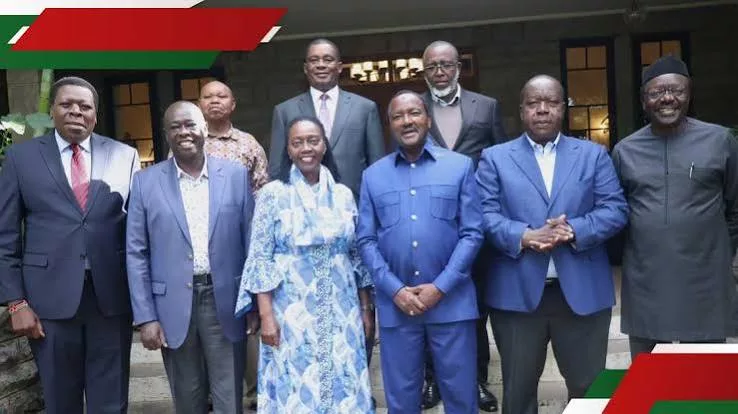
 ODM Leaders during a meeting at Oburu Odinga's home in Bondo.