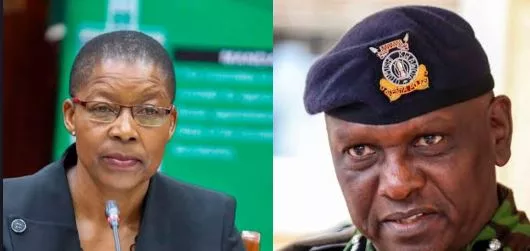


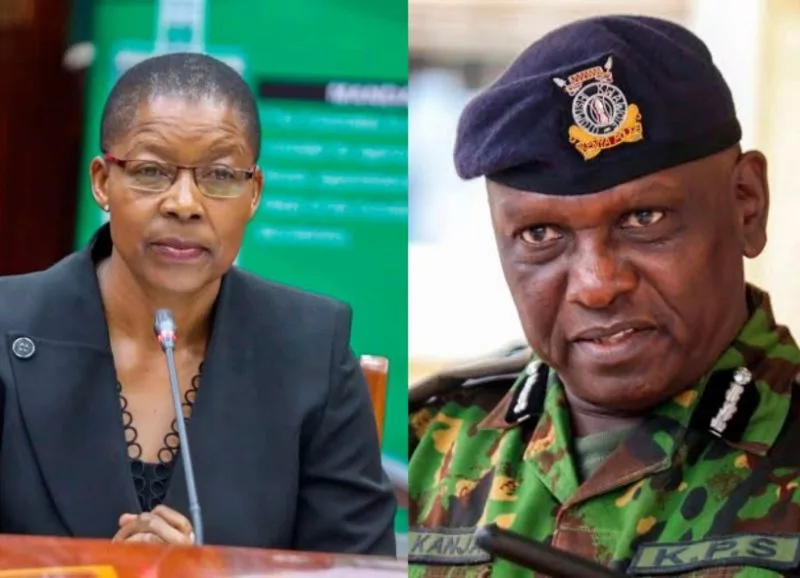
 Attorney General Dorcas Oduor and Inspector General of Police Douglas Kanja./FILE
The High Court in Kisumu has summoned the Inspector General of Police, the National Police Service (NPS) and the Attorney General.
The court wants the three respondents to explain why contempt proceedings should not be initiated against them for failing to comply with orders requiring the development and publication of public order management regulations.
Justice Alfred Mabeya issued the summons on Tuesday after finding that the respondents had failed to comply with orders issued on March 25, 2026, directing them to prepare, develop and publish regulations governing public demonstrations and picketing within 90 days.
 International Justice Mission (IJM) Justice Programme Manager Ruth Kihuria addressing the media in Kisumu./FAITH MATETE
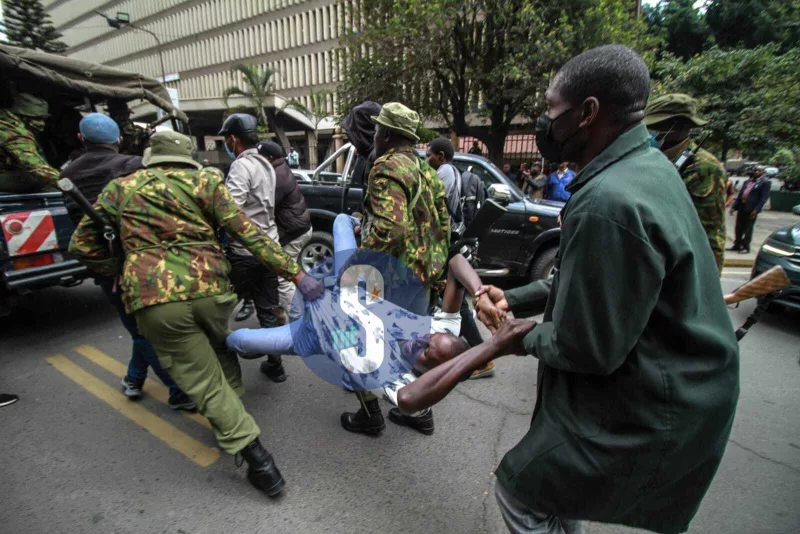
The orders arose from Petition No. 15 of 2024, filed by victims and survivors of the 2023 anti-government protests in Kisumu, who sought justice over alleged police brutality during the demonstrations. Justice Mabeya said the directive was informed by the court's findings during the hearing of the petition.
"That directive arose from what the court observed first-hand in this petition. For far too long, many have died and been maimed while either trying to exercise that right or while being innocent bystanders. One death is too many," the judge said.
 Law Society of Kenya (LSK) Kisumu Chapter Chairperson Dorcas Oluoch addressing the media in Kisumu./FAITH MATETE
"There is nothing on record to show that the directive has been complied with," he ruled.
The judge faulted the respondents for failing to seek an extension of time before the deadline expired.
"If the first, second and third respondents felt they would be unable to comply with the directive, nothing would have been easier than filing an application for extension of time before today," he said.
Describing the failure as "blatant disobedience of clear court orders," Justice Mabeya stressed that court orders are binding and not optional.
"Such disobedience is an affront to the rule of law and a breach of the Constitution. Court orders are not suggestions. They are not to be second-guessed," he said.
He further warned that the absence of the regulations continued to leave police officers operating without clear legal guidance while handling demonstrations.
"The continued vacuum is dangerous. It was expected that members of the National Police Service would henceforth not operate in a vacuum where it is unknown how they are to engage persons desirous of exercising their rights under Article 37 of the Constitution," he said.
The judge emphasised that the constitutional right to demonstrate is firmly protected.
"That right is not a flowery provision in our supreme law. It is an entrenched constitutional right. The first, second and third respondents will not be permitted to operate as if this country has no laws. They are subject to the law, and they must obey court orders."
He directed the respondents to appear before the court on July 21, 2026, at 9 a.m. to show cause why contempt proceedings should not be instituted against them.
Speaking after the ruling, Law Society of Kenya (LSK) Kisumu Chapter Chairperson Dorcas Oluoch said the petitioners had expected the matter to be concluded but were disappointed that the structural reforms ordered by the court had not been implemented.
"Today is Saba Saba, a very important day in the history of this country. It is a day when we remember the struggle for democracy and celebrate the freedoms whose fruits we now enjoy," she said.
Oluoch said the institutions directed by the court appeared to be using compensation paid to victims as a substitute for implementing the structural reforms ordered in the judgment.
"We have noted with great regret that institutions mandated to ensure compliance with the court's orders appear to be treating reparations as an excuse to avoid accountability regarding the structural interdicts," she said.
She maintained that compensation alone could not replace institutional accountability.
"We want to reiterate that reparations do not replace structural accountability. Members of the National Police Service, IPOA and all other public institutions directed by the court must fully comply with those orders."
She said the petitioners wanted more than compensation.
"While compensation is important, what the petitioners want is urgent action and accountability for the harm they suffered and for the loved ones they lost due to alleged police brutality," she said.
Oluoch added that the Law Society of Kenya would continue pursuing justice for the victims and push for the full implementation of every aspect of the judgment.
International Justice Mission (IJM) Justice Programme Manager Ruth Kihuria welcomed the court's decision, saying it demonstrated the Judiciary's commitment to enforcing its orders.
"Today's proceedings clearly demonstrated that the court is determined to uphold its authority," she said.
Kihuria noted that the National Police Service and the Attorney General had failed to comply with the court's directive within the 90 days granted and had not sought an extension of time.
She said the court had now ordered officials from the Attorney General's Office and the Inspector General's office to appear on July 21 to explain their non-compliance.
"We are encouraged that the court is treating this matter with the seriousness it deserves," she said.
Kihuria echoed calls for accountability, saying reparations should go hand in hand with justice.
"As Oluoch has stated, while the process of reparations is ongoing, compensation must go hand in hand with accountability. Accountability means justice must be done. Someone must answer for what happened to the petitioners standing behind us."
She urged the relevant state institutions to ensure investigations into the alleged police abuses are conducted transparently.
"We therefore call for investigations that are not only conducted but are seen to be conducted. It is important that all relevant state institutions take seriously the issues raised by the court," she said.