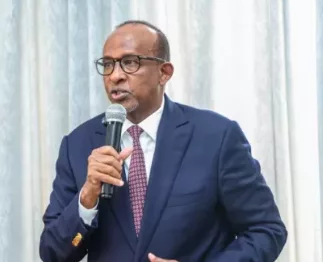


 Eliud Owalo, former CS and 2027 presidential candidate /HANDOUT
Kenyan citizens today carry one of the heaviest fuel cost burdens in a world, which calls for urgent policy interventions, by the government to address the skyrocketing prices. Kenya’s petrol and diesel prices are currently 19 per cent and 14.1 per cent higher than the global average, respectively.
The truth of the matter, however, is that Kenya’s fuel prices are no longer driven purely by global oil prices, but by over-taxation, failed policy choices, non-competitive fuel import arrangements and misplaced government priorities. No economy can grow in an environment where the cost of movement, production, and survival becomes unbearable.
The Government-to-Government (G2G) fuel import arrangement, initially introduced to stabilise supply and lower prices, has failed to deliver meaningful relief to consumers.
Concerns have also emerged over reduced market competitiveness and inefficiencies within the import framework.
Despite government interventions, including subsidies financed through the Petroleum Development Levy (PDL) Fund, fuel prices, particularly diesel, have continued to hit record highs.
Heavy taxation on the other hand, is one of the biggest contributors to high fuel prices. A substantial portion of the pump price, estimated at more than Sh80 per litre, consists of government taxes, levies, and regulatory charges.
Consequently, even when global oil prices ease or tax reductions are announced, the cumulative burden of these charges continues to keep fuel prices elevated and the cost of living painfully high.
We cannot allow our people to be pushed any further to the brink, and this is why I am proposing urgent policy interventions to be undertaken.
Addressing Kenya’s fuel price crisis requires a multi-pronged approach involving both immediate fiscal interventions and long-term structural reforms.
I, therefore, wish to propose the following interventions:
VAT Reduction or Removal: The current eight per cent Value Added Tax (VAT) on fuel products significantly contributes to high pump prices. I propose the reduction or completely scrapping of this VAT. While such a move would result in short-term revenue losses for the government, the economic stimulus generated by lower fuel prices could offset part of the loss through increased economic activity and broader tax generation.
Review and Reform of Levies: Several levies significantly contribute to the high cost of fuel, including the Road Maintenance Levy and the Petroleum Development Levy (PDL). While the PDL has been used for price stabilisation, serious questions continue to be raised regarding its application, transparency and accountability. A comprehensive review of all fuel-related levies, with a view to reducing, streamlining, or rationalising them, is urgently necessary.
Capping Oil Marketing Company (OMC) Margins: During periods of economic crisis, the government should consider temporarily capping the margins of Oil Marketing Companies and retailers to prevent excessive profiteering and ensure that any reductions in import costs or taxes are fully passed on to consumers. However, such measures must be carefully implemented to avoid discouraging investment in the sector.
On long-term structural reforms, I wish to propose the following:
Establishment of Strategic Petroleum Reserves (SPR): Kenya currently lacks a functional national Strategic Petroleum Reserve. Establishing such reserves would allow the country to purchase petroleum products when global prices are low, and release them during periods of high prices or supply disruptions. This would provide an important buffer against global volatility and strengthen national energy security.
Re-evaluation and Reform of the G2G Oil Deal: The current Government-to-Government fuel import arrangement has been criticised for its lack of transparency and failure to secure competitive prices. The government should urgently re-evaluate the framework and consider transitioning toward a more open and competitive procurement model that allows multiple suppliers and promotes better price discovery. An independent audit of the current arrangement is also necessary.
Diversification of Supply Sources and Routes: Kenya’s over-reliance on limited supply routes and suppliers exposes the country to geopolitical and logistical risks. Exploring alternative supply routes and diversifying international suppliers would strengthen resilience against disruptions and potentially improve pricing competitiveness.
More Frequent Price Reviews: The current monthly fuel price review cycle by EPRA may not be sufficiently responsive during periods of extreme volatility. Introducing more frequent reviews, particularly during global crises, would ensure that reductions in international oil prices are passed on to consumers more quickly.
Investment in Local Refining Capacity: In the long term, investing in and modernising local refining capacity could reduce Kenya’s dependence on imported refined petroleum products, lower logistics costs, reduce foreign exchange pressure, and enhance national energy security.
Promotion of Alternative Energy Sources: The current fuel crisis should serve as a wake-up call for Kenya to accelerate the transition toward alternative energy sources. Promoting electric mobility, expanding public transport infrastructure, and incentivising renewable energy adoption across industries would reduce reliance on fossil fuels and shield the economy from future global oil shocks.
The skyrocketing fuel prices in Kenya represent a serious national economic crisis driven by a dangerous combination of global shocks, excessive domestic taxation, and structural inefficiencies within the fuel import system.
Thus, addressing this crisis requires decisive, bold, and comprehensive action from the government. By implementing immediate fiscal relief measures alongside strategic long-term reforms, Kenya would reduce the burden currently crushing households and businesses, strengthen energy security, restore economic confidence, and place the country back on a path toward sustainable and inclusive economic growth.
Eliud Owalo is an Economist by training; Fellow of the Economists Society of Kenya; Member of the Institute of Economic Affairs and 2027 presidential candidate.