

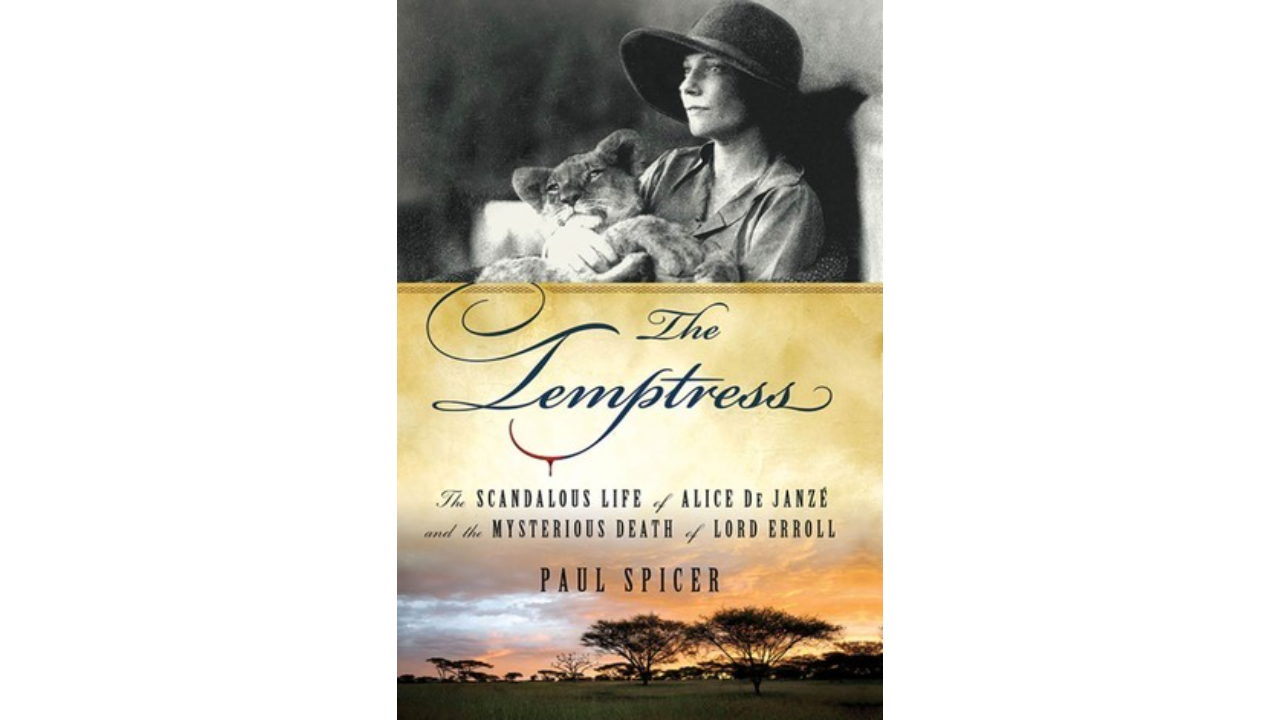
Paul Spicer’s The Temptress: The Scandalous Life of Alice de Janzé and the Mysterious Death of Lord Erroll is a dazzlingly atmospheric plunge into the life of one of the most mesmerising, reckless and emotionally volatile women of the last century. More than a biography, it is a full-bodied immersion into the hedonistic world of Kenya’s Happy Valley set, a realm of dangerous pleasures, peerless wealth and moral boundaries as thin as the equatorial air. Spicer resurrects Alice de Janzé with the kind of sharp, cinematic detail that makes her feel less like a distant historical figure and more like someone whose perfume you can still smell on the page.
Alice, born into American privilege, was never designed for the quiet or the conventional. She drifted through Paris salons and Kenyan estates with the same hypnotic magnetism that destroyed lovers, friendships and eventually herself. Her turbulent spirit is revealed in moments that Spicer threads through the narrative with unnerving intimacy. After the murder of her lover Josslyn Hay, Lord Erroll, a crime that shook the British colonial world, she was seen placing a branch on his lifeless body and whispering, “Now you are mine forever.” It’s a chilling, unforgettable image: part devotion, part possession and entirely in tune with the electrifying contradictions of her character.
In another moment of raw confession, Alice admitted, “I wanted to kill myself, for I have always had ideas of suicide… from time to time, and without reason, I have wanted to die.” These haunting declarations illuminate not only her fragility but the consuming storm that followed her through every chapter of her life.
Spicer’s writing sustains the reader’s fascination with a kind of elegant urgency. He does not simply tell Alice’s story, he orchestrates it. His sentences drift effortlessly between atmospheric description and investigative clarity, moving from the dusty shimmer of Kenya’s highlands to the decadent glow of Paris nightlife with a fluidity that mirrors Alice’s own shifting worlds. There is a sense that Spicer is not just chronicling events but summoning them, making history feel tactile and immediate. His narrative energy is one of the book’s greatest strengths: it keeps the reader leaning forward, hungry for the next revelation, the next gasp of scandal, the next flicker of psychological insight.
MYSTERY MURDER
The heart of the book beats around the mysterious 1941 murder of Lord Erroll. The case, long shrouded in gossip and speculation, becomes the central gravitational force of the biography. Spicer advances a bold argument that Alice herself pulled the trigger, and he constructs his case with a mix of emotional logic, contextual evidence and unrelenting attention to the dark complexities of her relationships.
The story swells with tension as the reader follows the trail of motives, jealousies and past wounds that orbit Erroll’s death. It’s part true-crime narrative, part psychological study and part portrait of a society spiralling under the weight of its own excess.
What makes the book so mesmerising is not only Alice’s dramatic life but the way Spicer situates it within the larger moral and cultural chaos of the Happy Valley set. These were people searching for sensation at all costs: sex, alcohol, status, adrenaline, escape. And Alice fit into their world with a dangerous precision. Her choices, no matter how extreme, never feel entirely out of place in the heightened, feverish atmosphere Spicer evokes. Instead, they feel like the inevitable outcome of a world where desire had no guardrails and consequence was always one cocktail away.
Still, the biography has one unmistakable flaw: Spicer’s determination to prove Alice’s guilt occasionally overwhelms the narrative. At times, speculation is allowed to masquerade as inevitability, and the book’s otherwise steady momentum wobbles under the weight of its insistence. Readers hoping for a more balanced exploration of alternate theories may find themselves frustrated, as Spicer sometimes pushes interpretation further than the evidence comfortably allows. This is not a gentle misstep, it’s a structural weakness that leaves certain sections feeling forceful rather than persuasive.
Ultimately, The Temptress remains a hypnotic reading experience: moody, evocative and impossible to shake off. Spicer delivers a portrait of Alice de Janzé that glitters with seduction and danger, a life burning so brightly that it was destined to collapse into its own fire. The book lingers long after the final page, like the echo of a laugh in a darkened room or the scent of someone unforgettable who has just slipped out the door.